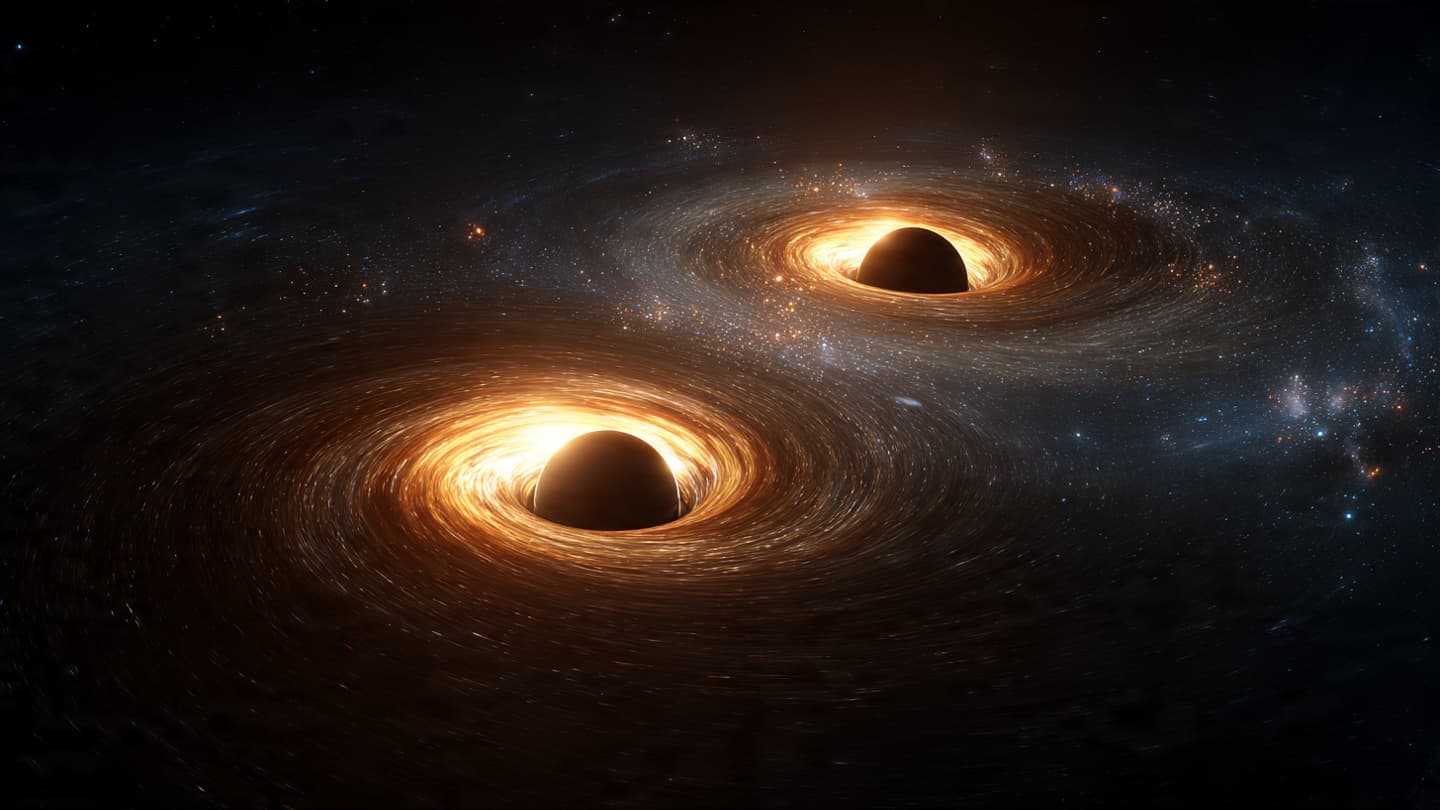
The universe often reveals its greatest mysteries through faint signals that travel across unimaginable distances. Hidden among the stars and galaxies are black holes, objects so dense that even light cannot escape their gravitational pull. A recent astronomical study has drawn attention to what researchers believe may be a record-breaking pair of black holes, offering another opportunity to understand some of the cosmos's most extraordinary phenomena.
Black holes form when massive stars exhaust their fuel and collapse under their own gravity or through other large-scale cosmic processes. In many galaxies, including the Milky Way, scientists believe supermassive black holes occupy the central regions, influencing the movement of surrounding stars and gas.
The newly reported observation involves two black holes that appear to orbit one another. Researchers used advanced telescopes and data analysis techniques to identify unusual patterns of light and motion that suggest the presence of a binary system. Continued observations will help confirm the nature of the discovery.
Astronomers study binary black holes because they provide valuable insights into galaxy formation and evolution. When galaxies merge over millions or billions of years, their central black holes may eventually form pairs before moving closer together through gravitational interactions.
The movement of binary black holes can also generate gravitational waves, tiny ripples in the fabric of space-time first predicted by Albert Einstein's theory of relativity. Modern observatories have already detected several gravitational wave events, opening a new era of astronomical research.
Scientists emphasize that the current findings remain under careful examination. Astronomy often requires repeated observations and independent verification before conclusions become widely accepted. Multiple observatories and research teams contribute to this process.
Technological advances have greatly improved humanity's ability to study distant objects. Powerful ground-based telescopes, space observatories, and sophisticated computer models allow researchers to investigate regions of the universe that were once beyond observation.
The public fascination with black holes reflects a broader curiosity about the universe and humanity's place within it. These extraordinary objects challenge understanding while encouraging continued exploration and scientific inquiry.
The possible discovery of a record-breaking black hole pair represents another step in the ongoing effort to understand the cosmos. As astronomers continue their observations, the universe once again demonstrates that it still holds remarkable stories waiting to be uncovered.
AI Image Disclaimer: This article includes an AI-generated illustration created to support the scientific subject.
Sources: Science News, Reuters, Nature Astronomy, European Southern Observatory
Published by Banx Network. This article is part of the Banx decentralized media programme, powered by the BXE token on the XRP Ledger.