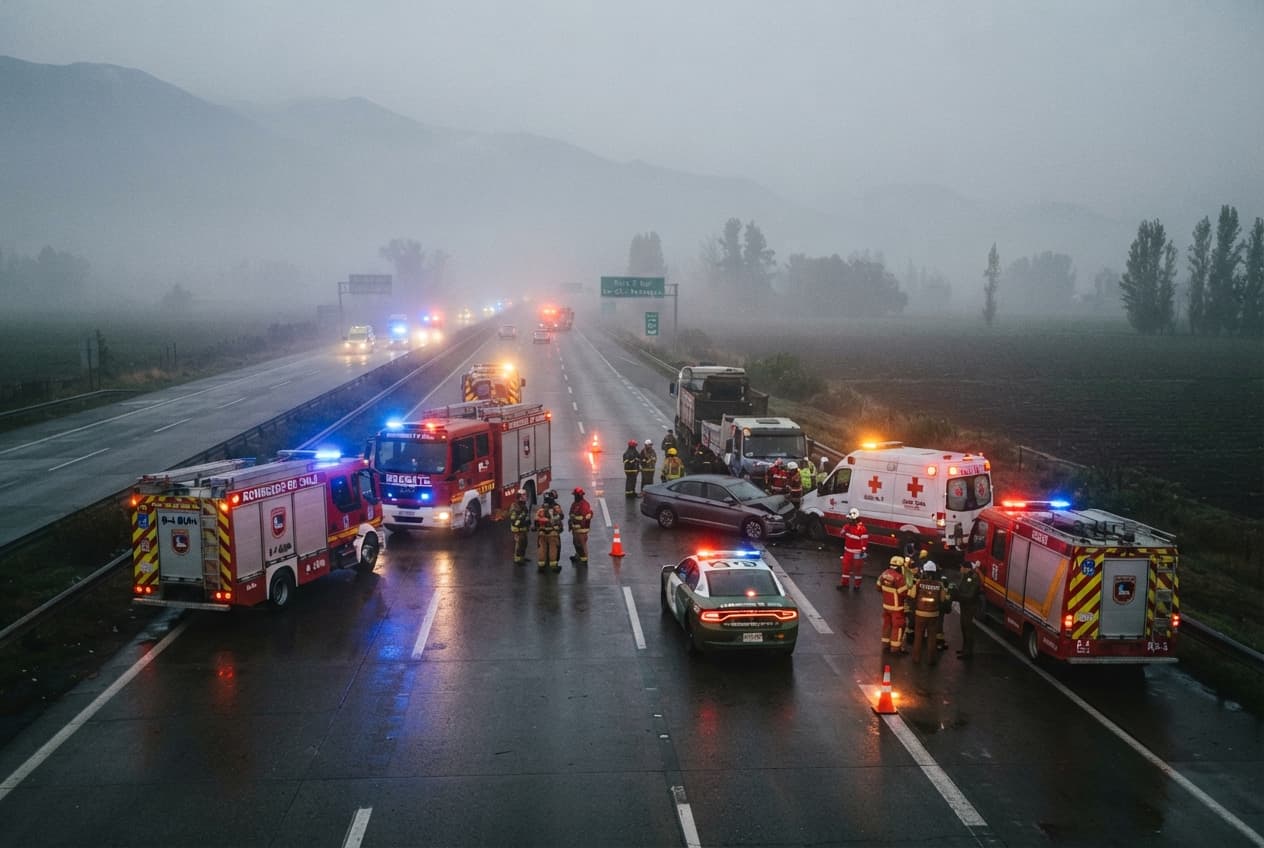
Santiago, Chile—Two people died and several others sustained injuries in a multi-vehicle pileup on a major highway south of Santiago. Transport authorities and emergency dispatchers reported that the collision occurred during early morning hours as a heavy blanket of dense fog drastically reduced visibility across the arterial route. The sudden drop in visibility caught morning commuters off guard, leading to successive chain-reaction impacts involving multiple passenger vehicles and commercial transport trucks.
Local fire departments and emergency rescue units deployed numerous ambulances and extrication teams to the crash site following distress calls from stranded motorists. Paramedics established an on-site triage area to treat the injured before transporting victims to nearby regional hospitals. First responders worked for hours using hydraulic cutting tools to free trapped occupants from severely crushed vehicles wedged beneath larger transport trucks.
Highway police closed all southbound lanes of the route to facilitate rescue operations and prevent secondary collisions in the low-visibility conditions. Traffic diversions redirected vehicles onto secondary local roads, causing extensive gridlock and delays for thousands of commuters traveling toward the capital. Concessionaire maintenance crews cleared wreckage and spilled automotive fluids from the asphalt lanes before reopening the highway later in the afternoon.
Preliminary findings from traffic investigators indicate that excessive speed relative to visibility conditions contributed to the severity of the multi-vehicle chain reaction. Meteorological services confirmed that dense seasonal fog banks frequently blanket the southern valley sectors during early spring mornings, prompting standing advisories for drivers. Police reiterated calls for motorists to reduce speed and utilize fog lights when visibility drops below critical safety thresholds.
Regional health officials provided updates on the hospitalized survivors, noting that several individuals remain under intensive medical observation for multiple trauma injuries. Transport ministry representatives announced an immediate review of electronic warning signage and fog detection sensors installed along high-risk stretches of the southern highway network. Investigators continue interviewing surviving witnesses and reviewing dashcam footage captured by vehicles involved in the initial impacts.
Legal authorities from the local prosecuting office opened an inquiry to determine potential criminal negligence or liability regarding the speed of commercial freight vehicles operating in zero-visibility conditions. Forensic specialists completed site reconstructions and vehicle inspections to map the exact sequence of collisions that spanned several hundred meters of roadway. Representatives from the national transport safety board participated in the preliminary technical analysis.
Family members of the victims gathered at local forensic medical services bureaus to complete identification procedures supported by social work teams. Government ministers expressed condolences to the bereaved families and pledged support for the injured survivors recovering in regional medical centers. Public safety advocacy groups renewed demands for enhanced automated speed enforcement and stricter fog-management protocols on major intercity corridors.
Road maintenance crews finalized the removal of disabled vehicles and repaired damaged guardrails along the affected sector of the southern route. Police reopened all lanes to normal traffic flow after clearance certificates were issued by accident investigation units. Transport authorities maintain heightened surveillance across southern approach routes as meteorological forecasts predict recurring low-visibility conditions for the upcoming week.
Published by Banx Network. This article is part of the Banx decentralized media programme, powered by the BXE token on the XRP Ledger.