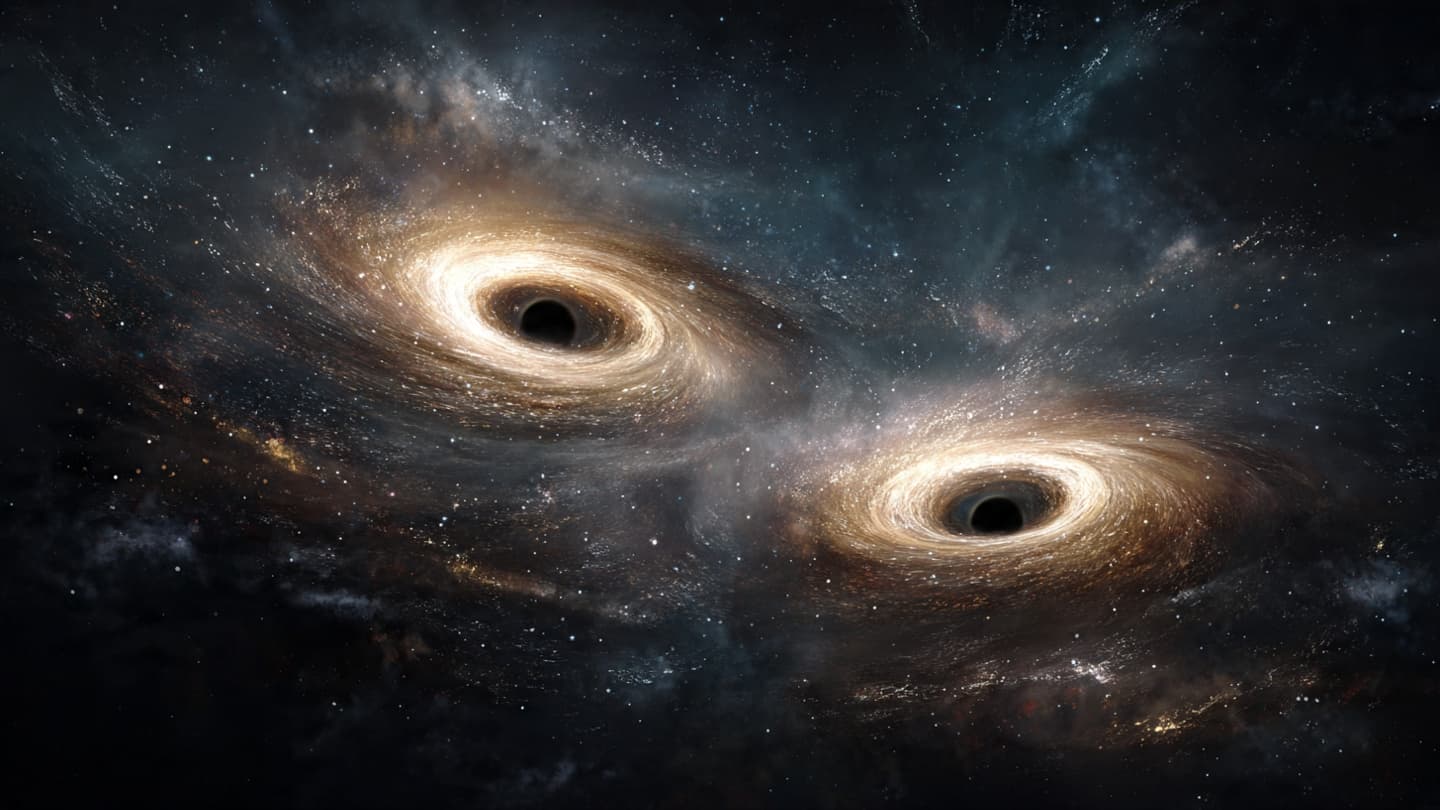
Deep within the universe, galaxies move through cosmic time like ships crossing an immense and ancient ocean. Hidden at their centers often lie black holes—objects so powerful that even light cannot escape their grasp. Now, astronomers believe they may have identified one of the most extraordinary pairs ever observed.
Researchers have reported the discovery of a candidate binary system containing what could be the largest pair of black holes yet detected. The finding, if confirmed through further observations, may offer new insights into the growth and evolution of galaxies.
The candidate system was identified using advanced astronomical observations and data analysis techniques designed to detect unusual gravitational and energetic signatures. Scientists believe the two supermassive black holes may be orbiting each other while gradually moving toward a future merger.
Supermassive black holes are commonly found at the centers of large galaxies. When galaxies collide and merge, their central black holes may eventually form binary systems, creating some of the most energetic events in the universe.
Astronomers estimate that mergers involving extremely massive black holes generate gravitational waves—ripples in spacetime first predicted by Albert Einstein and directly detected for the first time in 2015. Future observatories could potentially observe such signals from even larger systems.
The newly identified candidate is attracting considerable scientific attention because of its extraordinary estimated mass. Researchers caution, however, that additional observations will be necessary before definitive conclusions can be reached.
Scientists intend to continue studying the system using multiple telescopes operating across different wavelengths, including radio, optical, and X-ray observations. Combining these datasets may help confirm the nature of the object.
Beyond its immediate significance, the discovery could improve understanding of how galaxies evolve over billions of years. It may also refine theoretical models describing black hole formation and interaction.
As observational technologies continue to improve, astronomers expect that additional extreme systems will be discovered, further expanding humanity's view of the dynamic universe.
AI Image Disclaimer: The visuals accompanying this article are AI-generated interpretations based on current scientific understanding.
Sources (Source Verification Check): Science News, Nature, Reuters, European Southern Observatory, Astrophysical Journal
Published by Banx Network. This article is part of the Banx decentralized media programme, powered by the BXE token on the XRP Ledger.