
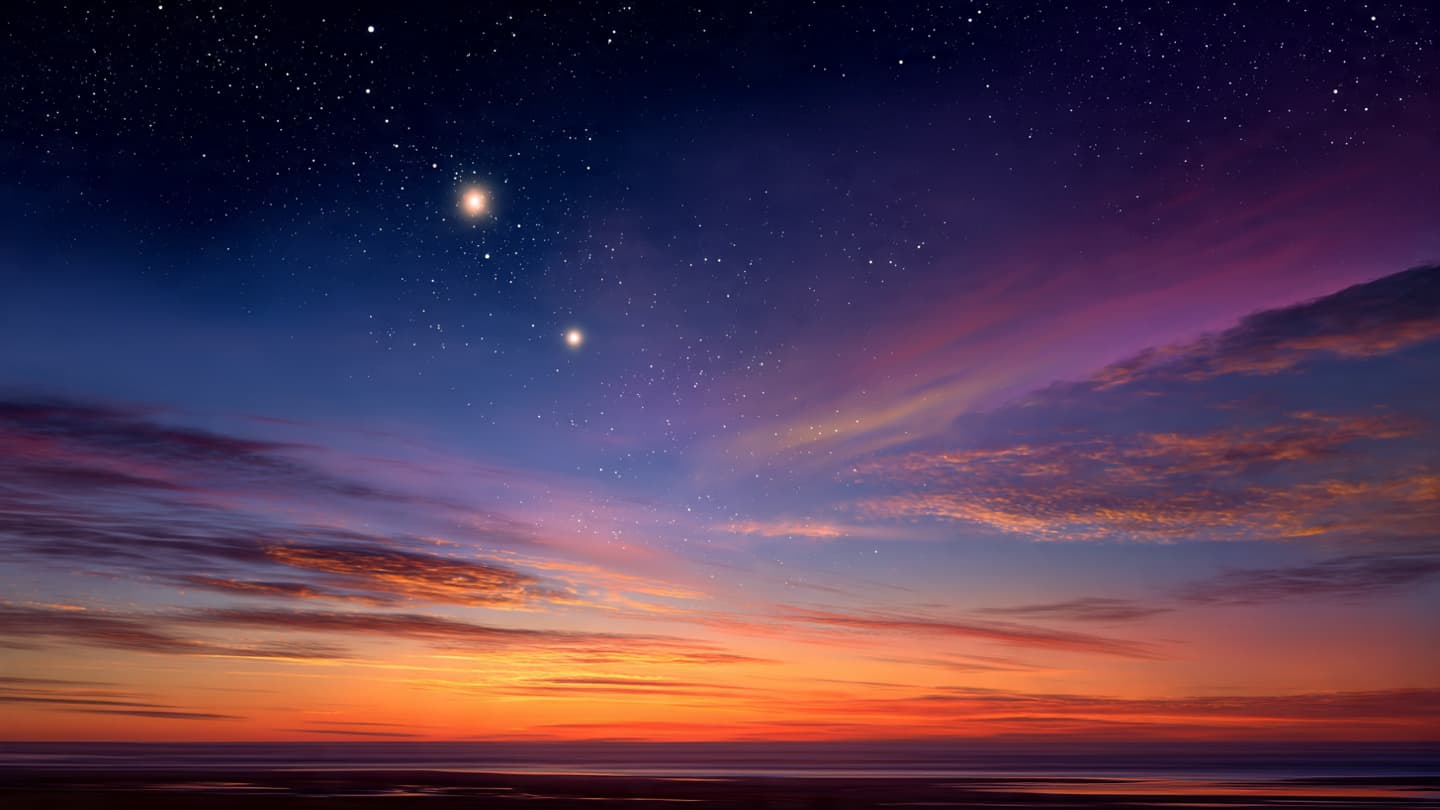
The evening sky has long served as a stage for celestial encounters. Night after night, planets follow their silent paths across the heavens, occasionally drawing close enough to create moments that capture the attention of both astronomers and casual observers. In early June 2026, one such meeting is set to unfold as Venus and Jupiter appear remarkably close together after sunset.
Although the two planets remain separated by hundreds of millions of miles in space, their positions relative to Earth create the illusion of a close encounter. Astronomers refer to this event as a conjunction, a common but often beautiful alignment involving celestial objects.
The conjunction is expected to reach its peak around June 9, when Venus and Jupiter will appear only about 1.6 degrees apart in the western sky shortly after sunset. To observers on Earth, the pair may seem almost close enough to touch.
Venus, often called the Evening Star, will be the brighter of the two objects. Jupiter, while slightly less brilliant, will remain easily visible to the naked eye. Together they will create one of the most striking planetary pairings of the year.
Skywatchers are encouraged to look toward an unobstructed western horizon shortly after sunset. The planets will remain visible for roughly an hour before descending below the horizon. Binoculars may enhance the view, though no special equipment is required.
Adding to the spectacle, Mercury may also become visible during part of the month, briefly joining Venus and Jupiter in a small planetary gathering. This additional alignment offers another reason for enthusiasts to spend time observing the evening sky.
Events such as conjunctions help connect scientific understanding with public appreciation of astronomy. They provide accessible opportunities to observe planetary motion and gain a better sense of the dynamic nature of the solar system.
For astronomers, the event is a predictable consequence of orbital mechanics. For many observers, however, it remains a reminder that even familiar planets can produce moments of unexpected beauty.
As darkness settles after sunset, Venus and Jupiter will briefly share the same patch of sky, creating a graceful celestial display visible across much of the world.
AI Image Disclaimer: The visual illustrations associated with this article are AI-generated artistic representations of the astronomical event.
Sources Verified:
NASA Science BBC Sky at Night Magazine Space.com Forbes
Published by Banx Network. This article is part of the Banx decentralized media programme, powered by the BXE token on the XRP Ledger.



