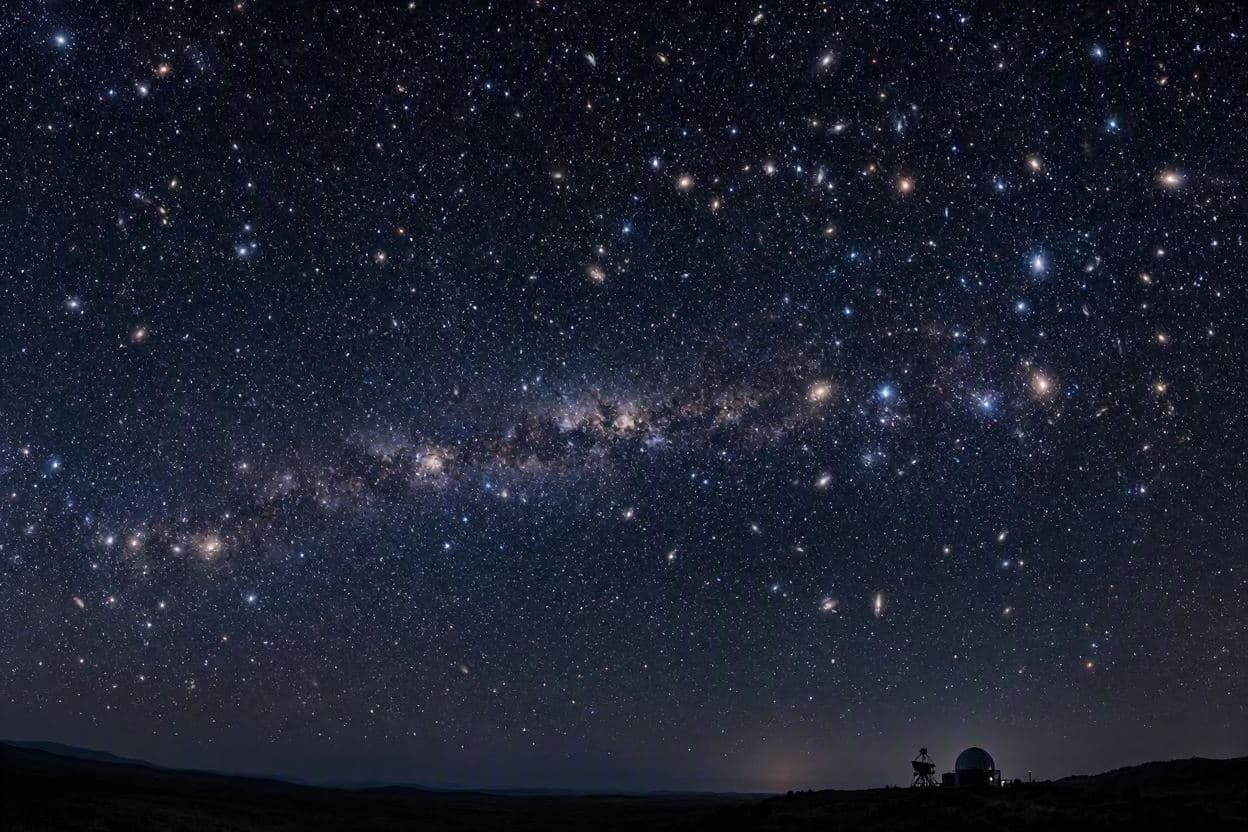
Knowledge accumulates like sediment, layer upon layer, building a foundation for understanding. In astronomy, this foundation is built on data, vast collections of observations that map the heavens. The Sloan Digital Sky Survey (SDSS) has been a cornerstone of this effort for over two decades, providing some of the most detailed maps of the universe ever created. With its 20th data release, the project continues to expand our cosmic horizon, offering new insights into galaxies, stars, and the structure of space itself. This milestone is not just an update; it is a continuation of a grand journey of discovery, inviting us to explore the depths of the cosmos with greater clarity.
The SDSS began in 2000 with the goal of creating a comprehensive digital map of the sky. Using a dedicated telescope in New Mexico, it has cataloged millions of celestial objects, measuring their positions, brightness, and spectra. Each data release adds more objects and deeper observations, refining our understanding of the universe’s composition and evolution. The 20th release includes new data from the Apache Point Observatory Galactic Evolution Experiment (APOGEE) and the Mapping Nearby Galaxies at Apache Point Observatory (MaNGA), enhancing the survey’s scope.
This latest release features improved spectral data for hundreds of thousands of stars and galaxies. Spectra act as fingerprints, revealing the chemical composition, temperature, and motion of celestial bodies. By analyzing these fingerprints, astronomers can determine the age of stars, the mass of black holes, and the expansion rate of the universe. The increased precision of the 20th release allows for more accurate models of cosmic history, helping to resolve lingering questions about dark matter and dark energy.
One of the key achievements of this release is the expanded coverage of the Milky Way’s bulge and halo. These regions are difficult to observe due to dust and crowding, but they hold clues to the galaxy’s formation. The new data provides a clearer picture of the stellar populations in these areas, shedding light on how our galaxy assembled over billions of years. It helps astronomers piece together the archaeological history of the Milky Way.
The SDSS is also contributing to the search for exoplanets and the study of variable stars. By monitoring changes in brightness over time, the survey identifies planets passing in front of their host stars and stars that pulsate or erupt. This time-domain astronomy adds a dynamic dimension to the static maps, revealing the changing nature of the universe. It opens new avenues for discovering rare and transient phenomena.
Accessibility remains a core principle of the SDSS. All data is made publicly available, allowing researchers, students, and amateur astronomers worldwide to use it for their own investigations. This open-access model has led to thousands of scientific papers and discoveries, demonstrating the power of collaborative science. The 20th release continues this tradition, ensuring that the benefits of the survey are shared broadly.
The technological advancements behind the 20th release are significant. Improved detectors, software, and data processing techniques have increased the efficiency and accuracy of the observations. These innovations not only benefit astronomy but also drive progress in related fields like computer science and engineering. The SDSS serves as a testbed for new technologies, pushing the boundaries of what is possible in observational science.
As the survey moves toward its next phases, including the SDSS-V project, the legacy of the first twenty releases remains strong. They have transformed our view of the universe, providing a reference frame for future exploration. The 20th data release is a testament to the endurance and vision of the scientific community, committed to mapping the unknown. It invites us to keep looking up, knowing that there is always more to discover.
The 20th data release of the Sloan Digital Sky Survey marks another step in mapping the universe. It provides valuable data for understanding cosmic structure and evolution. Let this achievement inspire continued exploration.
AI Image Disclaimer: Please be aware that images used in this context are AI-generated visualizations for illustrative purposes.
Sources: Sloan Digital Sky Survey Website Astrophysical Journal ScienceDaily
Published by Banx Network. This article is part of the Banx decentralized media programme, powered by the BXE token on the XRP Ledger.