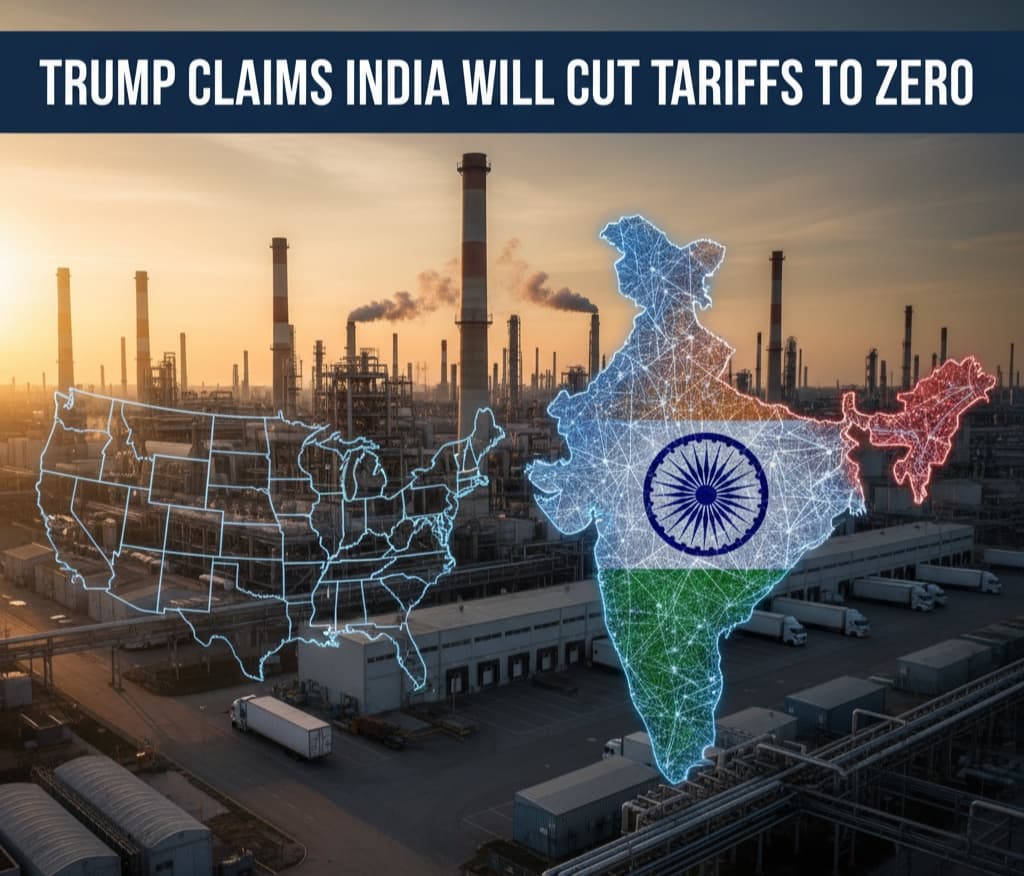
When President Donald Trump declared that India had offered to “cut their tariffs to nothing,” the news cycle lit up instantly. For some, it sounded like a historic breakthrough—a tectonic shift in U.S.–India trade relations. For others, it sounded like classic Trumpian bravado, a soundbite meant for headlines rather than the legal text of trade agreements.
The truth lies, as always, somewhere between politics and economics, between rhetoric and reality.
---
1. What Trump Actually Said
Trump framed the announcement as proof of his “America First” doctrine. India, a country long known for high protective tariffs, was—at least in his telling—ready to slash them to zero. A stunning victory, if true.
But history demands skepticism. India has always been fiercely protective of its domestic industries and agricultural sector. Its tariffs on certain products—especially farm goods like rice, sugar, and dairy—can run above 40%. Eliminating those barriers would not only shift trade flows but potentially shake India’s political stability.
---
2. The U.S.–India Trade Reality
Trade relations between Washington and New Delhi have been both cooperative and contentious.
• High Tariffs: India maintains some of the steepest tariffs among major economies, justified as protection for small farmers and local manufacturers.
• Past Clashes:Trump himself revoked India’s access to the “Generalized System of Preferences (GSP)” in 2019, costing India duty-free access to billions in exports.
• WTO History: India has consistently resisted external pressure to dismantle tariffs, citing development needs and “food sovereignty.”
So, if New Delhi really offered “zero tariffs,” it would represent a historic reversal.
---
3. The Politics Behind the Claim
Why would Trump make such a statement, especially during an election cycle? Several factors stand out:
1. Projection of Strength – Trump thrives on the image of a dealmaker who bends foreign governments to America’s will. India agreeing to zero tariffs reinforces that image.
2. Diaspora Politics – The Indian-American community is influential in states like Texas, New Jersey, and Florida. Presenting himself as the president who strengthened U.S.–India ties has domestic political payoff.
3. Strategic Chess Against China – India is China’s geopolitical rival. Drawing India closer to Washington economically undermines Beijing’s influence in Asia.
---
4. Is Zero Tariff Realistic?
The odds are slim.
• Agriculture Protectionism: India’s political class knows that farmers are a volatile bloc. Massive protests between 2020–2021 nearly destabilized the Modi government. Opening the floodgates to American farm exports would spark another uprising.
• Industrial Interests: From steel to textiles to pharmaceuticals, India’s industries depend on tariff shields to compete with global giants.
• Likely Conditions: If India did concede, it would almost certainly demand something in return: expanded visa access for Indian tech workers, guarantees for investment flows, or concessions in areas like digital services.
“Zero tariffs” might in reality apply only to a narrow basket of goods, not across the board.
---
5. Economic Consequences If It Happened
Still, it’s worth imagining the counterfactual:
• For the U.S. – A major boost to American exporters, particularly in agriculture and heavy machinery. Access to a market of 1.4 billion people without tariff barriers could be transformative.
• For India – Cheaper consumer goods, but devastation for small farmers and some manufacturers. Political protests would be inevitable.
• For Global Trade – A dramatic reshuffling of supply chains, with India positioned as America’s preferred alternative to China.
---
6. The Expert View
Trade economists are blunt: the claim strains credibility.
• “There is no precedent for India abandoning tariffs wholesale,” says one senior WTO analyst.
• Others suggest the phrase “cut to nothing” may have been shorthand—either miscommunication or exaggeration—rather than a literal policy commitment.
The skepticism is not about possibility in theory, but about feasibility in practice.
---
7. Why the Rhetoric Still Matters
Even if it is not literally true, rhetoric shapes the playing field.
• For U.S. Voters – It frames Trump as a warrior against global protectionism.
• For India – It signals that Modi’s government is at least open to deeper trade talks, even if conditions remain.
• For Other Nations – It pressures allies and rivals alike. If India is “offering zero tariffs,” what excuse do Europe or Japan have to hold back?
Trump’s words may not reflect today’s reality, but they can still set tomorrow’s agenda.
---
8. What to Watch
1. Official Documentation – Is there any memorandum of understanding between Washington and New Delhi? 2. India’s Response – Will Modi confirm, deny, or strategically remain silent? 3. Industry Pushback – How will Indian farmer unions, business federations, and opposition parties react? 4. Follow-Through in the U.S. – Will Trump move to codify this claim into formal negotiations or trade deals?
---
Conclusion: Theater or Turning Point?
Trump’s declaration that India will cut tariffs to zero is likely more rhetorical thunder than immediate reality. But thunder still matters: it shakes the ground, it signals a storm, and it alters expectations.
Even if no zero-tariff pact emerges, the conversation it sparks—about U.S.–India alignment, about alternatives to China, about the tension between populist promises and economic math—has value.
For now, the promise hangs between theater and policy. But in politics, theater is not a sideshow. Often, it is the show.
Published by Banx Network. This article is part of the Banx decentralized media programme, powered by the BXE token on the XRP Ledger.