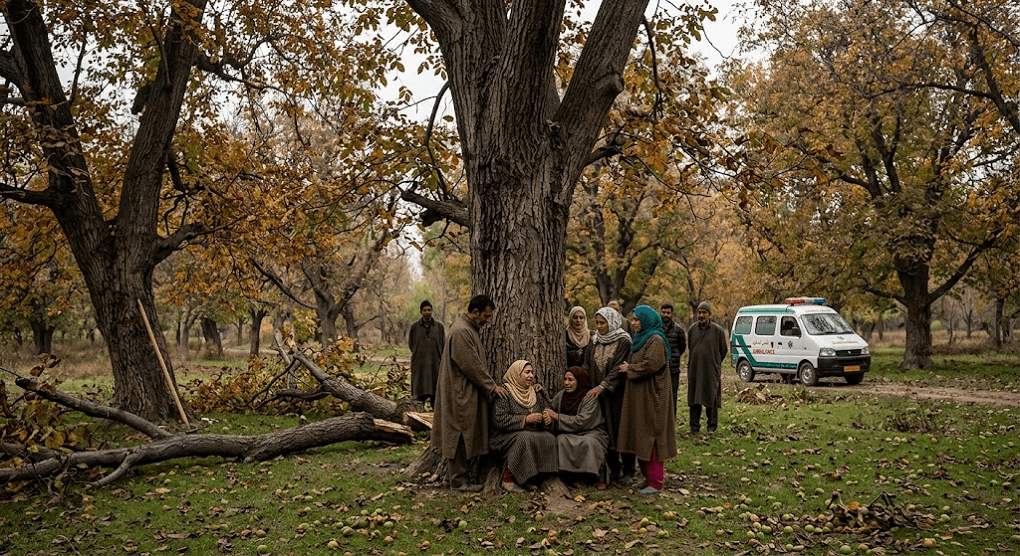
SRINAGAR, KASHMIR — The ongoing autumn walnut harvest season in Jammu and Kashmir turned deadly following two separate falling incidents in the Budgam and Shopian districts, leaving two men dead and reigniting widespread concern over safety practices in the region’s traditional orchards.
The first tragedy occurred in central Kashmir’s Budgam district, where a local worker fell from a tall, unpruned walnut tree while using traditional wooden poles to knock down the fruit. Despite being rushed to a nearby medical facility by fellow harvesters and family members, he succumbed to severe head and spinal injuries shortly after arrival.
Hours later, a similar fatal incident was reported in the Shopian district of South Kashmir. Witnesses reported that a branch snapped under the weight of a farmer who was scaling the tree without protective safety gear, sending him plunging onto the hard ground below. Emergency responders confirmed he died at the scene from major trauma.
Local police have taken cognizance of both incidents and initiated standard legal proceedings. Authorities expressed condolences to the grieving families while reminding workers of the hazards associated with climbing towering walnut trees—many of which reach heights of 40 to 80 feet—during the peak harvest weeks.
The double tragedy has sparked renewed calls from agricultural experts and health officials for mandatory safety measures during Kashmir’s walnut season. Falls from massive walnut trees represent a recurring occupational hazard in the Kashmir Valley, routinely resulting in multiple fatalities and severe spinal cord injuries each autumn.
Community leaders and advocacy groups are urging the local government to promote modern harvesting tools, such as mechanical shakers and safety harnesses, to protect orchard workers. For now, local families mourn as the annual harvest continues to claim lives across rural districts.
In response to the growing casualties, local health departments and rural administration teams have announced plans to conduct safety workshops across key walnut-producing districts ahead of the next harvesting cycle. These initiatives aim to distribute subsidized safety helmets, climbing ropes, and protective netting, while encouraging orchard owners to phase out hazardous traditional practices in favor of safer, modern harvesting technology.
Published by Banx Network. This article is part of the Banx decentralized media programme, powered by the BXE token on the XRP Ledger.