Key Highlights
- At least 12 dead and dozens injured in a massive pileup on the A1 Trakia Motorway.
- The accident involved approximately 50 vehicles, triggered by dense fog.
- Prime Minister Rumen Radev declared a national day of mourning for the victims.
YAMBOL, Bulgaria — A dense blanket of fog turned a major Bulgarian highway into a scene of apocalyptic carnage on Tuesday morning, triggering a catastrophic chain-reaction collision involving an estimated 50 vehicles. Officials have confirmed that at least 12 people are dead and dozens more are injured following the horrific pileup.
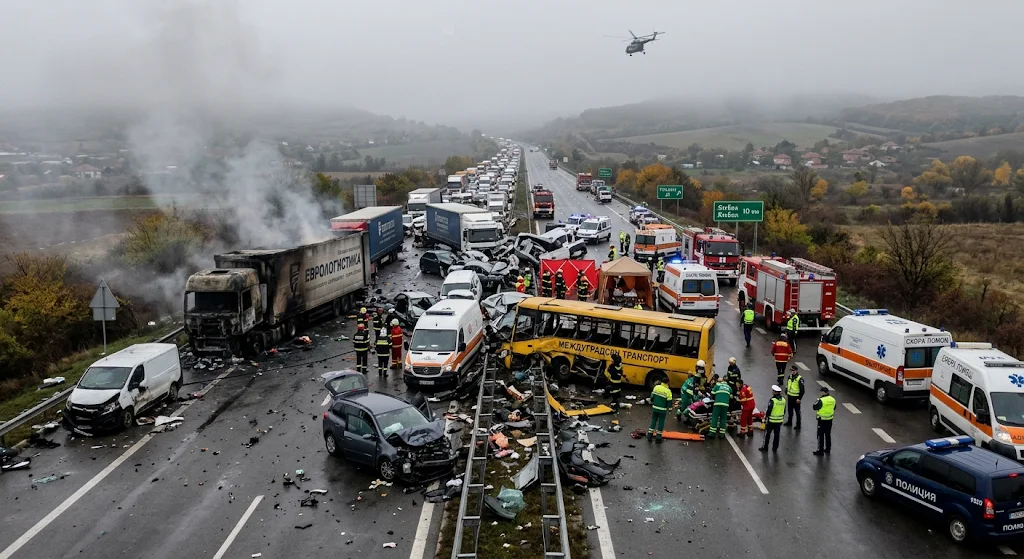
The disaster occurred shortly after 7 a.m. EET on the A1 Trakia Motorway near the city of Yambol, a vital artery connecting the capital, Sofia, with the Black Sea port of Burgas. Eyewitnesses described a terrifying scenario where visibility was reduced to mere meters. The initial crash reportedly involved a bus and a heavy truck, blocking the eastbound lanes toward Burgas. Moments later, unable to see the wreckage ahead, passenger cars and other trucks ploughed into the scene at high speed, creating a massive tangle of crushed metal.
The horror escalated rapidly when a second, smaller pileup occurred moments later on the opposite westbound lane, likely caused by drivers reacting to the initial crash or the impenetrable fog. Images broadcast by local Bulgarian media showed six lanes of traffic completely obliterated. Semi-trucks were seen jackknifed, some split open, their cargo scattered across the asphalt. Passenger cars were unrecognizable, crumpled beneath the chassis of larger vehicles or thrown off the embankment. Rescue workers had to use hydraulic equipment to cut through the twisted wreckage to free survivors. At least one truck caught fire, adding a terrifying inferno to the unfolding tragedy.
The scale of the accident overwhelmed local emergency resources, prompting a massive response from nearby cities including Yambol and Sliven. Dozens of ambulances, fire brigades, and police units were dispatched to the scene. Interior Healthcare Minister Katya Ivkova reported that 10 victims "died on the spot," while two others succumbed to their multiple injuries either during transport or shortly after arrival at hospital.
Roughly 50 injured survivors were transported to medical facilities. Hospital officials reported a range of injuries from simple fractures to critical, life-threatening trauma, including multiple limb fractures, severe head injuries, and internal damage. Several of the injured are currently in intensive care, and the death toll may yet rise. Prime Minister Rumen Radev confirmed that military aircraft equipped with stretchers and medical teams were deployed to evacuate the most critically injured patients.
Bulgarian Prime Minister Rumen Radev declared Wednesday, November 11, a day of national mourning, describing the incident as a profound tragedy. European Commission President Ursula von der Leyen, who was visiting Bulgaria on official business, reportedly cut short her trip to express her condolences and support following news of the disaster.
Investigators are now beginning the arduous task of reconstructing the timeline of events. While dense fog is heavily suspected as the primary catalyst, authorities are also examining factors such as vehicle speed and the wet road surface. The Yambol regional governor, Georgi Chalakov, has confirmed that both directions of the A1 motorway remain closed near the incident site for the foreseeable future.
Motorways in southeastern Bulgaria are ranked among the most dangerous in the European Union, with high road fatality rates a persistent concern for local authorities and the EU.
Published by Banx Network. This article is part of the Banx decentralized media programme, powered by the BXE token on the XRP Ledger.