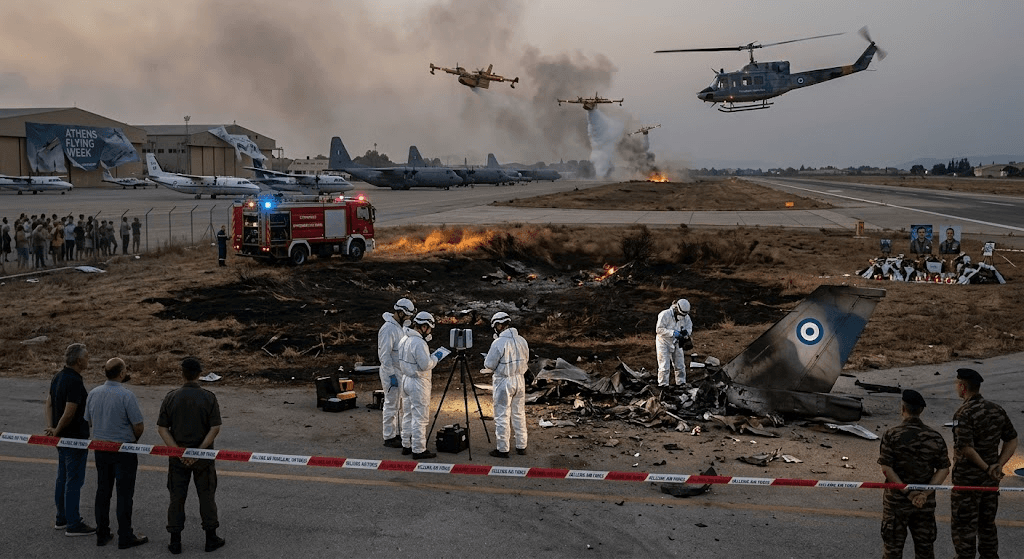
ATHENS, Greece — Tragedy struck the Hellenic Air Force on Saturday, September 5, 2026 after a twin-seat F-4E Phantom II fighter jet crashed during a low-altitude maneuver at the Athens Flying Week international air show, killing both pilots on board.
The disaster occurred before thousands of spectators at Tanagra Air Base, located roughly 60 kilometers north of the Greek capital. Eyewitnesses and video footage showed the aircraft suddenly losing altitude during a tight right turn before impacting the ground just minutes into the demonstration. The initial crash triggered a massive fireball as the jet broke apart, sending dense black smoke billowing into the sky and igniting multiple fires across the air base grounds.
Emergency response teams, including 85 firefighters, 11 water-dropping planes, and search helicopters, were immediately deployed to extinguish the blaze. Military officials later confirmed that search crews had located the bodies of both aviators some distance from the main impact site. Spectators were unharmed, as the crash occurred at a distance from the designated viewing zones, though officials promptly cleared the air base and canceled all remaining weekend displays.
Greek Prime Minister Kyriakos Mitsotakis expressed deep condolences to the families of the fallen aviators, describing the tragic loss as a solemn reminder of the inherent risks faced daily by military pilots safeguarding the nation’s airspace. Greek Minister of National Defense Nikos Dendias officially declared a three-day period of mourning across the armed forces as investigators begin analyzing flight data to determine the cause of the fatal crash.
Technical experts from the Hellenic Air Force Air Accident Investigation and Aviation Safety Board have secured the crash site to secure the aircraft's flight data recorder and wreckage fragments. Early inquiries are focusing on structural integrity, potential mechanical failure, and dynamic environmental conditions, as aviation authorities attempt to piece together the sequence of events leading up to the tragic descent.
The incident has sparked fresh debate over the continued deployment of legacy military aircraft for high-risk aerobatic displays. While the F-4E Phantom II has served as a cornerstone of Greece's aerial defense strategy for decades, aviation safety advocates and military analysts are urging a thorough review of display protocols and equipment readiness standards during public air shows.
Published by Banx Network. This article is part of the Banx decentralized media programme, powered by the BXE token on the XRP Ledger.