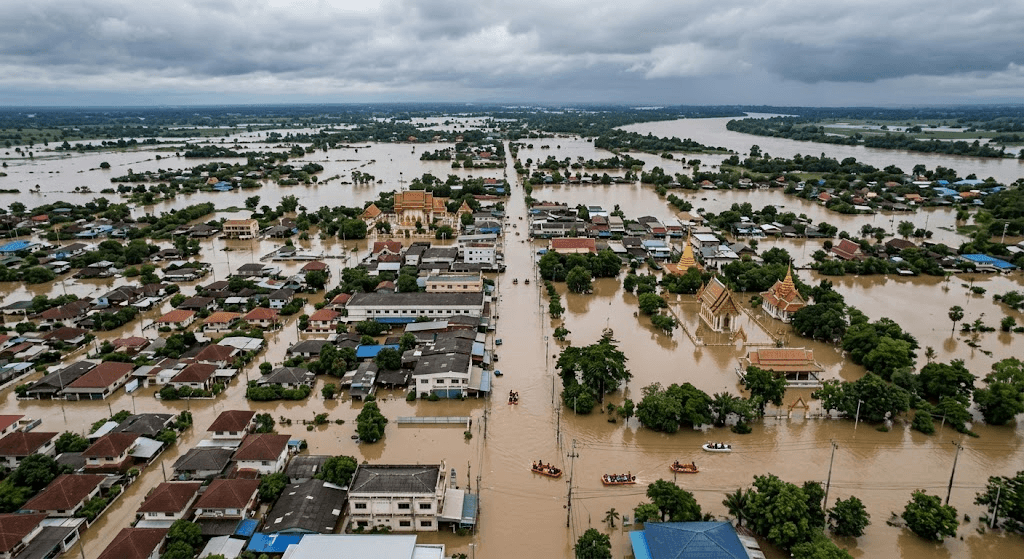
PRACHIN BURI, Thailand — What began as persistent monsoon rainfall has spiraled into one of the most severe natural disasters to hit eastern Thailand in recent years. Rapidly rising floodwaters have swept through Prachin Buri province, claiming at least nine lives and leaving all seven administrative districts submerged under heavy deluge.
Provincial authorities have officially classified the entire territory as an emergency disaster area, as rescue operations struggle against swift currents and deep waters to reach thousands of stranded residents.
The loss of life has cast a deep shadow over the region, with local officials confirming nine deaths resulting from drowning and flood-related accidents as swift waters inundated residential areas overnight.
More than 55,000 households have seen their homes, farms, and livelihoods swallowed by the rising waters. In low-lying communities, floodwaters have breached the one-meter mark, submerging vital roadway networks and cutting off remote villages from conventional transport.
The flooding has dealt a severe blow to the region, directly impacting over 55,200 households and tragically claiming 9 lives across the affected areas. The scale of the disaster has forced authorities to declare 100% of the province—spanning all seven districts—as emergency disaster zones, while waist-deep floodwaters have submerged critical infrastructure, including major highways, schools, local temples, and vast agricultural fields.
Emergency responders, state disaster relief agencies, and military personnel have mobilized flat-bottom rescue boats to deliver emergency food, drinking water, and medical supplies to isolated families. Special emphasis is being placed on evacuating elderly residents, young children, and individuals requiring medical assistance from flooded single-story homes to elevated emergency shelters.
With weather forecasters warning that continuous monsoon troughs could bring additional precipitation to the basin over the coming days, local leaders are urging communities near riverbanks and low-elevation zones to prepare for further potential evacuations.
As neighboring reservoirs approach peak capacity and upstream runoff continues to flow into the basin, provincial engineers are closely monitoring local dam levels to prevent catastrophic overflow. Local authorities are coordinating with national disaster management teams to establish temporary medical centers and distribution hubs, ensuring that clean water and vital medicine reach cut-off zones before further rain worsens the inundation.
Published by Banx Network. This article is part of the Banx decentralized media programme, powered by the BXE token on the XRP Ledger.