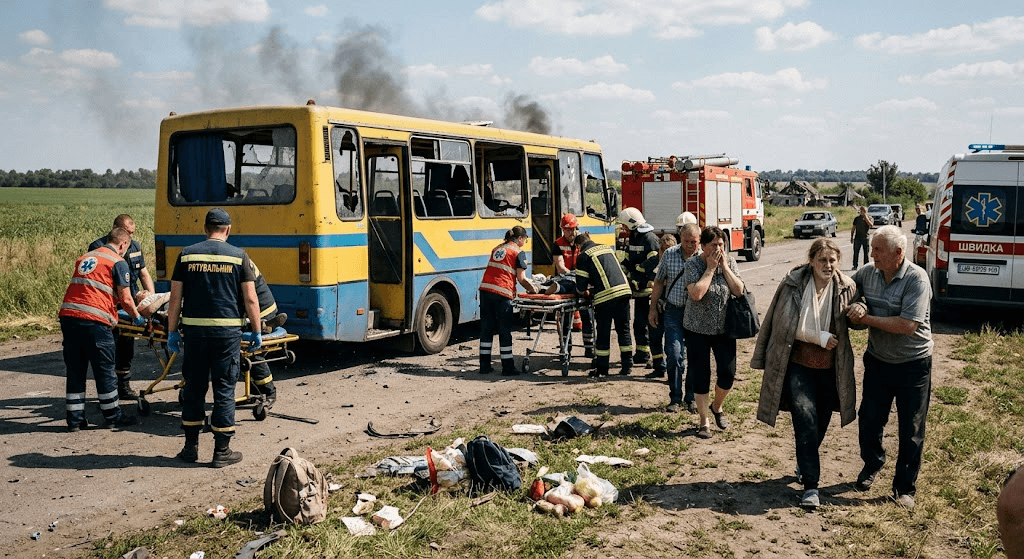
NIKOPOL DISTRICT, Ukraine — A devastating Russian drone attack directly targeted a scheduled passenger bus in Ukraine’s southern Nikopol district on Wednesday, leaving five civilians dead at the scene and at least seven others critically injured.
According to regional officials, the commuters were traveling along their regular daily route when an attack drone struck the civilian vehicle. Emergency responders quickly descended on the scene, providing immediate medical assistance to the survivors before transporting them to nearby health facilities.
Local authorities condemned the strike, emphasizing that the victims were ordinary citizens going about their daily routines when the attack occurred. The Nikopol district, situated across the Dnipro River from Russian-controlled territory, has faced persistent artillery and drone harassment throughout the ongoing war.
The Dnipropetrovsk Regional Prosecutor’s Office has launched a criminal investigation into the incident, citing violations of the laws and customs of war under Article 438 of the Criminal Code of Ukraine. Ukrainian officials continue to urge international bodies to take action as civilian infrastructure and public transit remain under high threat near frontline zones.
The tragic incident has once again highlighted the extreme vulnerabilities faced by civilians residing in frontline regions. For months, residents of the Nikopol district have lived under the constant shadow of incoming fire, with daily activities like commuting, shopping, or attending school carrying severe risks. Local community leaders noted that while air raid sirens sound frequently, the speed and low-altitude flight paths of small attack drones often leave civilians with mere seconds to seek adequate shelter.
Human rights advocates and international observers warn that targeting public transit infrastructure represents a dangerous escalation in risks to non-combatants. Transport networks are vital lifelines for rural communities, allowing access to essential services, food, and medical care. The destruction of the passenger bus not only claimed innocent lives but also further cripples the region's already fragile public transportation system, isolating vulnerable residents who rely entirely on local transit.
In response to the tragedy, regional authorities announced plans to increase emergency patrols and review public transport schedules along high-risk roads near the riverfront. Meanwhile, local humanitarian organizations have stepped in to offer psychological support, emergency financial aid, and temporary housing assistance to the families of the deceased and the injured survivors as the community attempts to process the devastating loss.
Published by Banx Network. This article is part of the Banx decentralized media programme, powered by the BXE token on the XRP Ledger.