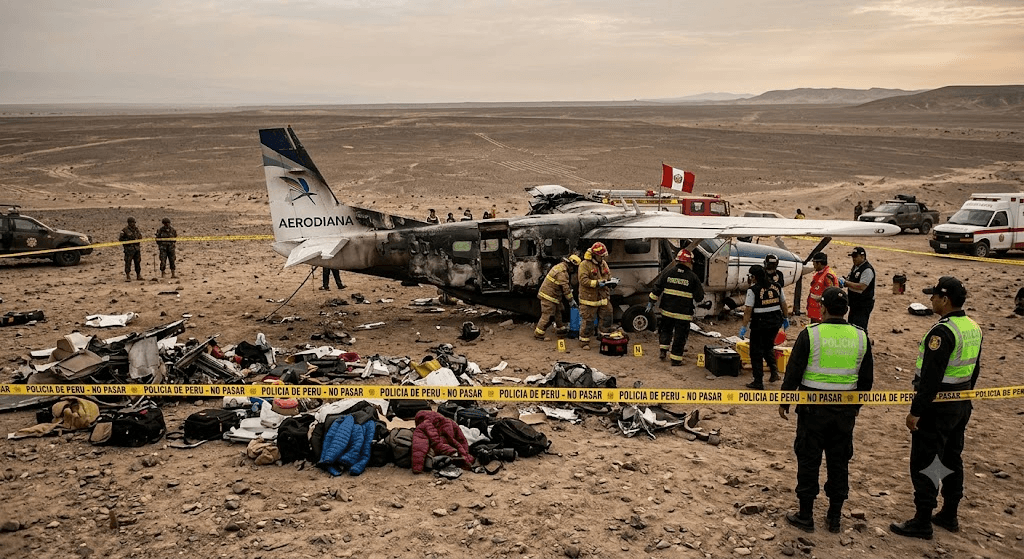
LIMA, Peru — A scenic sightseeing flight turned into an absolute tragedy on Saturday when a small tourist aircraft plunged into a field near the southern city of Nazca, killing all 13 people on board. The flight was transporting European tourists to view the world-famous Nazca Lines, a UNESCO World Heritage site renowned for its massive ancient geoglyphs.
According to Peru's Ministry of Transportation and Communications, the disaster claimed the lives of 11 foreign passengers and two crew members.
The aircraft, a Cessna Grand Caravan operated by the prominent local sightseeing company Aerodiana, had departed earlier in the afternoon. While some reports indicated a departure from Pisco Airport, municipal officials noted the flight was routed through the neighboring city of Ica.
Minutes into what was supposed to be a highlight of their vacation, the aircraft abruptly lost contact with the control tower. The plane came down in a field in the Pueblo Viejo area, located roughly six kilometers from the city of Nazca and 12 kilometers from the ancient lines themselves.
"Given the severity of the accident, there are no survivors," stated Police Major Jorge Andrade from the crash site, where first responders encountered heavily burning, smoldering wreckage that severely hampered initial recovery efforts.
Peruvian officials have released the identities of the 11 international tourists lost in the crash. The victims included seven Italian citizens ranging in age from 18 to 54, two Spanish citizens who were both 52 years old, and two German citizens aged 77 and 78.
The two Peruvian crew members piloting the aircraft were identified as Captain Américo Salazar and Co-pilot Irenka Guanilo del Carpio. Peru's Foreign Trade and Tourism Ministry confirmed they are actively working with the respective European embassies to coordinate the repatriation of the victims.
The Nazca Lines—massive figures of animals, geometric shapes, and plants etched into the desert floor between 500 BC and 500 AD—are one of Peru's top tourist draws. Because the vast designs can only be fully appreciated from high above, thousands of international travelers book small-craft fly over every year.
However, the region is notorious for unpredictable, high-velocity desert winds. Just one day prior to the crash, several flights over the Nazca Lines had been suspended or diverted due to intense wind gusts exceeding 40 kilometers per hour, which severely blinded visibility with whipped-up dust.
Aviation authorities have launched a formal investigation to determine whether mechanical failure, pilot error, or sudden adverse weather triggered the fatal plunge. Following the tragedy, President Keiko Fujimori expressed profound regret over the loss of life and stated that a temporary suspension of the local airfield is currently under consideration while safety investigators scour the crash site.
Published by Banx Network. This article is part of the Banx decentralized media programme, powered by the BXE token on the XRP Ledger.