NOUADHIBOU, MAURITANIA — In one of the most devastating maritime disasters on the Atlantic migration route this year, the United Nations Refugee Agency (UNHCR) confirmed that at least 144 refugees and migrants are dead or missing off the coast of Mauritania. The heartbreaking toll follows a series of tragic incidents, including a single vessel that spent nearly a month drifting helplessly in the open ocean.
The grimmest details emerged from a lone overcrowded vessel that originally departed from the coastal town of Bafuloto in The Gambia. Intending to reach Spain’s Canary Islands, the boat instead suffered a catastrophic failure when it completely ran out of fuel.
For 25 grueling days, the vessel was left entirely at the mercy of the Atlantic currents. According to local reports, the passengers exhausted their meager supplies of food and fresh water within the first ten days, forcing many to drink seawater in a desperate bid to survive.
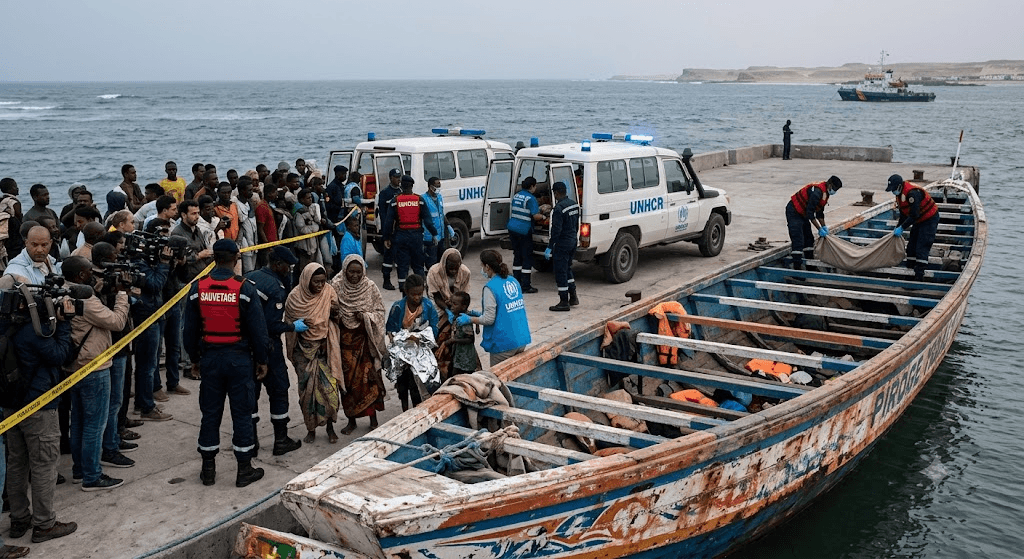
When the boat was finally intercepted by the Mauritanian Coast Guard and brought into the port city of Nouadhibou on July 18, rescue workers were met with an absolute horror scene: the vessel was carrying 38 severely weakened survivors alongside the bodies of those who succumbed to the journey. A staggering 143 people from that single boat perished or vanished at sea.
"Among the survivors of that ship were two children who have lost all their family members during the journey, and they are currently recovering in a local hospital," stated UNHCR spokesperson Matt Saltmarsh during a press briefing in Geneva.
The scale of the crisis spanned several days, requiring a massive response from local authorities and humanitarian partners. Between July 14 and July 18, emergency teams successfully managed three separate disembarkations off the Mauritanian coast, pulling a total of 387 survivors to safety from different stranded vessels.
The victims are reported to be nationals from various sub-Saharan African countries. While one additional fatality was recorded during a separate disembarkation on July 14, another vessel carrying 180 individuals from neighboring Senegal was fortunately rescued in its entirety by the coast guard.
The UNHCR has repeatedly designated the Atlantic migration corridor between the West African mainland and the Canary Islands as one of the world's deadliest sea routes. The combination of vast distances, unseaworthy wooden pirogues, unpredictable ocean swells, and the absolute scarcity of timely deep-sea rescue options creates a recipe for catastrophe.
Interestingly, total arrivals to Europe via major sea routes have actually experienced a sharp drop this year—falling from over 65,000 during this period last year to roughly 40,000. The decline is largely credited to an intense, European Union-funded crackdown and stricter border agreements with North and West African nations.
However, human rights groups note that these intensified blockades have a dark side: they inadvertently force desperate migrants to launch from points further down the African coast, resulting in even longer, far more perilous journeys. Despite the drop in total traffic, the UNHCR warns that the proportion of deaths and disappearances remains at "alarming levels," with countless ghost ships likely vanishing into the Atlantic entirely unnoticed.
Published by Banx Network. This article is part of the Banx decentralized media programme, powered by the BXE token on the XRP Ledger.