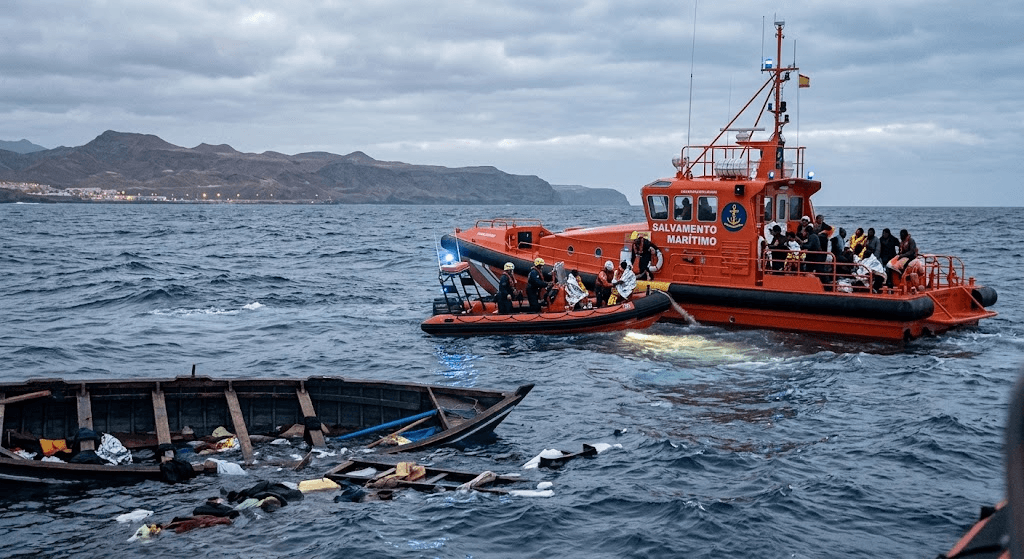
LAS PALMAS, Spain — At least 80 migrants are confirmed dead after a packed wooden vessel ran into severe distress and capsized in rough waters off the coast of Gran Canaria, marking one of the deadliest maritime disasters along the Atlantic migration route this year.
Spanish maritime rescue services and military aircraft launched a major search-and-rescue operation after local air traffic controllers spotted the overburdened vessel struggling against heavy swells several dozen miles south of the Canary archipelago.
By the time rescue cutters and helicopters reached the scene, the vessel had already capsized, leaving dozens of passengers struggling in open ocean conditions. Emergency crews managed to pull a small number of survivors from the water, while recovery teams worked under challenging conditions to retrieve bodies from the wreckage area.
Surviving passengers reported that the vessel had set sail from the West African coastline several days earlier, carrying over a hundred people attempting to reach European soil. The ship encountered severe mechanical failure and took on water before high waves overturned the hull.
Rescue vessels brought survivors into the port of Arguineguín in Gran Canaria, where Red Cross humanitarian teams and emergency medical services established a triage center.
Several survivors were immediately airlifted or transported to local hospitals suffering from severe hypothermia, acute dehydration, and saltwater inhalation. Medical personnel noted that the survivors were in a state of deep shock and physical exhaustion after spending hours clinging to debris in cold water.
The waters surrounding the Canary Islands have become one of the most hazardous sea crossings in the world for asylum seekers and migrants.
Human rights organizations and maritime monitors have repeatedly warned about the dangers of the Atlantic route, where small, poorly equipped wooden boats face extreme currents, unpredictable weather, and vast distances. Local authorities in Gran Canaria confirmed that search operations remain active, with naval vessels and aircraft scanning the surrounding sea area for additional casualties or potential survivors.
Published by Banx Network. This article is part of the Banx decentralized media programme, powered by the BXE token on the XRP Ledger.