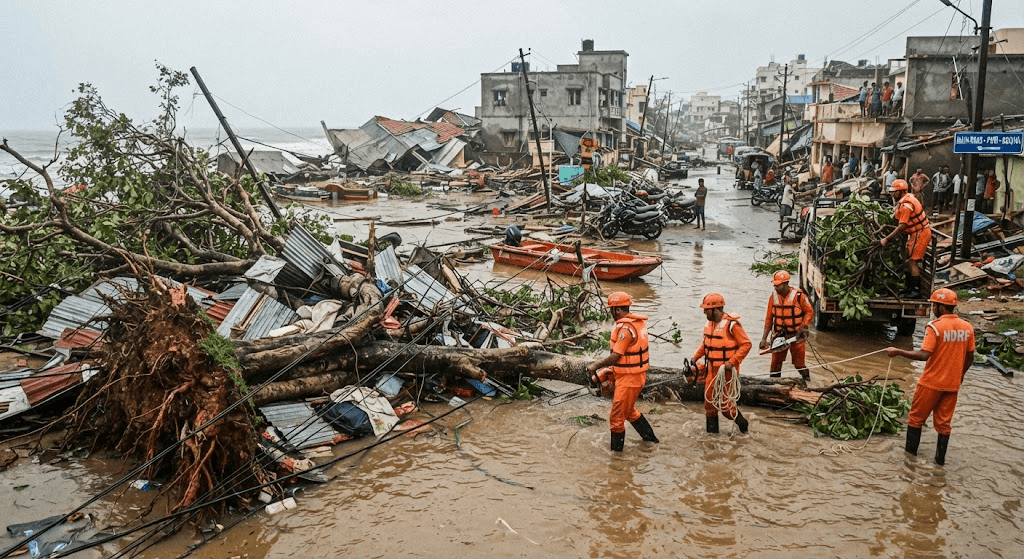
BHUBANESWAR, India — A powerful cyclone barreled through the Bay of Bengal and slammed into India’s eastern coastline, unleashing gale-force winds, torrential rain, and massive storm surges. Official reports confirm that at least six people have lost their lives, with power grids severed and extensive infrastructure damage reported across low-lying coastal regions.
The severe cyclonic storm made landfall along the eastern coast, whipping coastal towns with wind gusts up to 150 km/h and causing intense water logging. Visakhapatnam and surrounding coastal districts bore the brunt of the onslaught, recording over 20 cm of rainfall in a span of hours.
The tempest uprooted thousands of trees, snapped high-tension power lines, and damaged hundreds of homes and farmlands. Official sources confirmed that the initial fatalities resulted from wall collapses, falling trees, and electrocution caused by downed power cables.
Anticipating the destructive path of the storm, state authorities and disaster management agencies mounted massive pre-emptive evacuation drives. Over 180,000 residents were moved from vulnerable, low-lying coastal areas into emergency shelters and relief camps across Andhra Pradesh and neighboring Odisha.
Teams from the National Disaster Response Force (NDRF) alongside state emergency personnel are actively navigating flooded thoroughfares with heavy machinery to clear debris, restore access along critical road networks, and reach isolated communities.
Local officials report widespread power outages affecting millions, while train services and regional flights were temporarily suspended to ensure passenger safety. Agricultural authorities have raised immediate concerns over extensive crop destruction, with tens of thousands of hectares of farmland submerged under floodwaters.
Chief Ministers in the affected states have briefed central government leadership to request immediate relief funding and federal assistance. As the cyclone gradually loses strength while moving further inland, emergency responders remain on high alert to mitigate secondary flooding risks from swelling rivers and relentless rainfall.
In the coming days, international humanitarian groups and local volunteers are expected to join government relief operations, distributing clean drinking water, food rations, and medical aid to thousands housed in makeshift shelters. Community leaders and economists warn that rebuilding coastal infrastructure and restoring damaged agricultural land could take several months, leaving displaced residents facing a prolonged road to recovery.
Published by Banx Network. This article is part of the Banx decentralized media programme, powered by the BXE token on the XRP Ledger.