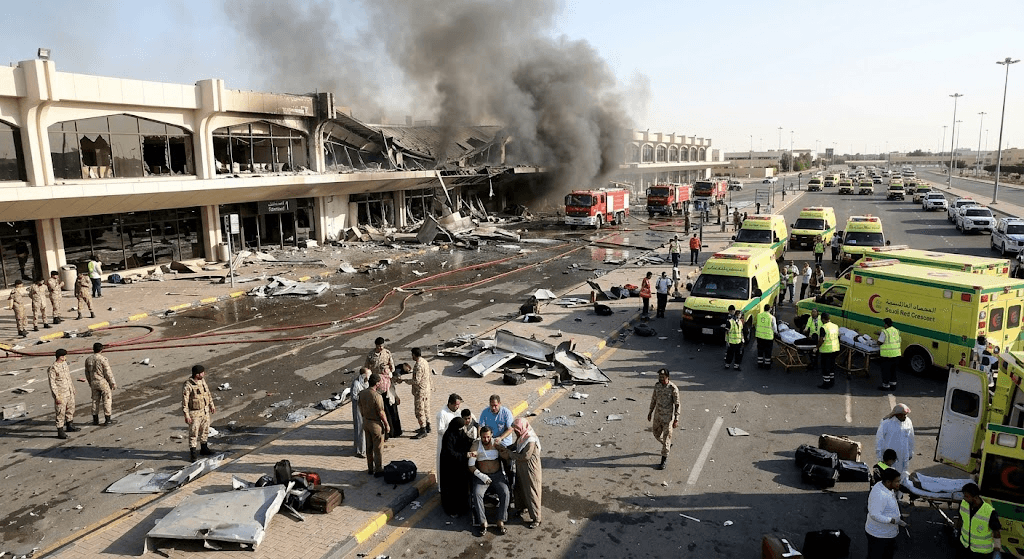
RIYADH, Saudi Arabia — A major strike targeted King Khalid International Airport in Riyadh on Saturday, October 10, 2026 killing at least 12 people and injuring 309 others. The assault marks one of the deadliest strikes on the capital's primary transit hub during the recent surge in regional hostilities.
According to the Saudi General Authority of Civil Aviation (GACA), the fatalities include four Saudi nationals and eight foreign residents from the United States, Bangladesh, Egypt, Jordan, Syria, Palestine, and Sudan.
Dozens of ambulances and first responders rushed to the terminal complex following the blasts to extinguish fires caused by the impact and evacuate victims. Official reports confirmed 12 fatalities—comprising four Saudi citizens and eight foreign residents—while 309 individuals were injured and received care across multiple medical facilities, with several remaining in intensive care due to severe injuries.
Operations at King Khalid International Airport were immediately suspended, with incoming flights diverted to neighboring regional hubs while authorities conducted safety checks and evaluated structural damage.
The attack was the third strike to hit Riyadh's international airport within the past week amid intensified fighting between Saudi forces and Houthi rebels. The Saudi-led coalition attributed the assault to the Iran-backed group, labeling the targeting of civilian transport infrastructure a grave violation of international law.
The strike drew swift international reaction. U.S. officials condemned the targeting of civilian infrastructure and confirmed the death of an American citizen in the blast.
Emergency repair crews and forensic specialists remain on site assessing infrastructure damage across terminal facilities. High-level security meetings are underway in Riyadh to review air defense protocols as public calls grow for enhanced international protections around vital civilian transit hubs.
The escalating strikes on key transportation hubs have sent ripples through global aviation networks, prompting international carriers to reassess flight routes and security protocols across the region. With thousands of travelers stranded and logistics chains disrupted, international leaders are urging immediate diplomatic intervention to de-escalate hostilities and establish secure corridors for civilian transit before the regional crisis deepens further.
Published by Banx Network. This article is part of the Banx decentralized media programme, powered by the BXE token on the XRP Ledger.