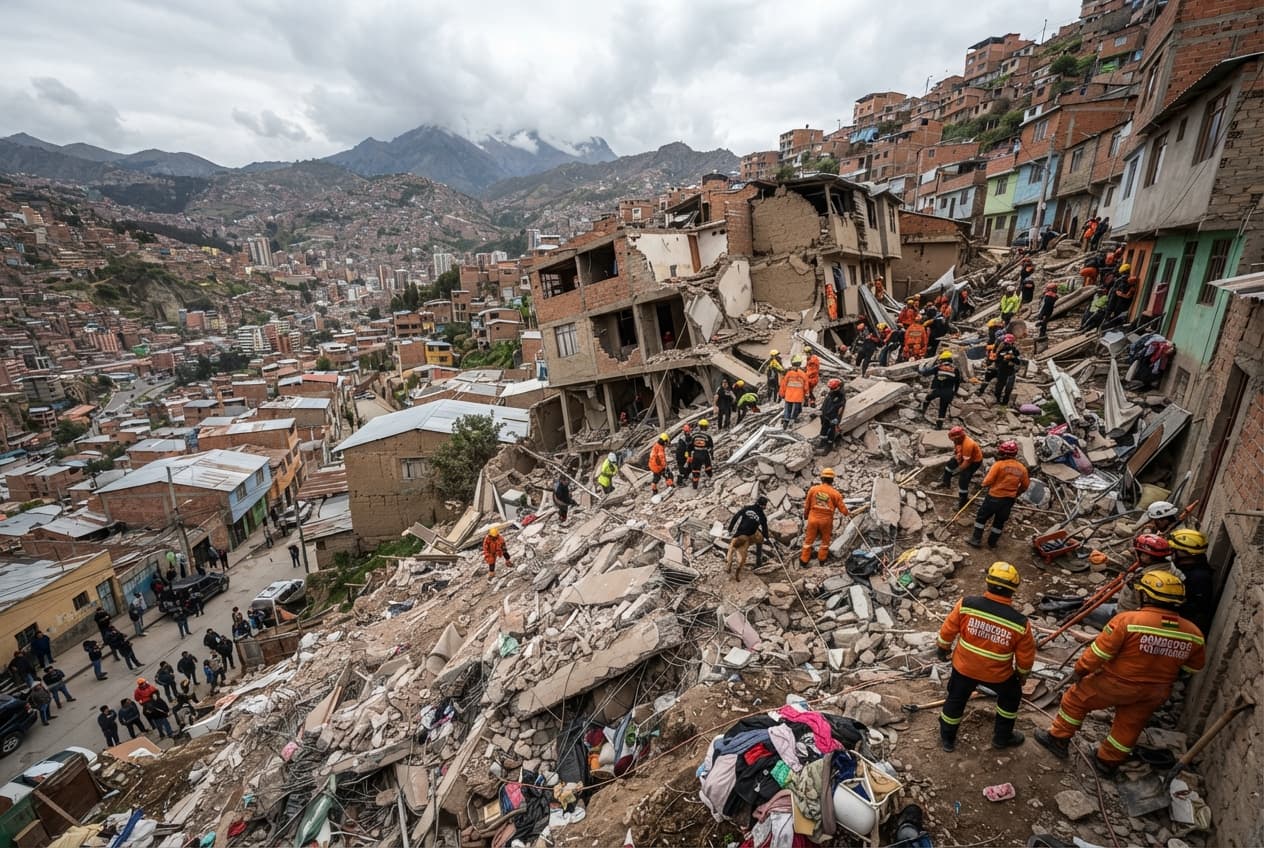
La Paz, Bolivia—A series of violent structural collapses tore through steep hillside suburbs early Thursday morning as relentless downpours undermined building foundations across the metropolitan basin. Municipal rescue squads confirmed that at least two multi-story residential buildings pancaked into the ravine below without warning, burying occupants beneath tons of concrete and wet earth. Emergency dispatchers received hundreds of panicked calls from homeowners reporting massive cracks splitting exterior walls and foundations.
Continuous seasonal precipitation over the past week has saturated the unstable clay soils of the canyon slopes far beyond their structural limits. Local civil defense directors stated that unauthorized and unregulated construction practices across the hillside districts drastically compounded the disaster potential. Heavy earthmoving equipment remains paralyzed miles away as secondary mudslides block the narrow access switchbacks leading into the canyon floor.
Neighbors living adjacent to the collapse zones rushed into the debris fields with shovels and buckets before official rescue units arrived on scene. Community leaders reported that municipal water and gas mains fractured during the initial cave-ins, filling the air with the hiss of escaping fuel. Police officers established wide exclusion perimeters to prevent curious onlookers from interfering with heavy extraction machinery.
National emergency coordination centers mobilized specialized urban search and rescue squads equipped with acoustic listening devices and thermal cameras. Officials warned that continuing rain threatens to trigger further progressive failures along adjacent ridge lines, endangering rescue workers operating below. Temporary medical triage stations were hastily erected on paved parking lots above the danger zone to treat injured survivors.
Regional hospitals across La Paz declared immediate yellow alerts to receive trauma victims transferred from the collapse sites. Doctors and orthopedic surgeons remain on standby, though ambulances face severe gridlock navigating waterlogged arterial roads. Communication links between municipal command posts and outlying district offices continue to suffer intermittent blackouts.
Urban planners have repeatedly categorized these steep suburban slopes as critical red zones unfit for permanent residential construction. Despite municipal zoning prohibitions, informal housing expansions have proliferated across the unstable canyons for over a decade. Residents have long depended on precarious retaining walls that lack proper subterranean drainage infrastructure.
Emergency shelters are currently being organized in municipal sports coliseums to house families who lost their dwellings overnight. Relief supplies including blankets, dry rations, and bottled water are being trucked from central warehouses for immediate distribution. Logistics coordinators admitted that aerial crane support will become necessary if ground excavation remains obstructed.
The search perimeter stays heavily restricted as structural engineers evaluate the stability of remaining houses clinging to the cliff edge. Heavy equipment operators continue clearing concrete slabs and mud from the main canyon arteries under pouring rain. Official tallies of missing persons remain fluid as municipal workers cross-reference survivor registries with local neighborhood committees.
Published by Banx Network. This article is part of the Banx decentralized media programme, powered by the BXE token on the XRP Ledger.