On a clear September evening, the sky offers a quiet invitation to look up—not for something dramatic or fleeting, but for something steady. Saturn, the ringed planet, has been brightening for weeks as it approaches opposition, the point in its orbit when it sits directly opposite the Sun from Earth's perspective . This makes it as bright as it will get this year, a calm, golden point of light in the eastern sky after sunset. And tonight, it is not alone.
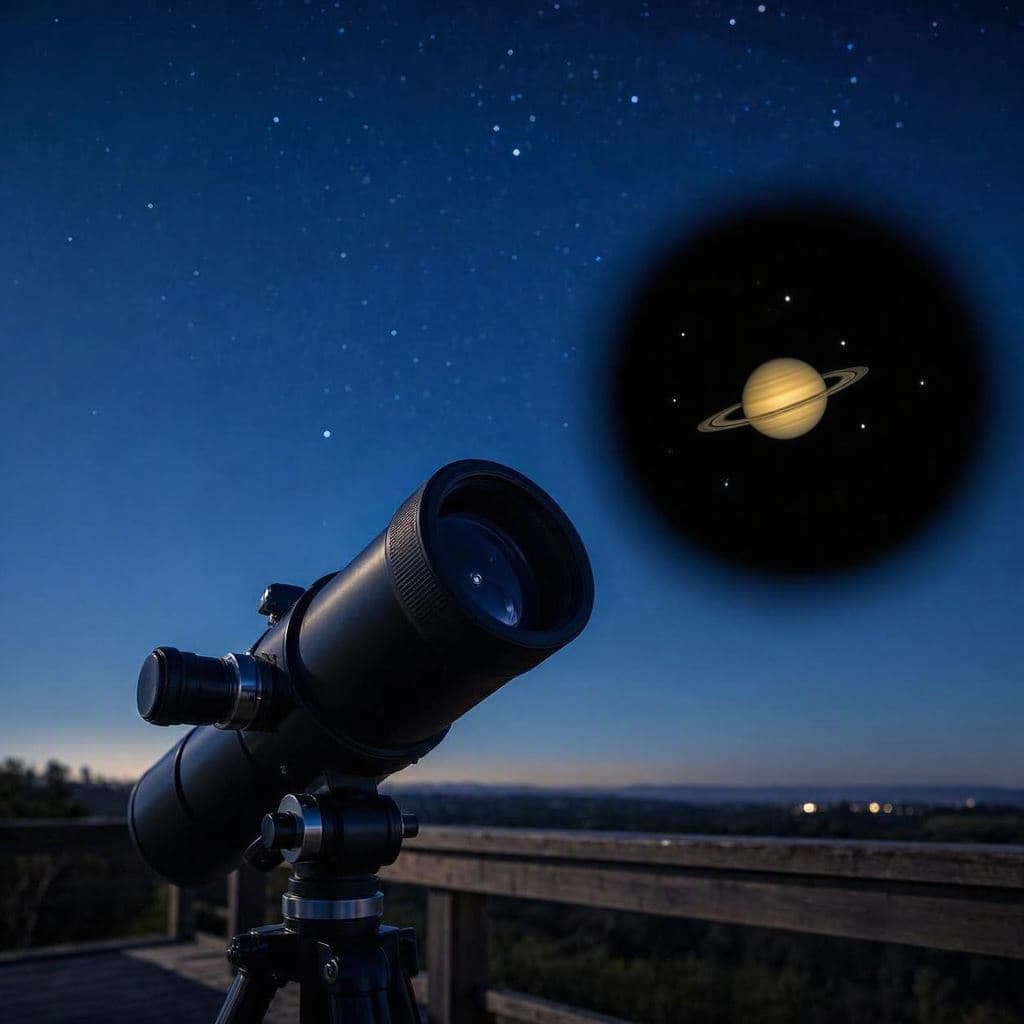
Through a telescope, Saturn's disk spans about 20 arcseconds, while its rings stretch more than twice that width, spanning roughly 44 arcseconds from end to end . The rings are tilted favorably, offering a view that has captivated observers since Galileo first puzzled over their strange appearance. But the planet's moons are the quieter reward of an evening spent at the eyepiece.
Titan, Saturn's largest and brightest moon, shines at mid-eighth magnitude and sits about 2.6 arcminutes west of the planet's center tonight . Over the coming days, Titan's orbit will carry it closer to Saturn, and it will pass south of the planet in the early hours of September 30 . Titan is large enough and bright enough to be spotted even in modest telescopes, appearing as a tiny, steady point of light near the rings.
Closer to Saturn and its rings are three more moons, all around tenth magnitude: Tethys, Rhea, and Dione . These are fainter and require a bit more aperture to resolve clearly, but a six-inch telescope should reveal them as small specks orbiting near the ring system. Their positions shift noticeably over the course of a few hours, as each completes its orbit in a matter of days. Dione takes about 2.7 days, Rhea about 4.5, and Tethys just 1.9—fast enough that a patient observer can watch them move relative to Saturn and each other .
There is a practical caution for tonight's observation. A field star of about eleventh magnitude sits just southwest of Saturn, faint enough to be mistaken for a moon at first glance. Fortunately, it is dimmer than Titan and the three inner moons, making it distinguishable with careful observation . A couple of brighter field stars also lie farther out, north and east of Saturn, beyond the planet's satellite system.
The Moon, meanwhile, is a waning gibbous, about 97 percent illuminated, and passes more than 13 degrees northeast of Saturn by mid-evening . Its brightness will wash out some of the fainter stars, but the moons of Saturn are close enough to the planet to remain visible with the right equipment. For those without a telescope, Saturn itself is still worth finding—a steady, golden light near the border of Cetus and Pisces, bright enough to be unmistakable.
Saturn is visible in the eastern sky after sunset on September 27, appearing as a bright golden point near the border of Cetus and Pisces. Through a telescope, four of its moons—Titan, Tethys, Rhea, and Dione—are visible, with Titan appearing near the planet and the inner three orbiting close to the rings.
AI Image Disclaimer: The images in this article are AI-generated and are for illustrative purposes only. They do not depict actual astronomical observations.
Sources: Astronomy Magazine, Star Walk, BBC Sky at Night Magazine, The Peninsula Qatar
Published by Banx Network. This article is part of the Banx decentralized media programme, powered by the BXE token on the XRP Ledger.