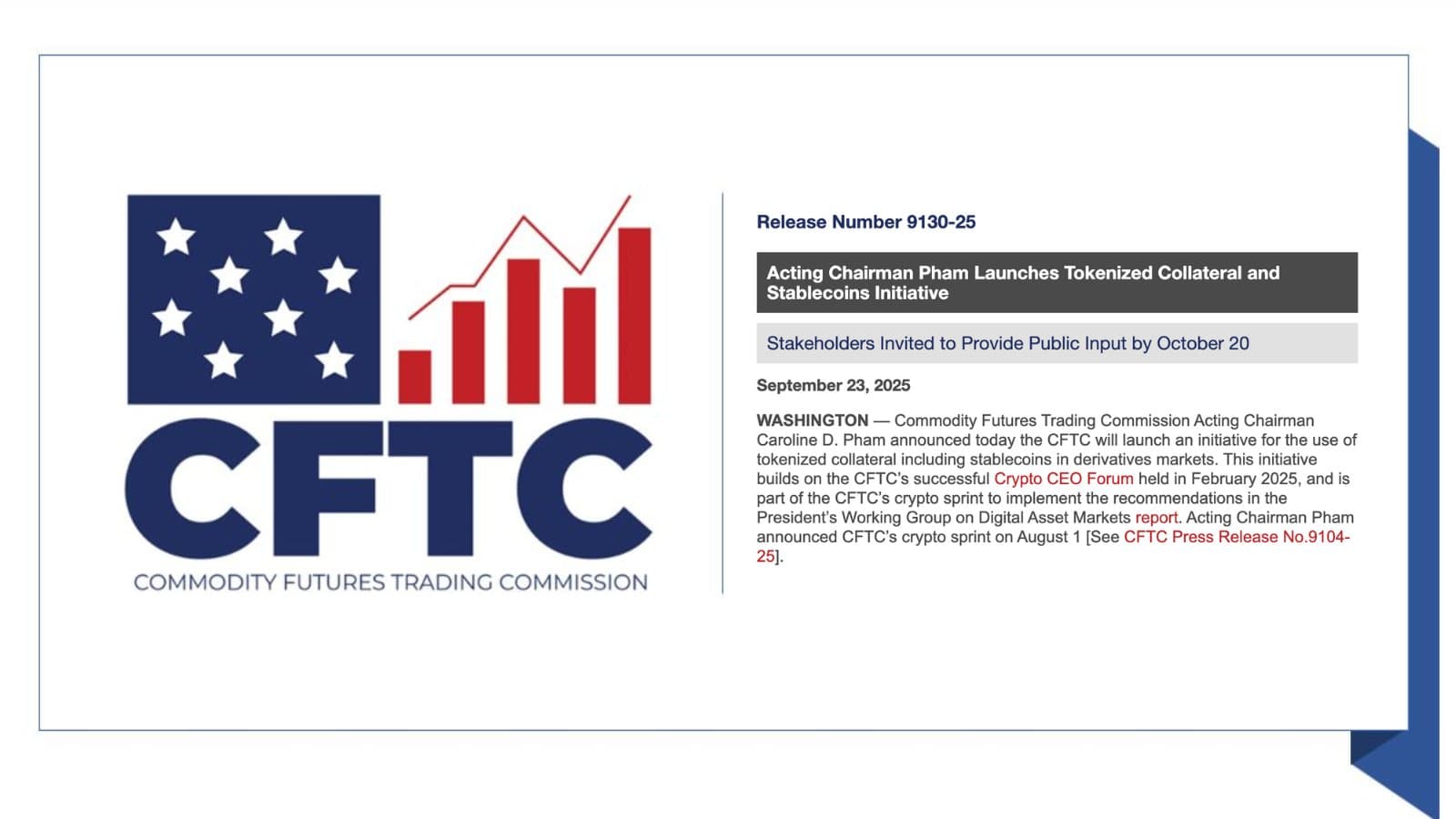
A new era in global finance is taking shape. According to Caroline D. Pham, Acting Chair of the Commodity Futures Trading Commission (CFTC), “Tokenized markets are here, and they are the future.” Her statement follows a groundbreaking announcement that could permanently reshape the structure of modern markets.
The CFTC has introduced an initiative that will allow stablecoins and tokenized U.S. Treasuries to be used as collateral in derivatives trading. With the derivatives market representing notional values in the hundreds of trillions of dollars, this move could open the doors for digital assets to integrate directly with the deepest layers of traditional finance.
For years, digital assets and blockchain technology have existed on the fringe of mainstream markets, often questioned for their legitimacy. This initiative marks a turning point: the blending of tokenized finance with the traditional system. The use of tokenized Treasuries and stablecoins not only brings speed and efficiency but also unlocks accessibility, transparency, and interoperability across global financial networks.
The lines separating old and new finance are quickly vanishing. By officially considering blockchain-based assets in collateral frameworks, the CFTC is signaling that tokenization is no longer experimental—it’s structural.
As regulatory bodies adopt this direction, one thing becomes clear: the next phase of financial markets will not be defined by paper contracts and legacy rails, but by tokenized assets moving at the speed of code.
Published by Banx Network. This article is part of the Banx decentralized media programme, powered by the BXE token on the XRP Ledger.