Key Highlights
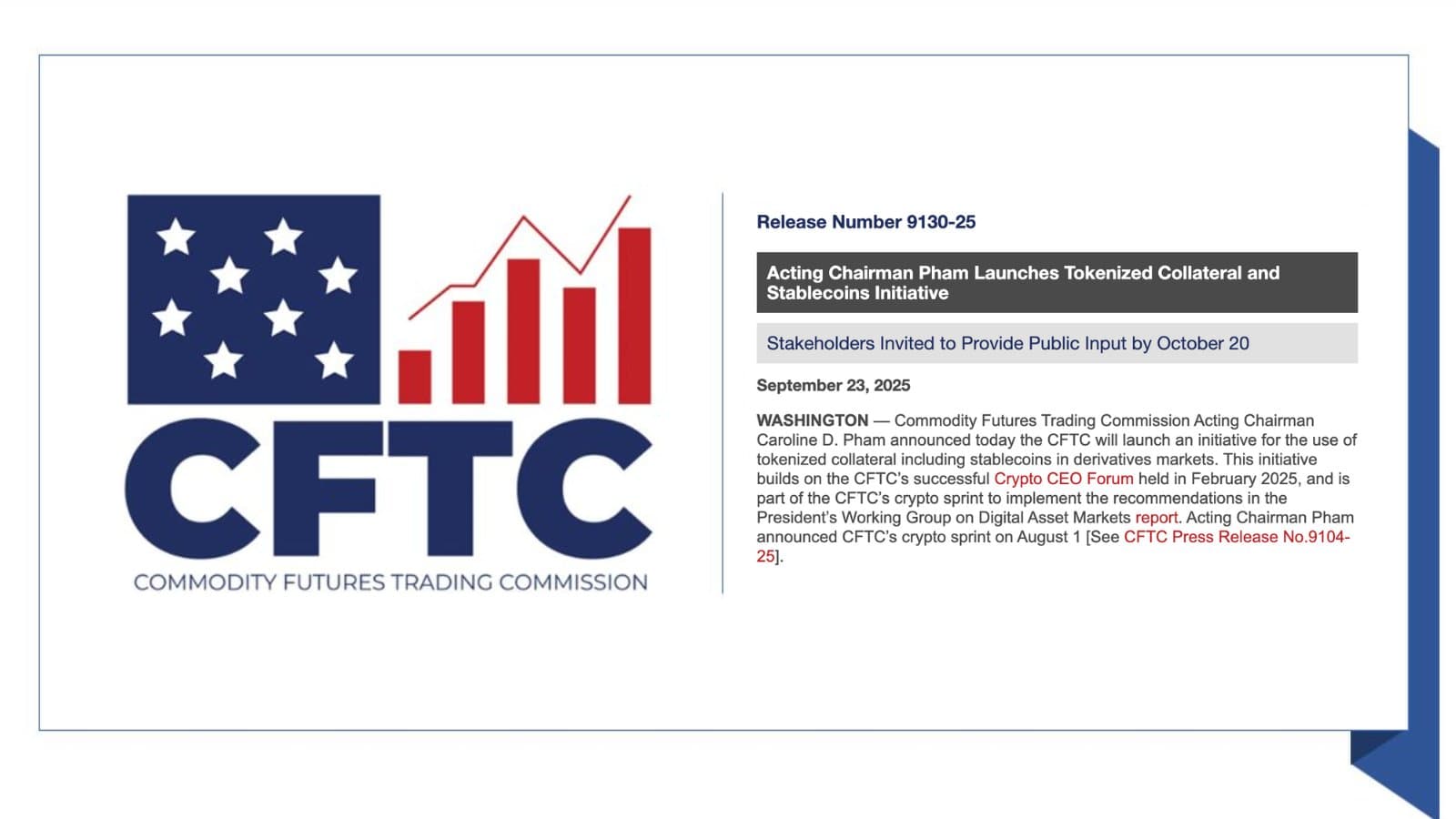
- CFTC Initiative:The CFTC has launched a new initiative allowing tokenized assets as collateral.
- Market Impact:This move could reshape the derivatives market, valued in the hundreds of trillions.
- Future of Finance:The integration of digital assets signifies a major shift in traditional finance.
The landscape of global finance is undergoing a significant transformation. Caroline D. Pham, the Acting Chair of the Commodity Futures Trading Commission (CFTC), recently stated, "Tokenized markets are here, and they are the future." This declaration follows the CFTC's announcement of a pioneering initiative that could fundamentally alter the structure of modern financial markets.
The CFTC's new initiative permits the use of stablecoins and tokenized U.S. Treasuries as collateral in derivatives trading. Given that the derivatives market encompasses notional values reaching into the hundreds of trillions of dollars, this development could facilitate the direct integration of digital assets into the core of traditional finance.
Historically, digital assets and blockchain technology have been relegated to the periphery of mainstream financial markets, often facing skepticism regarding their legitimacy. However, this initiative represents a pivotal moment: the convergence of tokenized finance with established financial systems. The incorporation of tokenized Treasuries and stablecoins not only enhances speed and efficiency but also promotes accessibility, transparency, and interoperability across global financial networks.
The distinction between traditional and modern finance is rapidly diminishing. By formally recognizing blockchain-based assets within collateral frameworks, the CFTC is indicating that tokenization is no longer a mere experiment; it is now a structural component of the financial ecosystem.
As regulatory bodies increasingly adopt this forward-thinking approach, it becomes evident that the next evolution of financial markets will be characterized not by paper contracts and outdated infrastructures, but by tokenized assets operating at the speed of code. This shift not only reflects technological advancements but also a broader acceptance of digital assets as integral to the future of finance.
In conclusion, the CFTC's initiative marks a significant step towards the mainstream acceptance of tokenized finance. As the regulatory landscape evolves, stakeholders in the financial sector must adapt to these changes, embracing the opportunities presented by digital assets and the efficiencies they offer.
Published by Banx Network. This article is part of the Banx decentralized media programme, powered by the BXE token on the XRP Ledger.