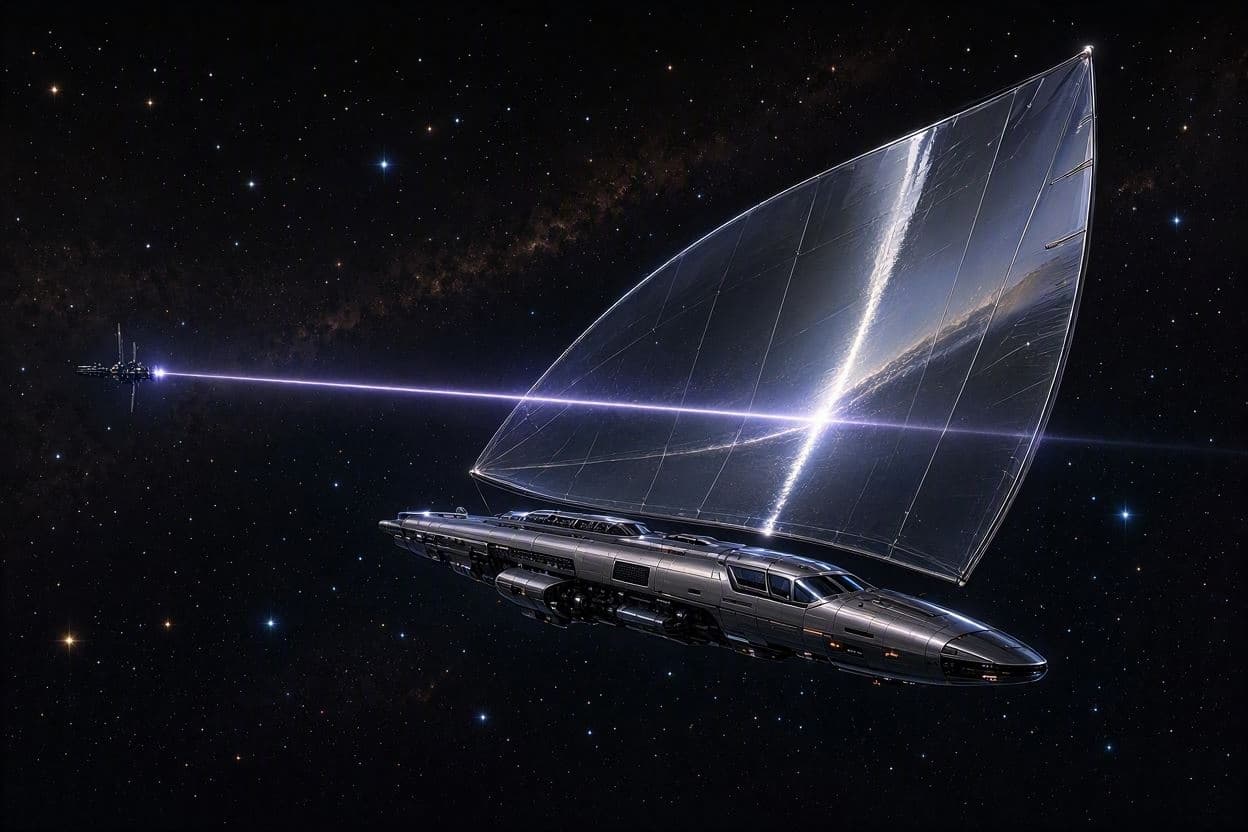
In the cosmic neighborhood, a dark giant lurks just 1,500 light-years away. Gaia BH1, a stellar-mass black hole, has long been considered unreachable, a distant object of theoretical interest. But a new proposal from physicists suggests that with emerging propulsion technologies, humanity might send a probe to this enigmatic void within the next hundred years, turning science fiction into a tangible mission plan.
The study, led by researchers at the University of California, Santa Barbara, outlines a pathway using laser-directed energy propulsion. This method involves using a powerful array of lasers on Earth or in orbit to push a lightweight spacecraft equipped with a reflective sail. By concentrating light onto the sail, the spacecraft can achieve relativistic speeds—a significant fraction of the speed of light—without carrying heavy fuel loads.
At speeds reaching 10 percent of the speed of light, a journey to Gaia BH1 would take approximately 15,000 years with current chemical rockets. However, with laser propulsion, the travel time could be reduced to under a century. This dramatic reduction makes the mission feasible within the lifespan of multiple generations of scientists, allowing for direct observation and data collection from the vicinity of a black hole.
The target, Gaia BH1, is particularly interesting because it is part of a binary system with a sun-like star. This configuration allows astronomers to study the black hole’s gravitational effects on its companion, providing clues about its mass and spin. A close-up probe could reveal details about accretion disks, event horizons, and the extreme physics that govern these objects.
Challenges remain significant. The spacecraft must withstand intense radiation and gravitational forces as it approaches the black hole. Additionally, the communication delay, though reduced by faster travel, would still be substantial. Data transmission would require advanced laser communication systems capable of sending information across vast distances with minimal signal loss.
Funding and international collaboration will be key to realizing this vision. Projects like Breakthrough Starshot have already demonstrated the feasibility of laser propulsion for interstellar travel to nearby stars. Extending this technology to black holes requires scaling up the infrastructure and refining the engineering designs. The scientific community is increasingly viewing such missions as the next frontier in exploration.
Beyond the technical aspects, the mission carries profound philosophical weight. Sending a probe to a black hole is akin to sending a messenger to the edge of known physics. It represents humanity’s desire to confront the unknown, to look into the abyss and understand the fundamental laws that shape our universe.
While the mission remains in the conceptual stage, the roadmap is clear. With continued advancements in propulsion and materials science, the dream of visiting a black hole may soon move from the pages of theory to the launchpad of reality.
AI Image Disclaimer: Visuals for this report are AI-generated interpretations designed to convey the themes of futuristic space travel and black hole exploration.
Sources: University of California Santa Barbara, ArXiv, Scientific American, Space.com
Published by Banx Network. This article is part of the Banx decentralized media programme, powered by the BXE token on the XRP Ledger.