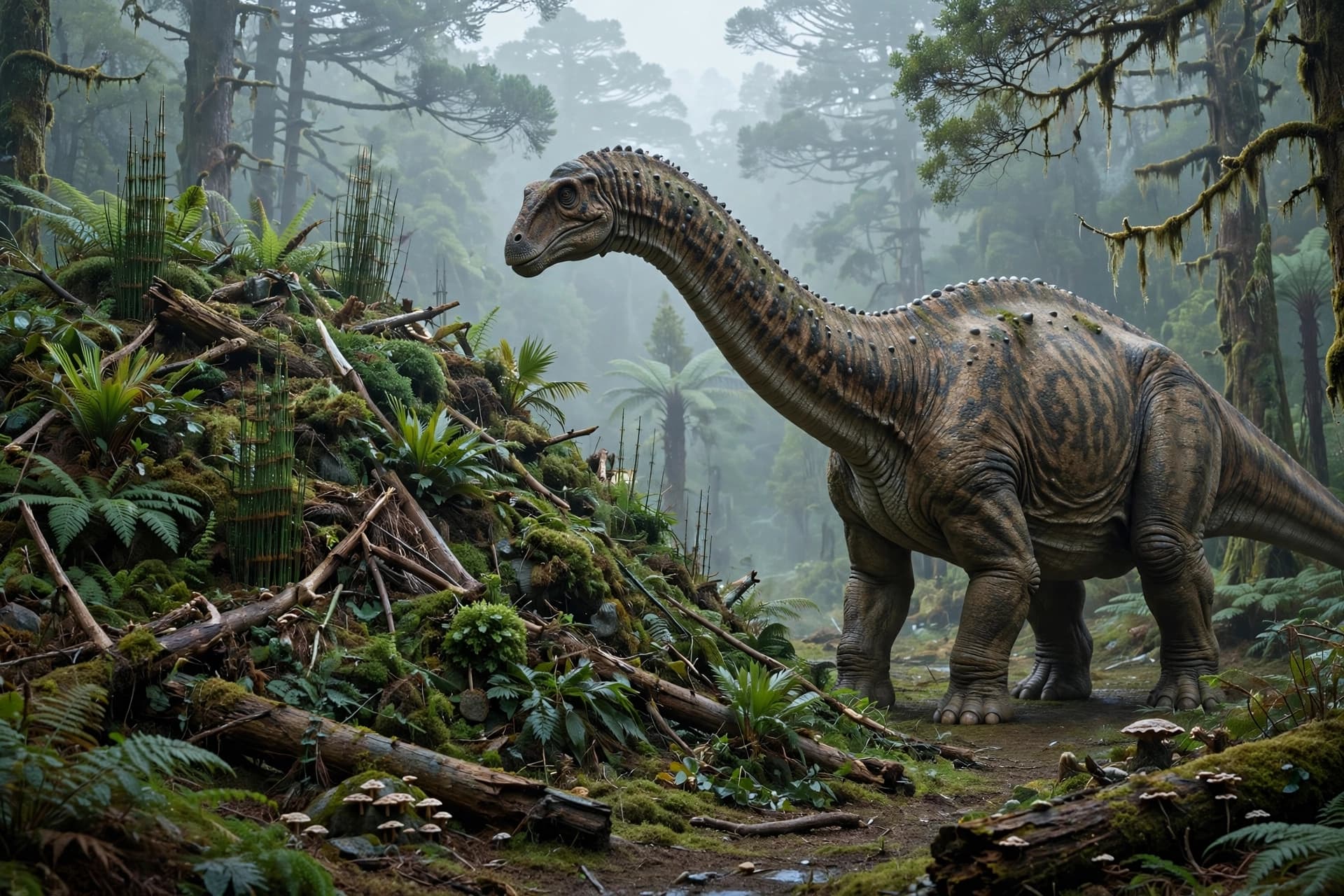
In the frozen landscapes of ancient Patagonia, where temperatures would have been chilly even during the Cretaceous period, dinosaurs faced a unique challenge: how to keep their eggs warm enough to hatch. A new study suggests that titanosaurs, massive long-necked herbivores, may have engineered sophisticated incubation mounds using rotting vegetation, much like modern crocodiles and megapode birds. This ingenious adaptation allowed them to thrive in high-latitude regions where solar heat alone was insufficient.
The research, based on fossilized eggshells found in Argentina, analyzes the isotopic composition of the shells to estimate incubation temperatures. The results indicate that the eggs were kept at a consistent, warm temperature, likely generated by microbial decay within large mounds of plant matter. By burying their eggs in these compost-like heaps, titanosaurs created a natural greenhouse effect, providing the stable warmth necessary for embryonic development in a cold climate.
This finding challenges the traditional view that all dinosaurs relied on body heat or sun-basking for incubation. While some smaller theropods may have sat on their nests, giant sauropods like titanosaurs were too heavy to do so without crushing their eggs. The mound-building strategy offers a plausible solution, allowing them to reproduce successfully in environments that would otherwise have been inhospitable. It highlights the behavioral flexibility of these ancient giants.
The comparison to modern crocodiles is particularly apt. Crocodiles build similar mounds, carefully regulating the temperature by adding or removing material. If titanosaurs employed similar techniques, it suggests a level of parental care and environmental engineering that was previously underestimated. This behavior would have required significant effort and knowledge of local resources, indicating a complex interaction with their ecosystem.
For paleontologists, this discovery provides new insights into the distribution of dinosaurs. It helps explain how these large animals could inhabit high-latitude regions, where fossils are increasingly being found. The ability to control incubation temperature would have been a key factor in their evolutionary success, allowing them to expand their range beyond the tropics. It reshapes our understanding of dinosaur ecology and adaptability.
The study also raises questions about the social behavior of titanosaurs. Did they build communal nesting grounds, sharing the labor of mound construction? Or did each female manage her own nest independently? While the fossil record cannot answer these questions directly, the presence of multiple egg clutches in some sites suggests that communal nesting may have been common, offering protection and shared warmth.
As we reconstruct the lives of these extinct creatures, we are reminded of their ingenuity. They were not just passive inhabitants of their world but active shapers of it, using available resources to solve biological problems. The image of a giant dinosaur tending to a steaming mound of vegetation is a powerful testament to their resilience and adaptability.
In the end, the story of titanosaur incubation is one of survival through innovation. By engineering their own heaters, they conquered the cold and left their mark on the planet. This discovery invites us to look at dinosaurs not just as monsters of myth, but as complex animals with sophisticated strategies for life.
AI Image Disclaimer: The images accompanying this article are AI-generated artistic interpretations of prehistoric scenes and dinosaur behavior, not actual photographs of fossils or living animals.
Sources: ScienceAlert Smithsonian Magazine Frontiers in Ecology and Evolution
Published by Banx Network. This article is part of the Banx decentralized media programme, powered by the BXE token on the XRP Ledger.