Exploring has always required imagination as much as engineering. Vast deserts, rocky plains, and towering volcanoes have already challenged generations of robotic explorers. Yet beneath the Martian surface may lie another world entirely—hidden lava tubes and underground tunnels that scientists believe could preserve clues about the planet’s geological history and perhaps signs of ancient habitability.
To investigate those difficult environments, researchers are now developing an unusual concept: a roly-poly robot capable of releasing tiny “dandelion drones” into underground spaces. The idea combines mobility, resilience, and swarm technology to reach locations traditional rovers may struggle to access safely.
Scientists believe Martian lava tubes could offer important scientific opportunities. Underground tunnels may shield material from harsh radiation, extreme temperatures, and dust storms that affect the planet’s surface. Some researchers speculate that such environments might preserve water ice or chemical traces connected to Mars’ ancient past.
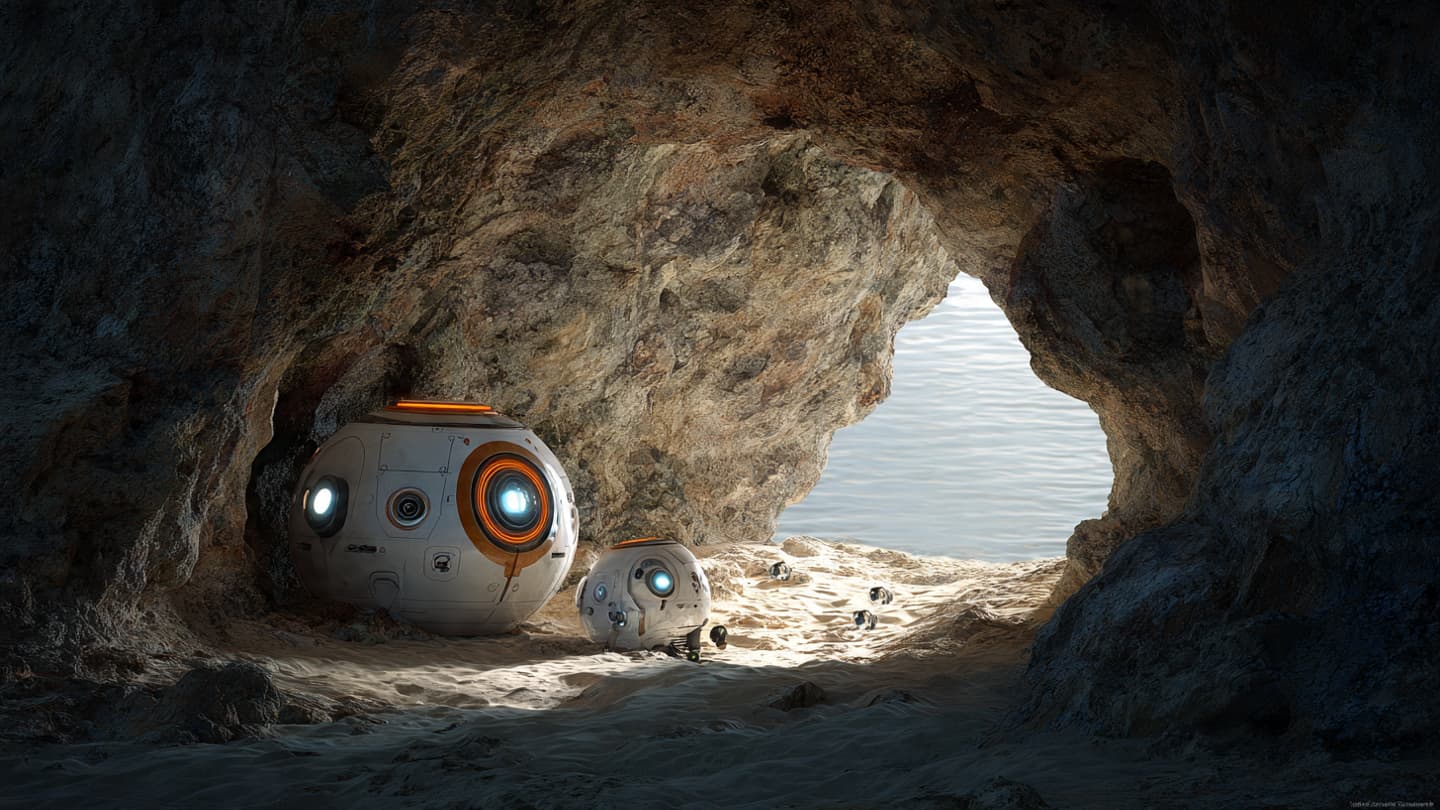
The proposed robot reportedly resembles a rolling spherical device able to bounce or tumble across uneven terrain. Once near a cave or tunnel entrance, it could deploy lightweight drone-like sensors designed to drift or navigate through narrow underground passages. The “dandelion” comparison comes from the small, floating design of the individual devices.
Engineers note that underground exploration on Mars presents major technical challenges. Communication signals weaken beneath rock layers, visibility is limited, and terrain can be unpredictable. Swarm-based drone systems may help researchers map tunnels more effectively while reducing the risk of losing an entire mission if one unit fails.
The concept also reflects a broader shift in space robotics toward distributed exploration systems. Rather than relying solely on one large rover, future missions may involve networks of smaller specialized machines working together. Similar ideas are being tested for lunar exploration and disaster-response environments on Earth.
Planetary scientists are especially interested in lava tubes because they could someday support human exploration. Underground habitats might provide natural protection from radiation and meteorite impacts, making them potential shelter sites for future astronauts. Before that becomes possible, however, researchers must first understand the structure and stability of these hidden environments.
For now, the project remains in the experimental and developmental stage. Yet the vision of rolling robots releasing drifting drones across the Martian underground captures something enduring about exploration itself: every frontier eventually leads not only outward across landscapes, but downward into unseen spaces still waiting quietly beneath the surface.
AI Image Disclaimer: Some futuristic Mars exploration visuals used with this article were generated using AI-assisted scientific illustration tools.
Sources: NASA, Reuters, Space.com, IEEE Spectrum, New Scientist
Published by Banx Network. This article is part of the Banx decentralized media programme, powered by the BXE token on the XRP Ledger.