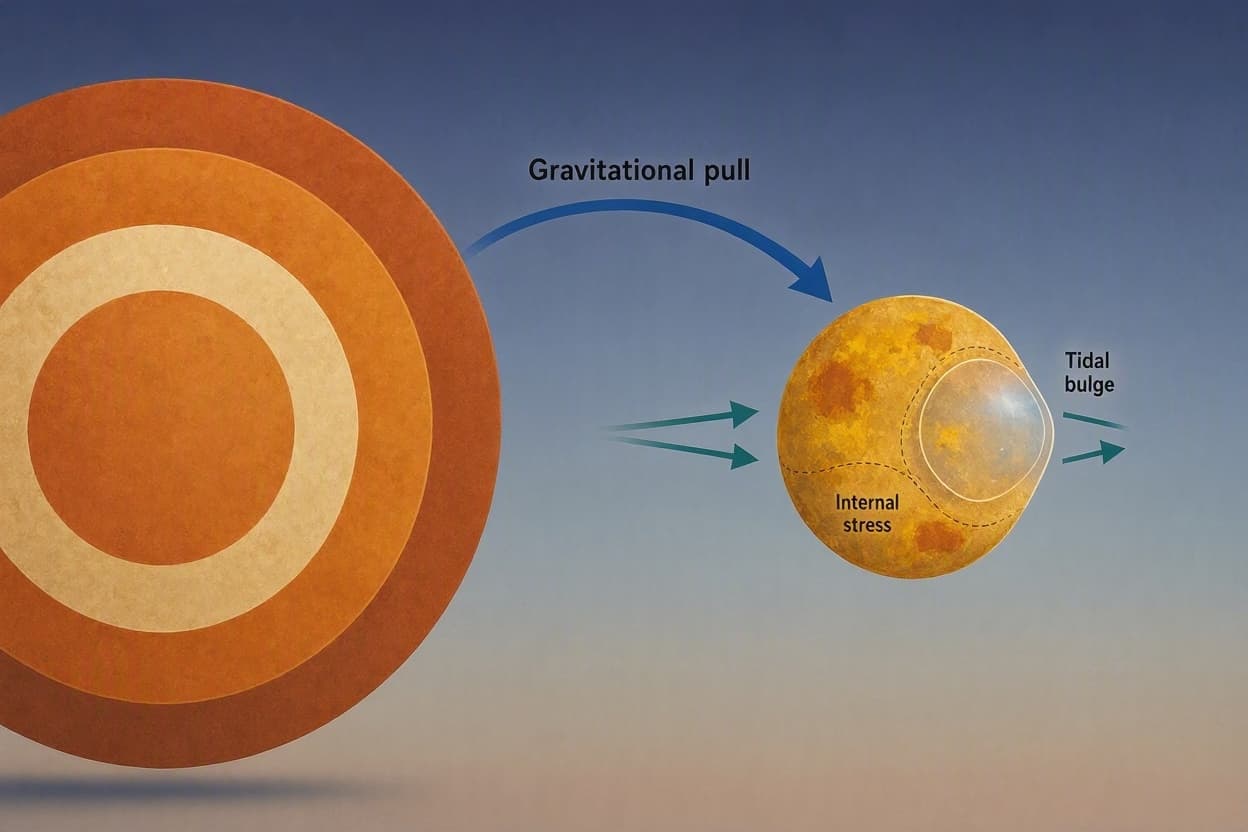
In the dynamic dance of the Solar System, few relationships are as violent and vibrant as that between Jupiter and its moon Io. Orbiting close to the gas giant, Io is subjected to immense gravitational forces that stretch and squeeze its solid body. This tidal flexing causes the moon’s crust to rise and fall by up to 100 meters with every orbit, a deformation equivalent to the height of a 30-story building. This relentless mechanical stress generates intense heat, driving Io’s status as the most volcanically active world in our celestial neighborhood.
Unlike Earth, where tides affect primarily the oceans, Io experiences tides in its very rock. Jupiter’s massive gravity, combined with the gravitational pull of neighboring moons Europa and Ganymede, creates an orbital resonance that keeps Io’s path slightly elliptical. As Io moves closer to and farther from Jupiter, the gravitational force varies, causing the moon to bulge and relax repeatedly. This friction generates internal heat, melting rock into magma and fueling hundreds of volcanoes.
The surface of Io is a chaotic landscape of lava flows, sulfur deposits, and volcanic plumes. It is constantly being resurfaced, erasing impact craters and creating new terrain. This geological activity makes Io a unique laboratory for studying volcanism and planetary interiors. Scientists observe eruptions that dwarf anything seen on Earth, with plumes reaching hundreds of kilometers into space. It is a world in constant flux, shaped by external forces rather than internal decay.
The discovery of Io’s tidal heating revolutionized our understanding of planetary science. Before the Voyager missions, scientists did not expect such activity on a small moon. The realization that gravitational interactions could generate enough heat to melt rock expanded the possibilities for habitability elsewhere in the universe. It suggested that moons around gas giants, previously considered frozen and dead, might harbor subsurface oceans and energy sources.
For astronomers, Io is a key piece in the puzzle of the Jovian system. Its interaction with Jupiter’s magnetic field creates powerful electrical currents and auroras. Studying these phenomena helps researchers understand the complex dynamics of planetary magnetospheres. Io’s volcanoes also supply material to Jupiter’s rings and atmosphere, linking the moon’s geology to the planet’s broader environment. It is a system where everything is connected.
The visual spectacle of Io is unmatched. Images from spacecraft show colorful patches of sulfur and bright lava lakes glowing against the dark sky. These visuals capture the raw power of nature, reminding us of the forces that shape worlds. For the public, Io represents the exotic and extreme, a place where the rules of Earth do not apply. It inspires curiosity about the diversity of planetary bodies.
As we plan future missions to the Jovian system, such as the JUICE mission by ESA and Europa Clipper by NASA, Io remains a priority. Understanding its volcanic activity and internal structure is crucial for modeling the evolution of icy moons and gas giants. Data from these missions will refine our theories of tidal heating and planetary formation, offering deeper insights into how solar systems work.
In the end, Io is a testament to the power of gravity. It shows that even without a sun’s direct heat, a world can be alive with energy. The 100-meter tide in rock is a symbol of the dynamic forces at play in the cosmos. For scientists and dreamers alike, Io is a reminder that the universe is far more active and surprising than we ever imagined. It is a world of fire and stone, dancing to the tune of Jupiter.
AI Image Disclaimer: Images accompanying this report are AI-generated artistic interpretations of volcanic landscapes and tidal forces, intended to visualize the context of Io’s geology without depicting real proprietary spacecraft images or specific eruption data.
Sources: NASA, ESA, Nature Astronomy, Space.com
Published by Banx Network. This article is part of the Banx decentralized media programme, powered by the BXE token on the XRP Ledger.