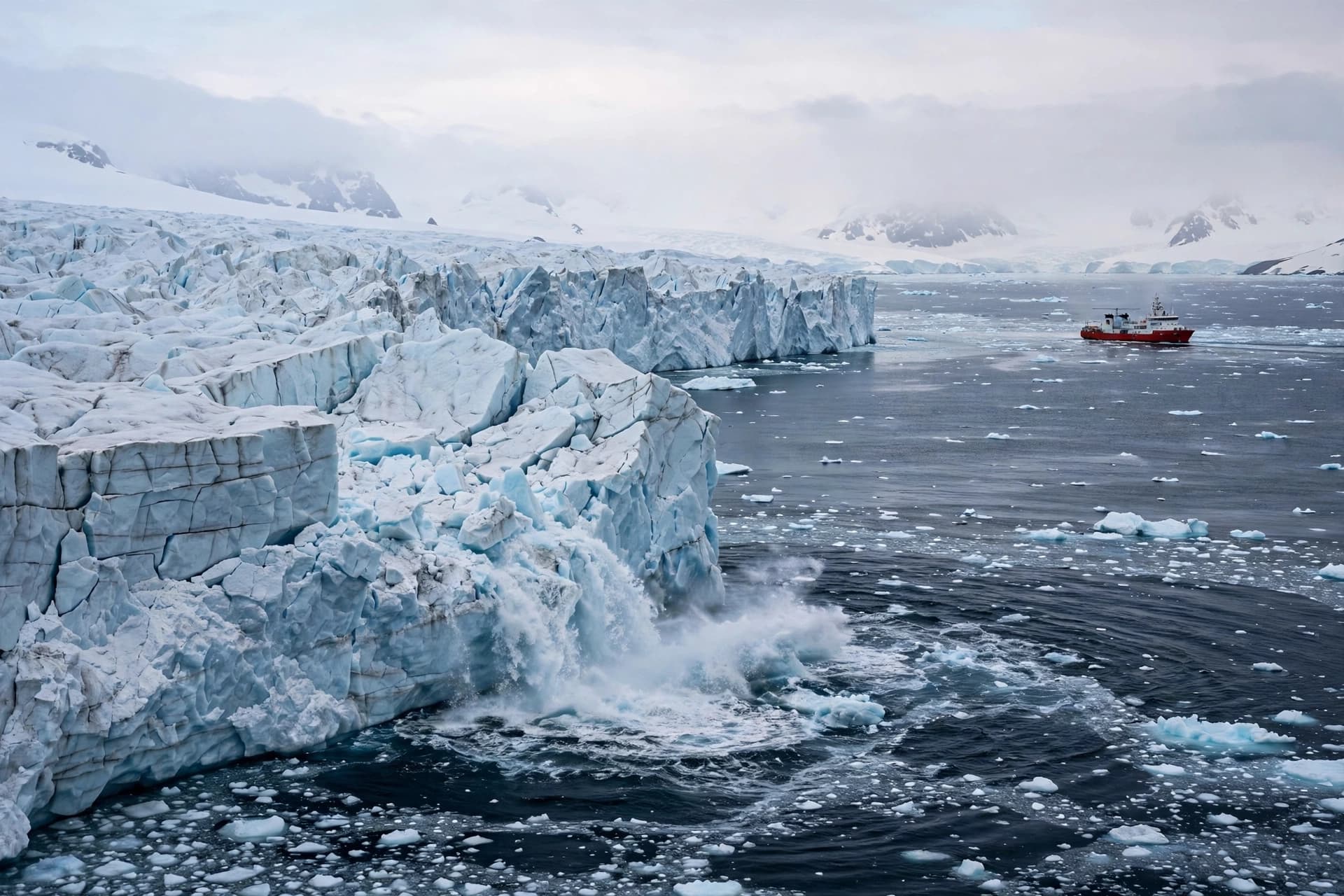
There is a particular unease that settles over the study of ice, a sense that what is happening at the bottom of the world is both distant and inevitable, a process that unfolds on a timescale we can measure but cannot feel. Thwaites Glacier, nicknamed the Doomsday Glacier for the consequences its collapse would unleash, has been retreating for decades. But new research suggests the mechanism of its melting has been underestimated in a way that changes the arithmetic of sea-level rise.
The study, published in Nature Communications, found that warm ocean water is pushing several kilometers beneath the glacier's grounding zone—the boundary where ice lifts off bedrock and begins to float—and melting it from below. Previous models treated that boundary as relatively fixed. The new work describes a broader "grounding zone" where tides repeatedly lift and lower the ice, a process lead author Mattia Poinelli of UCLA calls "tidal pumping." This pumping allows warm seawater to reach deep beneath the ice and cause vigorous melting .
The consequence is a revised projection. Thwaites could contribute up to 30 millimeters, or about 1.2 inches, to global sea-level rise by 2100—roughly double the 15 millimeters estimated by conventional models. That figure holds even without additional warming beyond recent conditions . The glacier currently accounts for about four percent of global sea-level rise and has lost more than a trillion tons of ice since 2000, continuing at roughly 50 billion tons annually .
There is a structural vulnerability that the research brings into sharper focus. Thwaites is currently restrained by an underwater formation called the Mouginot Ridge. The study's simulations, consistent with recent observations, indicated a roughly 60 percent chance that the glacier could detach from this ridge by 2100, potentially as early as the late 2030s. Such a detachment would accelerate its retreat and expose coastal communities to greater flooding risks than previously projected .
Thwaites is not merely a large glacier. It is a keystone. Together with Pine Island Glacier and others, it acts as a barrier holding back the vast West Antarctic Ice Sheet. The glacier spans roughly 192,000 square kilometers, an area larger than Florida. Its full collapse would raise seas by more than two feet, but its role as a structural support for the larger ice sheet means the consequences of its weakening extend far beyond its own mass .
The research does not predict imminent catastrophe. The timescales remain decades, and the models carry the uncertainties inherent to ice-sheet science. But the direction of the finding is clear: the mechanism of melting is more aggressive than the standard framework assumed. The ocean is not merely lapping at the edges of the glacier. It is reaching underneath, into the places where the ice meets the rock, and working there.
For now, the glacier continues its slow retreat. Scientists are planning an expedition to the grounding line in 2028 to install instruments capable of recording the precise flow of seawater. The data will refine the models, but it will not change the physical reality the models describe. The Doomsday Glacier is melting faster than we thought, and the clock it keeps is not the one we set our lives by.
---
AI Image Disclaimer: The imagery in this article is generated by artificial intelligence and is intended for illustrative purposes only.
Sources: Nature Communications, Anadolu Agency, Al Jazeera, Times Now World
Published by Banx Network. This article is part of the Banx decentralized media programme, powered by the BXE token on the XRP Ledger.