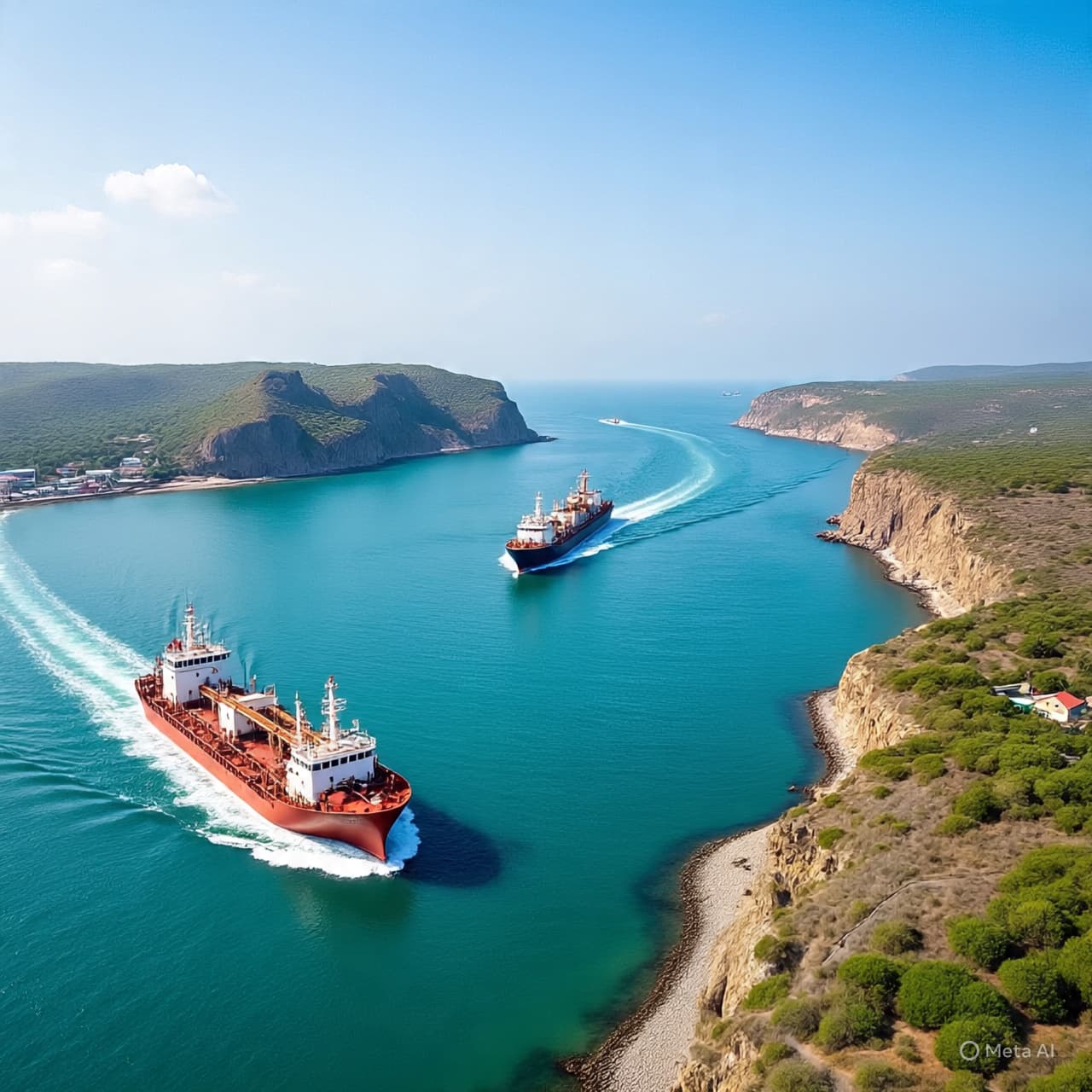
There are waterways in the world that feel less like geography and more like lifelines—narrow passages through which the rhythms of global trade quietly pass each day. The Strait of Hormuz is one such place, where distance compresses and movement becomes deliberate, each vessel tracing a path that carries significance far beyond its own journey.
In recent developments, attention has turned once again to how ships are navigating this critical corridor. Reports indicate that vessels exiting the Persian Gulf have been increasingly routed through lanes that fall within or near Iranian-controlled waters, a pattern that has drawn both observation and quiet concern among maritime and geopolitical analysts.
The shift is not abrupt, nor is it without precedent. The Strait of Hormuz has long operated under carefully defined traffic separation schemes, designed to ensure the safe and orderly movement of ships through one of the world’s busiest energy chokepoints. Yet within this structured system, subtle adjustments can carry meaning—particularly when they intersect with regional tensions.
For ship operators, the decision of which route to take is shaped by a combination of safety, regulation, and risk assessment. Navigating closer to Iranian territorial waters may, in some cases, align with established maritime lanes. At the same time, it can also reflect an evolving calculation, influenced by recent incidents, security advisories, or the broader geopolitical climate.
Energy markets watch these developments closely. A significant portion of the world’s oil and liquefied natural gas passes through the Strait, making any perceived shift in shipping patterns a matter of global interest. Even minor disruptions—or the suggestion of increased risk—can ripple outward, affecting prices, insurance costs, and logistical planning.
Diplomatically, the situation unfolds with measured language. Regional actors and international stakeholders continue to emphasize the importance of freedom of navigation and the stability of maritime routes. At the same time, there is an understanding that the Gulf remains a space where political dynamics and commercial activity intersect in complex ways.
The phrase “Iranian corridor,” as it has been described in some reporting, does not necessarily imply a formal or newly established route. Rather, it reflects a recognition of proximity—of how existing shipping lanes relate to national boundaries within a confined maritime space. In such an environment, even routine movements can acquire added layers of interpretation.
For crews aboard these vessels, the experience is often more immediate than abstract. Navigation through the Strait requires constant attention, coordination, and adherence to international maritime protocols. The broader geopolitical context may shape the journey, but the day-to-day reality remains focused on safe passage.
Observers also note that the current patterns may evolve. Shipping routes are inherently adaptive, responding to changes in security conditions, regulatory guidance, and operational needs. What appears as a trend today may adjust tomorrow, shaped by factors both visible and unseen.
Still, the renewed focus on the Strait of Hormuz serves as a reminder of its enduring importance. It is a place where global dependence on energy converges with regional complexities, where each passing ship becomes part of a larger narrative about connection, vulnerability, and resilience.
As monitoring continues, industry groups and international bodies are likely to maintain close oversight of traffic patterns and security developments. For now, vessels continue their passage—entering and exiting the Gulf with the same steady purpose, even as the context around them quietly shifts.
In the days ahead, further updates from maritime authorities and analysts may offer additional clarity. Until then, the flow of ships remains uninterrupted, moving through one of the world’s most closely watched waterways.
AI Image Disclaimer Illustrations were produced with AI and serve as conceptual depictions.
Source Check Credible sources covering this topic include:
Reuters Bloomberg Financial Times Lloyd’s List Al Jazeera
Published by Banx Network. This article is part of the Banx decentralized media programme, powered by the BXE token on the XRP Ledger.