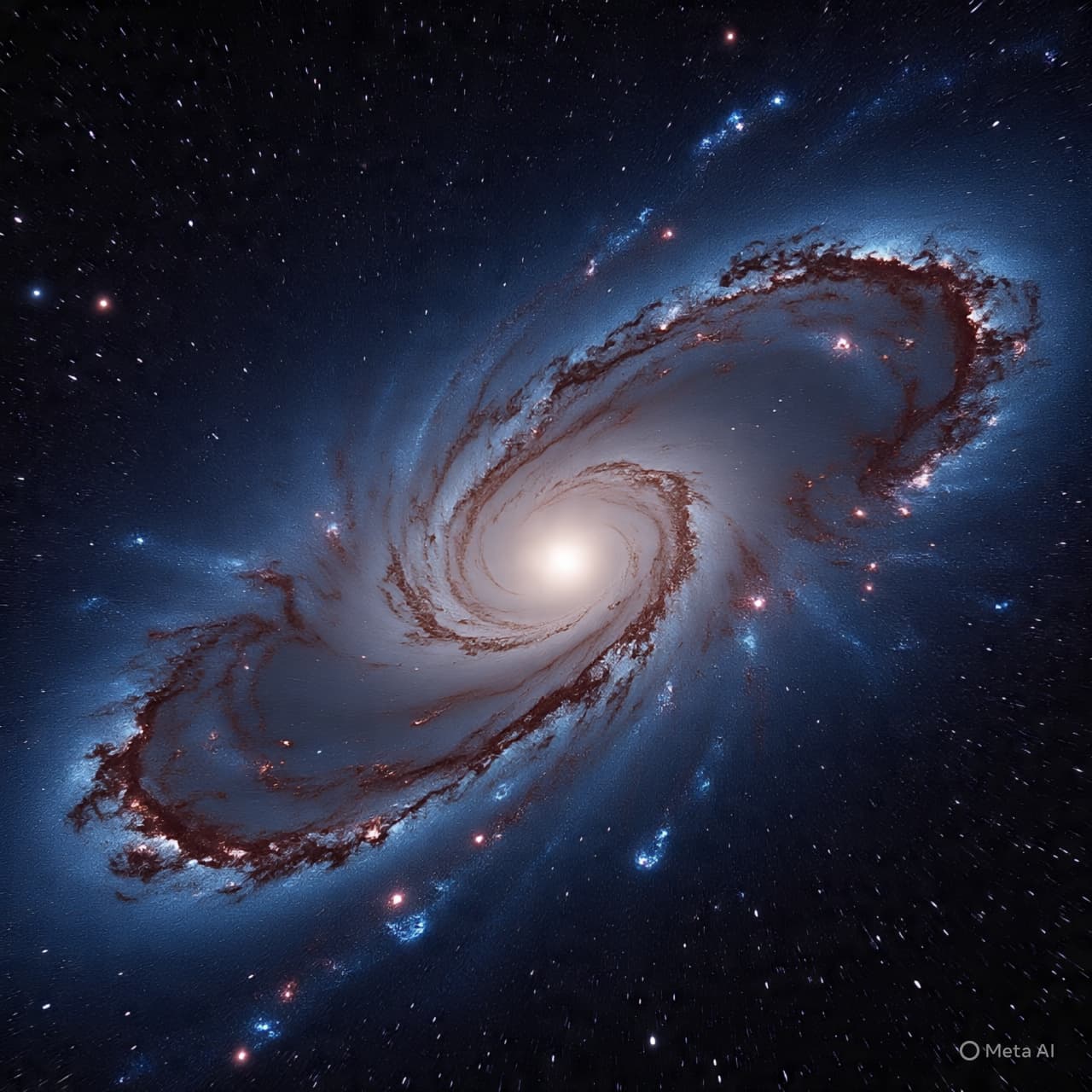
Far beyond the familiar pinprick of night, galaxies swirl in quiet, majestic motion, their stars and dust clouds tracing the slow arcs of cosmic time. NASA’s James Webb Space Telescope has now turned its gaze toward one such system: the Circinus Galaxy, a spiral tucked near the edge of our cosmic neighborhood. The telescope’s instruments have penetrated the dense gas and dust at its center, revealing structures and activity invisible to previous observatories.
The Circinus Galaxy is notable not only for its proximity — relatively speaking, in astronomical terms — but for its active galactic nucleus, where a supermassive black hole interacts with surrounding gas and dust. Webb’s infrared capabilities allow scientists to pierce the obscuring material, capturing light that has long been hidden. These observations provide insights into star formation, accretion processes, and the interplay between galactic cores and their wider environments.
Infrared imaging reveals a network of filaments and heated gas clouds, some shaped by powerful winds from the galaxy’s center, others illuminated by nascent stars. The level of detail offers an unprecedented look at both structure and motion, showing how energy from the central black hole may regulate the birth of new stars and the evolution of the galactic disk.
The data collected by Webb is not only visually striking but scientifically transformative. Researchers can now model the dynamics of Circinus with greater fidelity, refine estimates of black hole mass, and examine how active galactic nuclei influence their surroundings over time. Each observation adds a layer to humanity’s understanding of the mechanisms shaping galaxies across the universe.
In clear terms, the James Webb Space Telescope has captured detailed infrared images of the Circinus Galaxy, allowing astronomers to study its central regions obscured by dust. The observations shed light on star formation, the behavior of gas around the central black hole, and the complex structures within the galaxy’s core.
AI Image Disclaimer Visuals are AI-generated and serve as conceptual representations.
Sources (names only) NASA Space.com The Verge Science News Astronomy Magazine
Published by Banx Network. This article is part of the Banx decentralized media programme, powered by the BXE token on the XRP Ledger.