In laboratories where microscopes illuminate the smallest textures of life, there are moments when biology begins to resemble weaving. Threads appear where none were expected, delicate strands forming structures that quietly organize the microscopic world.
Researchers studying bacterial spores have recently described such a phenomenon: fibers known as sporesilk, which can spontaneously crosslink and draw together two important components of certain bacteria—endospores and Cry toxins. The discovery offers a new glimpse into how microbial systems assemble themselves with minimal external guidance.
Endospores are among nature’s most resilient biological forms. Produced by bacteria such as Bacillus species, they allow organisms to survive harsh conditions by entering a dormant, highly protected state. Cry toxins, meanwhile, are crystalline proteins produced by Bacillus thuringiensis, widely known for their role in biological pest control.
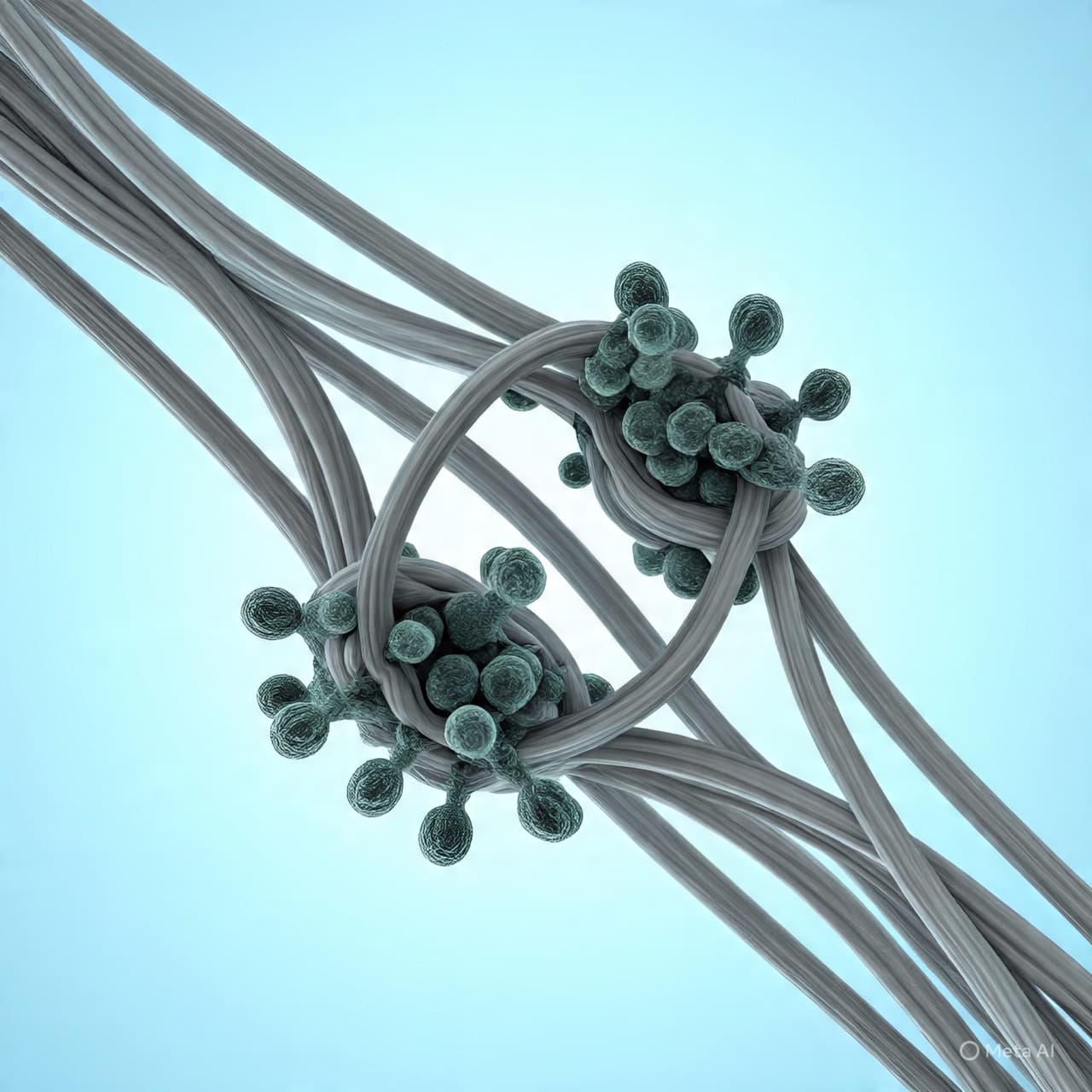
The new research describes how sporesilk fibers—protein-based filaments associated with bacterial spores—can undergo auto-crosslinking, meaning the fibers chemically bind to one another without requiring additional enzymes or catalysts. As these fibers link together, they form a mesh-like network that gathers spores and toxin crystals into clusters.
Viewed through advanced microscopy, the arrangement resembles a delicate scaffold. The fibers stretch outward and connect, and the surrounding spores and Cry toxin particles gradually accumulate within this growing framework. What begins as scattered microscopic components slowly becomes a compact assembly.
Such clustering may carry practical advantages for the bacteria themselves. When Cry toxin crystals remain near spores, the pairing could enhance the efficiency with which these toxins are delivered in natural environments, particularly during interactions with insect hosts. In ecological terms, the arrangement may help ensure that spores and toxins travel together through soil, water, or the digestive systems of insects.
The auto-crosslinking property of sporesilk fibers also suggests an elegant simplicity. Instead of relying on complex biochemical pathways to construct larger structures, the system uses the inherent chemistry of the fiber proteins themselves. Once produced, the fibers naturally bind and organize nearby materials, forming stable clusters through self-assembly.
Researchers note that this mechanism may also hold promise beyond microbial ecology. Because sporesilk fibers are robust and capable of self-crosslinking, they could potentially inspire new biomaterials designed to capture or organize microscopic particles. In biotechnology, such materials might one day help package proteins, stabilize enzymes, or create targeted delivery systems.
For now, the discovery adds another quiet layer to our understanding of bacterial architecture. Even among organisms measured in microns, structure emerges through small acts of chemistry—fibers meeting fibers, particles gathering around them, and the invisible threads of biology weaving systems that persist in environments both hostile and ordinary.
The study reports that auto-crosslinking sporesilk fibers promote the clustering of endospores and Cry toxin crystals, forming stable microbial assemblies that may influence both bacterial survival and toxin delivery.
AI Image Disclaimer
Visuals are AI-generated and serve as conceptual representations of the scientific findings.
Source Check
Credible coverage and/or primary reporting exist from: Nature Communications Nature Microbiology ScienceDaily Phys.org Microbiology Society
Published by Banx Network. This article is part of the Banx decentralized media programme, powered by the BXE token on the XRP Ledger.