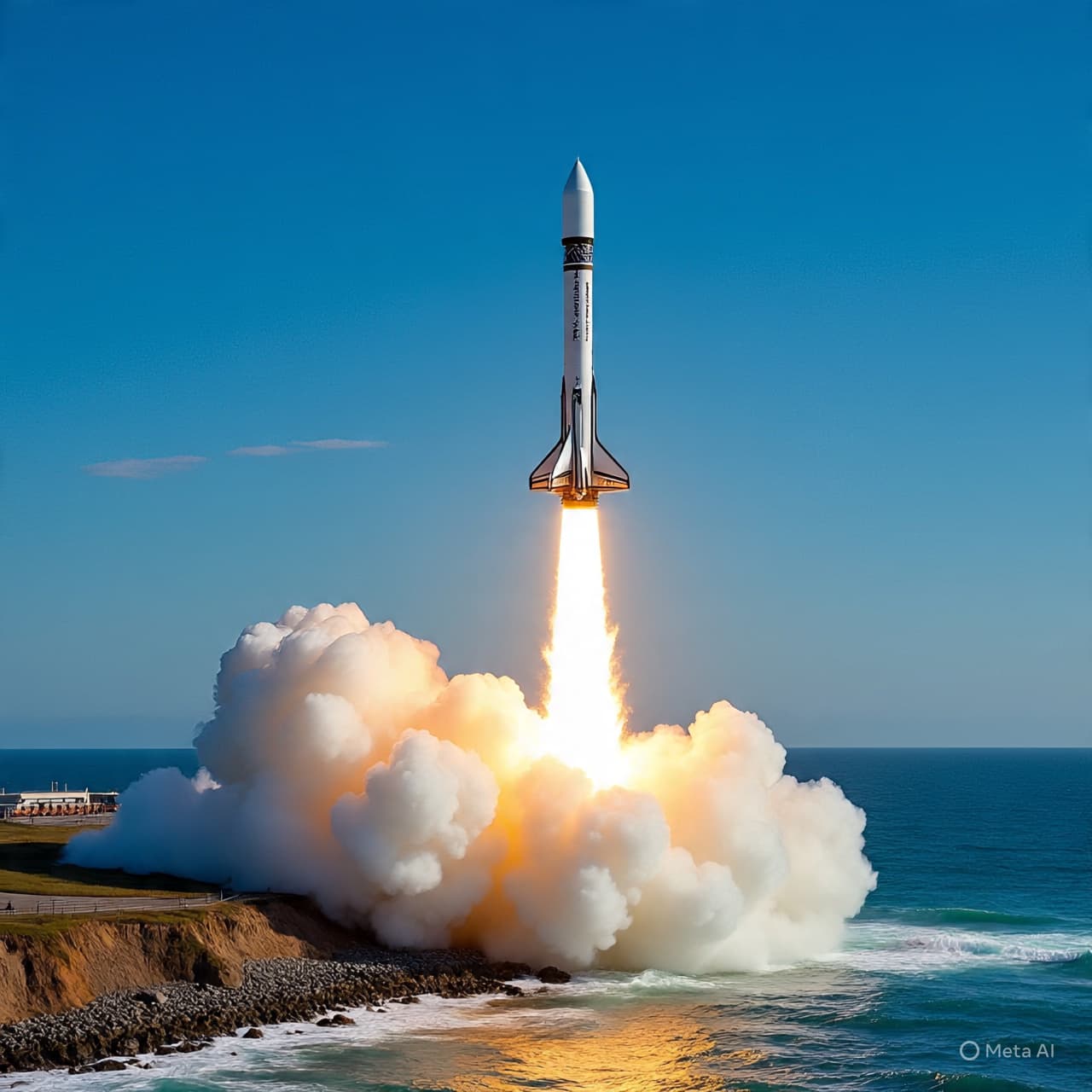
There was a time when rockets were like shooting stars — brilliant, brief, and gone forever. They blazed upward, fulfilled their mission, and vanished into oceans or silence. Today, some return like seasoned mariners, bearing the marks of many journeys yet ready to sail again. In that quiet evolution, repetition has become its own kind of revolution. This week, sent its most-flown Falcon 9 first-stage booster skyward for a record 33rd mission, setting a new benchmark in orbital reusability. The veteran booster, already familiar with the arc of ascent and the choreography of landing, carried another batch of Starlink satellites into low Earth orbit before guiding itself back for a controlled touchdown.
Thirty-three flights would have once seemed improbable, if not impossible. Traditional rockets were expendable by design — engineered for a single, precise burst of performance. Falcon 9 altered that equation. With landing legs deployed and grid fins steering through reentry, its first stage returns from space, often to a droneship stationed offshore. Each recovery marks not only a technical achievement but a recalibration of how access to orbit can be managed.
The booster’s long service record speaks to a system refined through iteration. After each mission, teams inspect engines, structures, avionics, and heat protection systems. Data gathered from previous flights informs adjustments and builds confidence. Reusability is not merely about endurance; it is about understanding — about learning how materials respond to stress, how systems age, and how reliability can be sustained across repeated launches.
This latest mission adds another layer to the expanding Starlink constellation, designed to deliver broadband connectivity across the globe. Launch cadence has become a defining feature of SpaceX operations, with frequent missions supporting both commercial payloads and internal satellite deployments. A booster reaching its 33rd flight underscores how routine refurbishment and streamlined processes have become integral to that rhythm.
Beyond the numbers lies a broader shift in spaceflight philosophy. Cost efficiency, once constrained by hardware that could not return, now benefits from components that fly again and again. Competitors and partners across the industry are studying similar models, recognizing that sustainable exploration may depend as much on reuse as on raw power.
Video of the launch captures a familiar yet still arresting sequence: engines igniting in a synchronized flare, the vehicle rising against the sky, stage separation unfolding with precision, and the booster descending under controlled thrust before landing upright. The imagery feels almost cyclical — ascent, return, readiness once more.
SpaceX confirmed the successful deployment of the satellites and the safe landing of the booster following its record-setting 33rd flight. The company continues preparations for upcoming launches as it advances both commercial missions and its broader ambitions. For now, the milestone stands as a testament to how persistence, engineering discipline, and incremental progress have reshaped the expectations of modern rocketry.
AI Image Disclaimer Visuals are created with AI tools and are not real photographs.
Sources
Space.com
Reuters
The Associated Press
Ars Technica
CNBC
Published by Banx Network. This article is part of the Banx decentralized media programme, powered by the BXE token on the XRP Ledger.