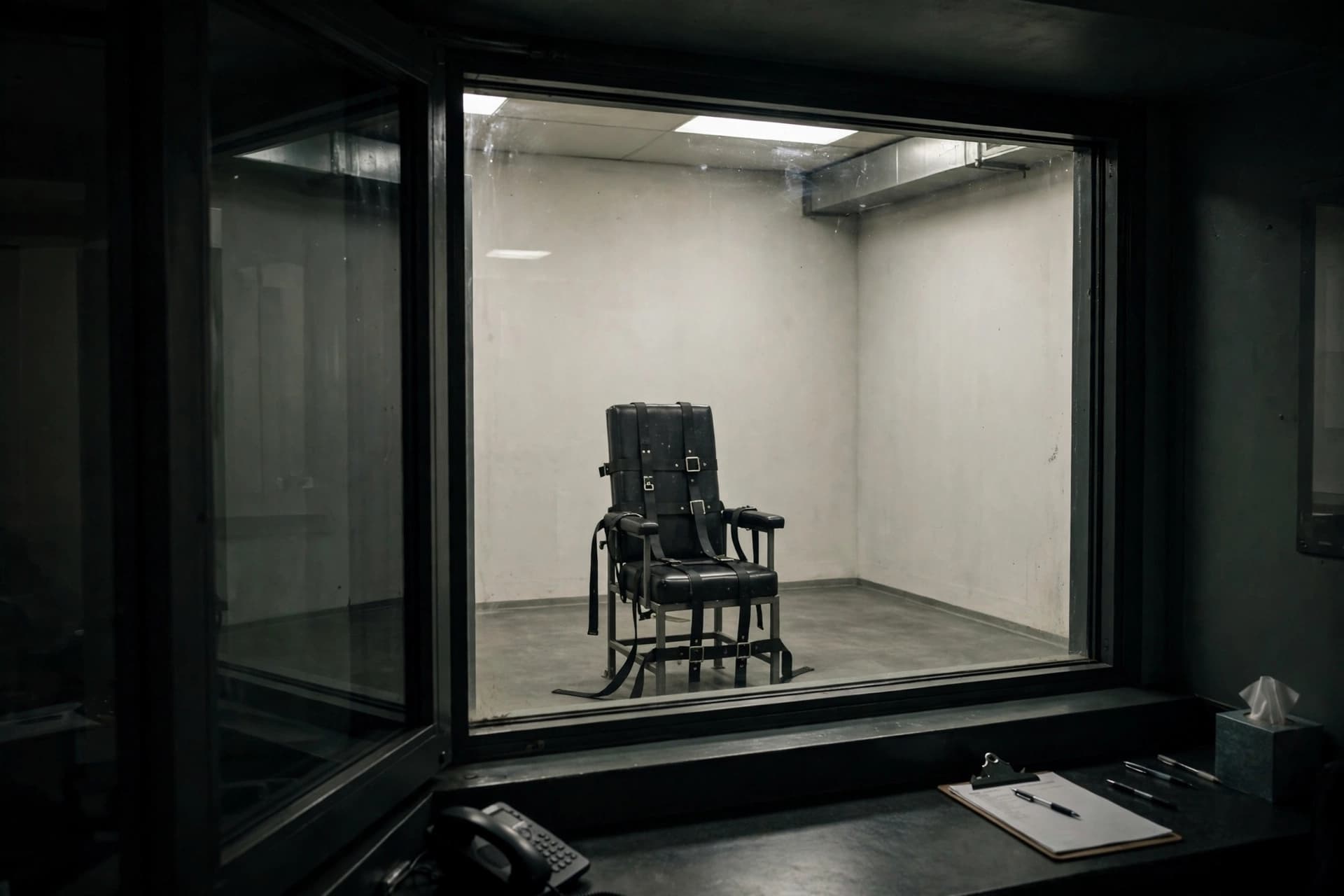
There is a particular distance that institutions create between the act of killing and the eyes that witness it—a distance measured in protocol, in procedure, in the quiet rooms where the state does its most irreversible work. When that distance was briefly threatened by a plan to broadcast an execution to the world, the recoil was immediate and unusually broad. What the episode revealed was not a debate about one prisoner's guilt, but a question about what a nation is willing to watch itself do.
The execution of Nidal Hasan, convicted of killing 13 people at Fort Hood in 2009, is scheduled for December 3 by military firing squad . Defense Secretary Pete Hegseth announced that the proceeding would be livestreamed, a plan that President Trump initially supported . Within days, the backlash had come from an extraordinary coalition: Democratic and Republican lawmakers, dozens of retired generals and admirals, the United Nations, the Catholic Church, and Vice President JD Vance, who said he would not watch . Trump cancelled the livestream on Thursday, writing that while streaming "might have been a strong deterrent," many "very good and well meaning people would rather not watch him die" .
The reasons for the reversal are layered. A Washington Post-ABC News-Ipsos poll found that eight in ten Americans opposed the livestream . Retired military officers warned in an open letter that broadcasting the execution would "taint the honor of the military" and "ensure that Hasan becomes a martyr" . House Speaker Mike Johnson, a top Republican ally of the president, said it could be a "recruiting tool for future terrorists" . The objections were not about sparing Hasan his sentence—the execution will proceed—but about the spectacle of the state displaying its power in a form that resembled entertainment.
Dr. Asim Qureshi, director of CAGE International, who has spent years navigating the legal mechanics of America's death row, offered an analysis that went deeper than the procedural debate. In remarks published after the cancellation, he argued that the livestream was abandoned not because the administration developed a conscience, but because it recognized that broadcasting the killing would invite the public to ask questions the state could not control . A livestream would force viewers to confront the circumstances that led Hasan to his crime—his stated motives rooted in American foreign policy—and that, Qureshi suggested, is a conversation the administration did not want to host .
There is also the matter of what the proposal has already accomplished, even in cancellation. By floating the idea of a televised execution, the state expanded the boundaries of what can be considered. The Overton window of acceptable violence shifted, however slightly, and a future livestreamed execution became more imaginable than it was before . The cancellation prevented the spectacle, but it did not undo the precedent of having considered it.
Hasan's lawyer, John Galligan, told the BBC that the cancellation "comes as no surprise," calling the original plan "a dumb decision" that violated Army regulations . He noted that Hasan is paralyzed from the chest down, a fact Trump allegedly did not know when he approved the plan, and said the episode would "permanently remain a stain on our military justice system" . The execution date remains December 3, and the families of victims will be allowed to witness in person .
What lingers is the question Qureshi raised: whether the cancellation was a victory for human dignity or a tactical retreat by an administration that tested the public's appetite for spectacle and found it wanting. The execution will still happen. The state will still kill. The only thing that changed is who is allowed to watch. And that, perhaps, is the most uncomfortable truth of all: the distance between justice and theater is sometimes measured only by the presence of a camera.
AI Image Disclaimer: This article includes AI-generated imagery created for illustrative purposes only.
Sources: CNN, BBC, Reuters (via Calgary Sun and The News), The New Arab, Yahoo News NZ, Express Tribune
Published by Banx Network. This article is part of the Banx decentralized media programme, powered by the BXE token on the XRP Ledger.