The space race of the 1960s was a era of bold ambitions and boundless imagination. While the moon captured the world’s attention, NASA harbored another audacious dream: sending astronauts to Venus. This forgotten mission, known as the Manned Venus Flyby, was a serious proposal that aimed to launch three astronauts on a year-long journey past Earth’s nearest neighbor. Although it never left the drawing board, the plan remains a fascinating chapter in space history, inviting reflection on what might have been. It is a story of human curiosity reaching for the stars, even when the destination was shrouded in clouds.
The proposed mission, studied between 1967 and 1968, utilized Apollo-derived spacecraft and a Saturn V rocket. The plan involved a flyby of Venus, using the planet’s gravity to slingshot the crew back to Earth. This trajectory would have minimized fuel requirements while maximizing scientific return. For a brief moment, it seemed like a viable next step after the lunar landings, showcasing the versatility of Apollo technology.
However, the harsh reality of Venus soon tempered enthusiasm. With surface temperatures hot enough to melt lead and an atmosphere crushingly dense, the planet posed significant challenges. Unlike the moon, Venus offered no safe landing site for humans with the technology of the time. The focus shifted to robotic probes, which could withstand the extreme conditions and send back valuable data without risking human lives.
Despite its cancellation, the Manned Venus Flyby left a legacy of innovation. The studies conducted during this period contributed to our understanding of orbital mechanics and long-duration spaceflight. They highlighted the complexities of interplanetary travel, from radiation protection to life support systems. These lessons paved the way for future missions to Mars and beyond.
Today, as NASA plans new missions to Venus, such as DAVINCI and VERITAS, the spirit of that old proposal lives on. Modern technology allows for more sophisticated exploration, seeking to uncover the secrets of Venus’s past habitability. The question of whether Venus once hosted oceans remains a driving force for scientists, linking past ambitions with present-day inquiry.
For space enthusiasts, the forgotten mission serves as a reminder of the risks and rewards of exploration. It shows that even unrealized dreams can contribute to progress. The vision of humans traveling to Venus may one day become reality, fueled by the groundwork laid decades ago.
NASA’s abandoned plan for a manned Venus flyby remains a intriguing footnote in space history. Though never executed, the mission concept advanced our understanding of interplanetary travel. As new robotic missions explore Venus, the dream of human visitation continues to inspire future generations.
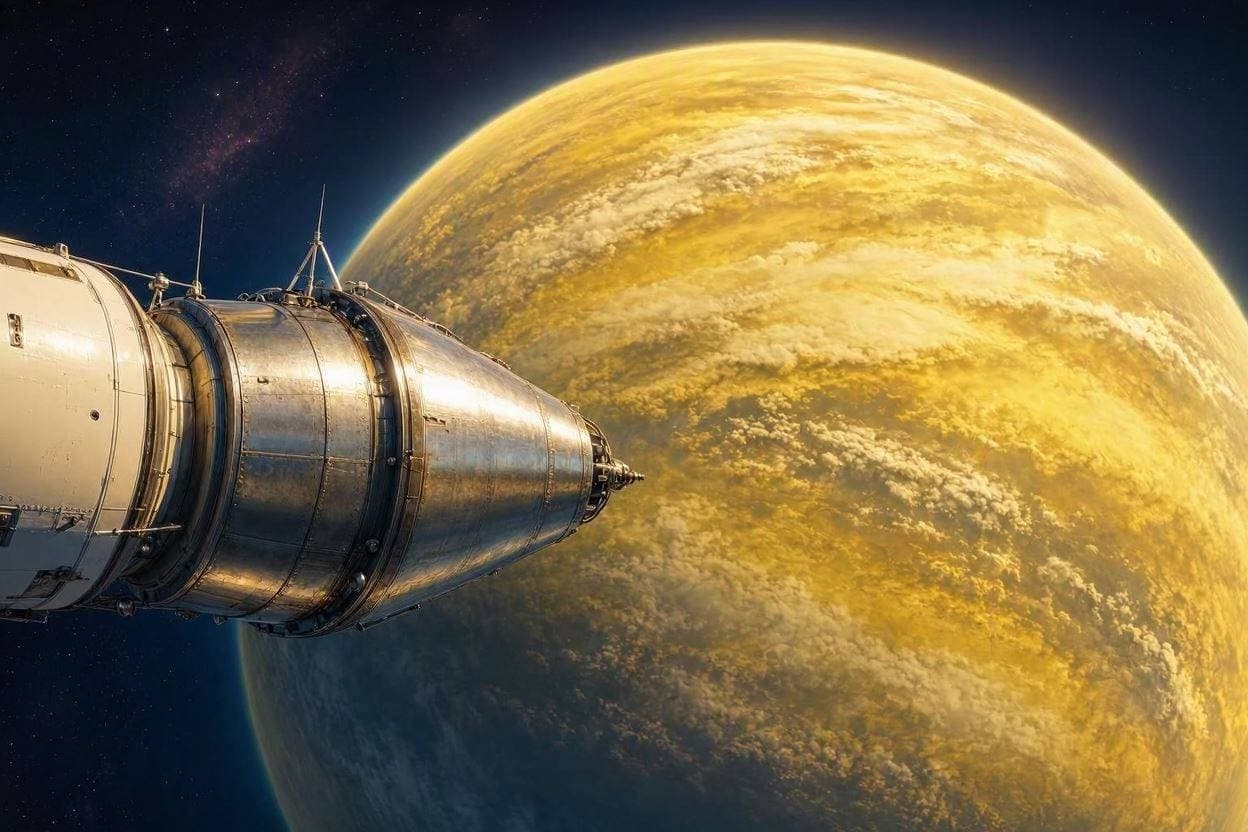
AI Image Disclaimer: The images provided are AI-generated to visually represent the historical and exploratory aspects of the story.
Sources: NASA Medium (The Vintage Space) Space.com
Published by Banx Network. This article is part of the Banx decentralized media programme, powered by the BXE token on the XRP Ledger.