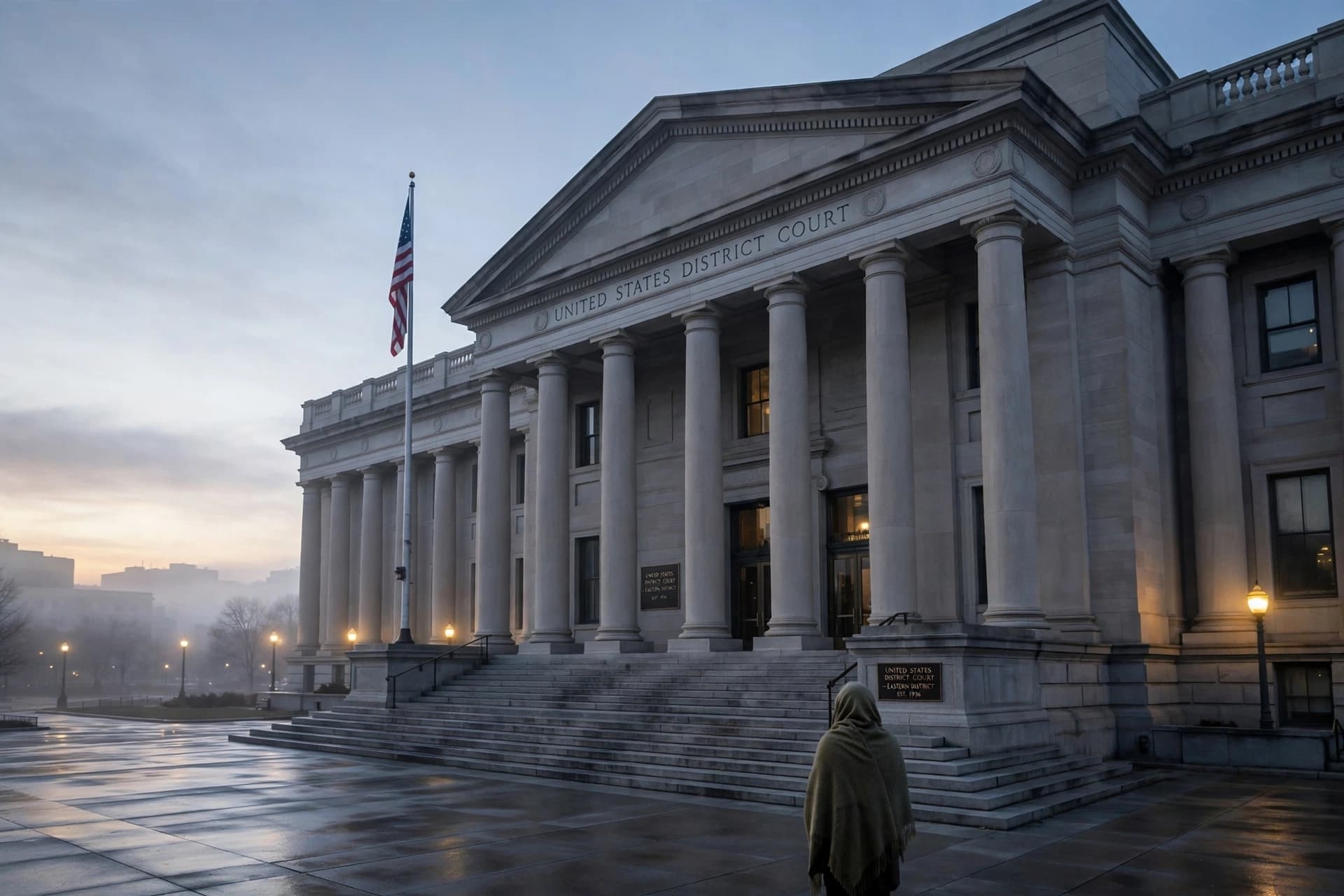
Before dawn on a Monday in Los Angeles, a thirty-year-old woman from India stood outside a federal courthouse wrapped in a tasseled shawl, waiting to turn herself in. She spoke little English. She had two young children at home. By the time the afternoon arrived, she had been fingerprinted and brought before a judge, her name and face now part of a case that carried the weight of a felony and the shadow of deportation.
The woman, Amandeep Kaur, is one of more than 220 people across 28 states charged in connection with voting violations during President Trump's second term, part of a months-long effort by the administration to identify and publicize instances of voter fraud . Many of those charged are legal permanent residents—green card holders who, according to the government, registered or voted unlawfully because they are not U.S. citizens. Election officials in California and elsewhere have criticized the government's identification system as flawed and error-prone, with some citizens caught in its net .
The stories that have emerged from these cases describe a range of experiences, from confusion to fear to a quiet sense of being used. Kaur's husband told The New York Times that his wife began receiving voter information in the mail after taking a driving test at the Department of Motor Vehicles, and that she believed she was eligible. "She was confused," he said. "She said there was no translation there at the voting center" . Omar Muñoz, a 72-year-old from Belize who has lived in California for decades, said federal agents arrived at his home before dawn, threatened to break down the door, and pulled his arms behind his back despite recent surgeries on his shoulder and neck. He was held for roughly ten hours in chains so tight, he said, that he could barely walk .
For Muñoz, the manner of the arrest mattered as much as the allegation. "I understand they have an allegation against me, that's their job, but it's the manner that they did this to me," he told The Guardian. "There were so many officers" . He described seeing news cameras positioned outside his home during the arrest, and later learning that his image had been featured in a Department of Justice promotional video . "The news portrays it as if I'm already guilty," he said .
The legal terrain is complicated. Some of the charges carry maximum sentences of five years in federal prison and can result in deportation. Kaur was charged with making false statements on her naturalization application, a felony that could derail her path to citizenship . Muñoz was charged with fraudulently registering to vote and making false statements. Both have denied the allegations or attributed the errors to confusion rather than intent . The Department of Justice has framed the prosecutions as a necessary response to election integrity concerns.
Election law experts have questioned the strategy. Richard Hasen, a professor at UCLA, told The Times that the cases appeared designed to "support the civil suit, as well as to support Donald Trump's claims of a big problem of noncitizen voters." He added: "My first reaction was: These are the best cases they have?"
The cases continue to move through the courts. For the families involved, the calculus is not abstract. Kaur's husband fears she could be deported, leaving their two children, ages three and five, without their mother . Muñoz, who was in the process of applying for citizenship, now faces a legal battle that could undo decades of belonging. The government's effort is ongoing, and the question of how it will be judged—by courts, by voters, and by history—remains open.
Image Disclaimer: The visuals for this article were generated by artificial intelligence and are not photographs of the individuals or events described.
Sources: Election Law Blog, The New York Times, The Guardian, ABC7 Los Angeles
Published by Banx Network. This article is part of the Banx decentralized media programme, powered by the BXE token on the XRP Ledger.