The question of life on Mars has a way of returning, each time wearing a slightly different face. Once it was canals and ancient civilizations. Then it was microbes in the soil, probed by landers with tiny ovens and labeled release experiments. Now it is water—not the water that once carved valleys and filled lakes billions of years ago, but water that may exist today, hidden deep beneath the surface, in the cracks and pores of rock where the planet's internal heat keeps it liquid. The question is no longer whether Mars was once habitable. It is whether it remains so, in the dark and the deep, and whether we could ever hope to look.
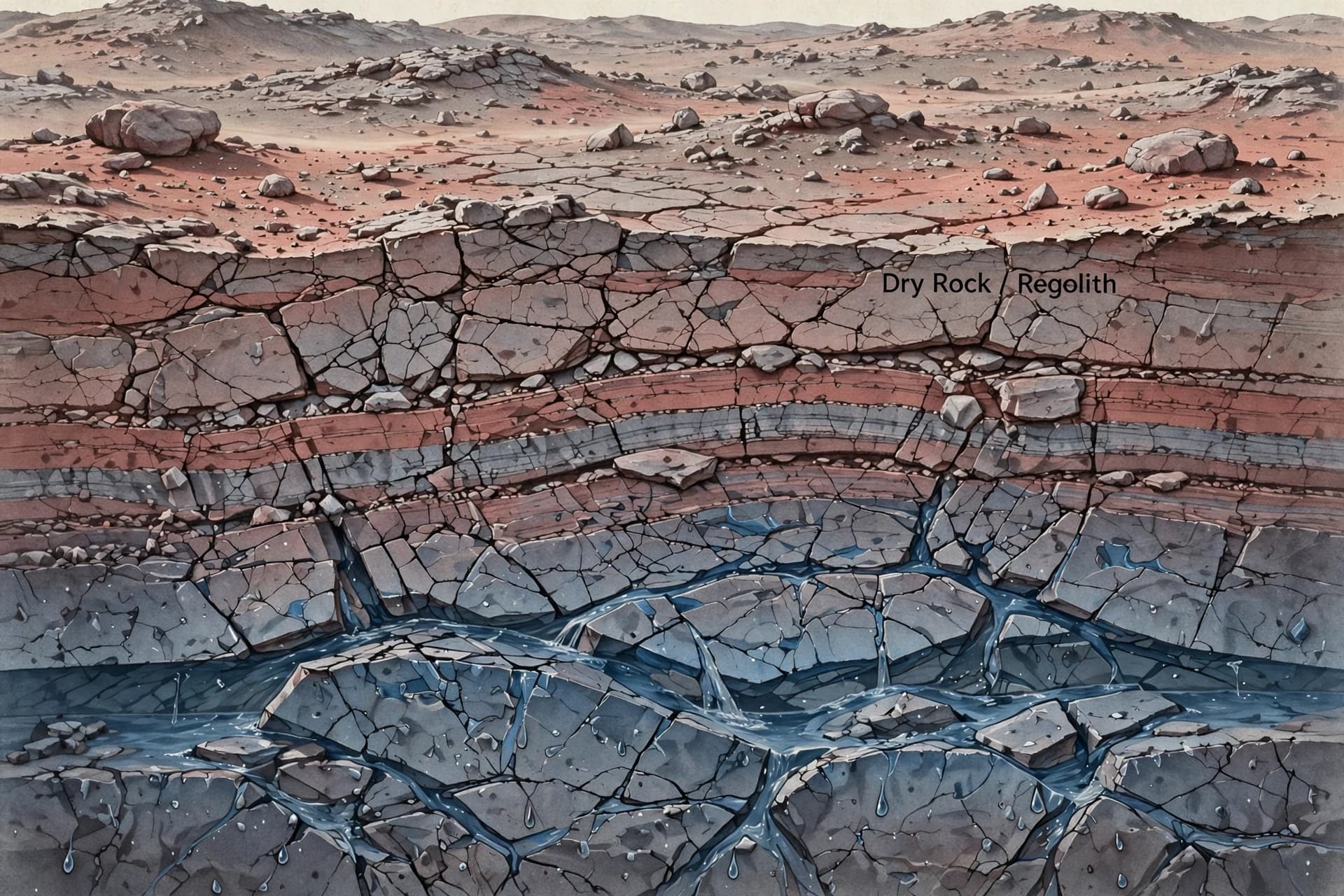
The evidence for present-day liquid water comes largely from NASA's InSight lander, which sat on the Martian surface from 2018 to 2022 and listened to the planet's seismic heartbeat. A seismometer, placed on the ground by the lander's robotic arm, recorded marsquakes and meteorite impacts, and the way those vibrations traveled through the interior revealed boundaries and transitions . In 2024, a team analyzing that data concluded that the Martian crust is essentially dry down to about 5 kilometers, but that between roughly 11.5 and 20 kilometers below the surface, there likely exists a layer of fractured rock saturated with liquid water . A separate line of interpretation, published in 2025, argued that seismic boundaries at 10 and 20 kilometers could represent a transition from dry cracks to water-filled cracks, supported by laboratory measurements of seismic velocities through wet and dry rock .
The depth is the difficulty. The headline question asks about 5 to 10 kilometers, and the science suggests that water may indeed exist in that range or deeper, but the uncertainty is significant. InSight's data point to a moist layer at greater depths than 5 to 10 kilometers, though the exact boundaries depend on models and assumptions about rock properties . What matters for the question of life is not the precise number but the principle: if liquid water exists anywhere beneath the surface, and if that water has persisted for a meaningful period, then the conditions that life as we know it requires are at least partially met.
Could life exist there? On Earth, microbial life has been found in the deepest, darkest, hottest recesses of the crust, in fractures where water circulates through rock and chemical reactions provide energy. If Mars once had life, or if it ever developed life independently in some subsurface aquifer, those organisms would have had to retreat downward as the planet lost its atmosphere and its surface water froze or evaporated. The deep crust may be the last refuge, a slow, cold, and isolated habitat where life could persist, if it ever began .
Could we find it? The honest answer is: not easily, and perhaps not soon. Drilling to 5 or 10 kilometers on Mars is beyond current capability. The deepest hole ever drilled on Earth, the Kola Superdeep Borehole, reached about 12 kilometers after decades of effort with massive industrial equipment. On Mars, the logistical challenges are far greater: the equipment must be launched, landed, and operated remotely or by a small crew with limited power and resources. NASA and its partners have studied subsurface exploration concepts, but no mission to drill kilometers deep is currently funded or scheduled .
There are other paths, indirect ones. If deep water occasionally escapes to the surface through seeps or fractures, a future lander might sample it. If the water interacts with rocks and produces chemical signatures—methane, hydrogen, certain minerals—orbiting instruments or surface probes might detect them. The European Space Agency's ExoMars program and other efforts have sought biosignatures, though the search remains unresolved. The question of life in the deep is, for now, a question we can pose but not answer.
There is a quiet discipline in this. Science often proceeds not by finding answers but by refining questions, by narrowing the range of the possible. The InSight data have shifted the question of Martian water from a matter of speculation to a matter of measurement. The water is there, or something like it is. Whether it holds life, and whether we will ever know, remains open. For those who study Mars, that openness is not a frustration but a condition of the work. The planet keeps its secrets at depth, and we are learning, slowly, how to ask.
Image Disclaimer: The image with this article was created using AI generation tools and does not represent actual spacecraft data or photography.
Sources: Science (AAAS), EurekAlert (Geological Society of America), NASA InSight Mission, Caltech Keck Institute for Space Studies
Published by Banx Network. This article is part of the Banx decentralized media programme, powered by the BXE token on the XRP Ledger.