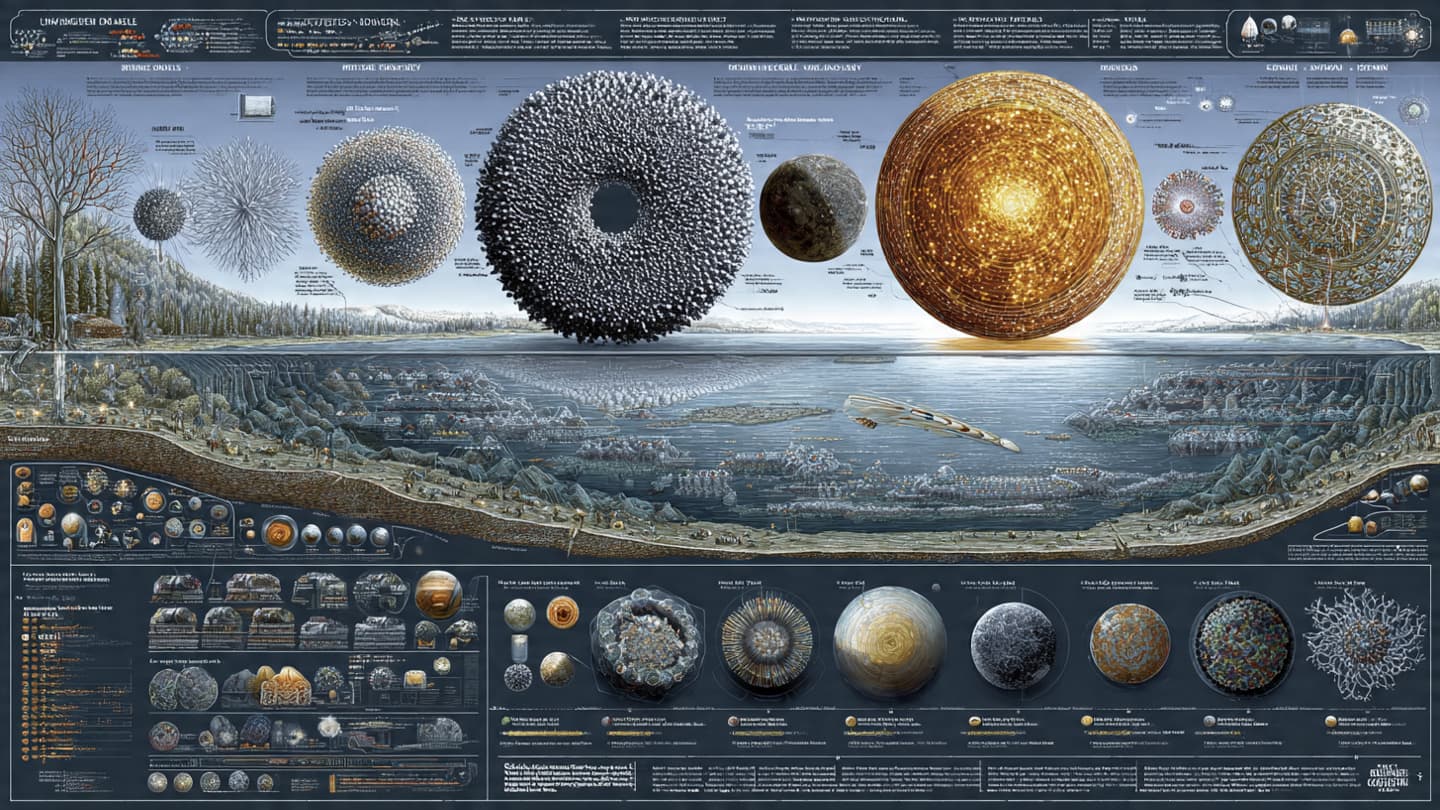
Looking into the universe can feel like standing between two mirrors that stretch endlessly in opposite directions. One reflection leads toward the smallest measurable scales, while the other expands into structures so vast that even light requires millions of years to cross them. A recent exploration of cosmic size highlights the extraordinary range that exists between these extremes.
Space is often associated with enormous distances, yet its story begins with remarkably small building blocks. Tiny particles and compact celestial objects occupy one end of the cosmic spectrum, demonstrating that significance in astronomy is not always tied to size.
Moving upward through the scale of the universe reveals familiar worlds such as planets and moons. Within our own solar system, these bodies vary dramatically in size, composition, and environment. Their diversity provides astronomers with valuable insight into how planetary systems form and evolve.
Beyond planets lie stars, ranging from relatively modest objects to immense stellar giants. Some stars dwarf our Sun many times over, illustrating how nature repeatedly produces structures of astonishing variety. The life cycles of these stars influence everything from chemical enrichment to the formation of future planetary systems.
Black holes add another layer to the cosmic hierarchy. While some possess masses only several times greater than the Sun, others reach scales measured in millions or billions of solar masses. These objects continue to challenge scientific understanding and remain central to modern astrophysical research.
Galaxies expand the scale further still. Each galaxy contains vast collections of stars, gas, dust, and dark matter. The Milky Way itself is only one member of a much larger cosmic community populated by countless neighboring systems.
At the largest scales, galaxies gather into clusters and sprawling filaments that weave across the observable universe. These immense structures form what astronomers describe as the cosmic web, a network that reveals how matter is distributed across space.
Examining the universe from smallest to largest offers more than a lesson in measurement. It highlights the interconnected nature of cosmic evolution, where tiny particles and gigantic structures participate in the same unfolding story.
As scientific instruments become increasingly sophisticated, researchers continue refining humanity’s understanding of these scales. Each new observation adds detail to a picture that remains both immense and incomplete, reminding us of the extraordinary range contained within the cosmos.
AI Image Disclaimer: The visual accompanying this article is AI-generated and serves as an illustrative interpretation of astronomical scale.
Sources Verified Big Think NASA resources ESA publications Academic astronomy references
Published by Banx Network. This article is part of the Banx decentralized media programme, powered by the BXE token on the XRP Ledger.