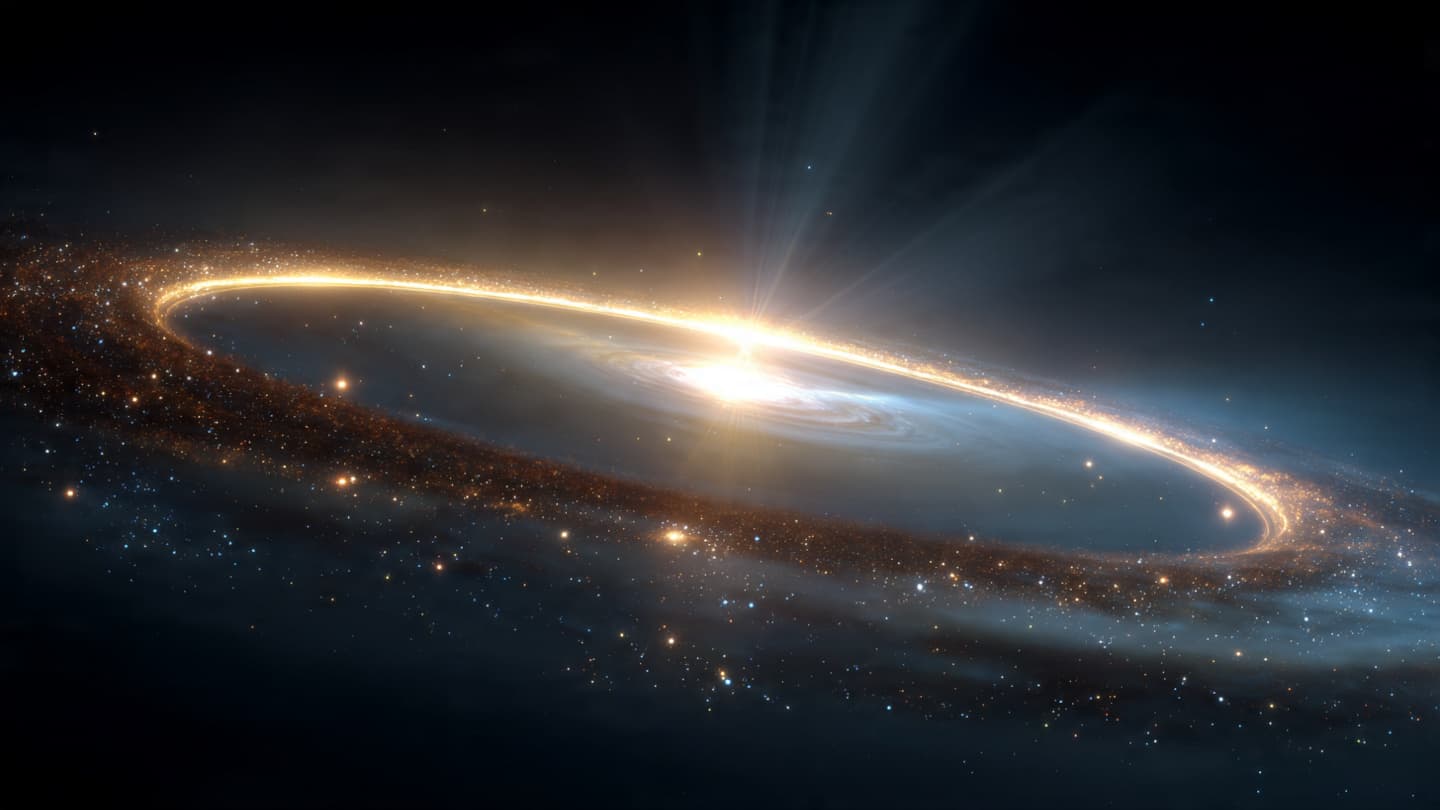
The universe often reveals itself through fragments of light that have traveled unimaginable distances. Occasionally, astronomers encounter an object so unusual that it seems to offer a glimpse not only into distant space, but also into the future and past at the same time. Such discoveries remind us that the cosmos remains far richer and stranger than our everyday intuition suggests.
A recently highlighted astronomical object has drawn attention for behaving like a “cosmic crystal ball,” providing researchers with a unique opportunity to observe multiple perspectives of the universe through the effects of gravity and light. The phenomenon is tied to gravitational lensing, one of the most fascinating predictions of modern physics.
Gravitational lensing occurs when a massive object, such as a galaxy or galaxy cluster, bends the path of light coming from more distant sources. In some cases, the distortion creates rings, arcs, or multiple images that allow astronomers to study objects otherwise too faint or distant to examine directly.
Scientists describe this particular observation as unusual because it provides a remarkably detailed and rare configuration. The arrangement allows researchers to investigate distant cosmic structures while simultaneously learning more about the massive object acting as the lens.
Like looking through an intricate crystal sculpture, astronomers can trace how light has traveled across billions of years. The resulting images contain information about the composition, motion, and history of galaxies that existed when the universe was far younger than it is today.
Such discoveries are valuable because they transform gravity into a natural telescope. Rather than relying solely on human-made instruments, researchers can use the universe’s own architecture to magnify distant targets and reveal otherwise hidden details.
The observation also contributes to broader efforts to understand dark matter, galactic evolution, and the distribution of mass across the cosmos. Each gravitational lens provides another piece of a much larger puzzle that scientists continue assembling.
Advances in modern observatories and imaging technologies have made these discoveries increasingly precise. Yet each new example demonstrates that nature still possesses ways of surprising even the most experienced observers.
As researchers continue studying this remarkable celestial arrangement, it stands as another example of how the universe can transform abstract physical laws into spectacular and informative displays.
AI Image Disclaimer: This article may include an AI-generated illustration created to visualize the astronomical phenomenon described.
Sources (Verification Check) Space.com Live Science New Scientist European Space Agency NASA
Published by Banx Network. This article is part of the Banx decentralized media programme, powered by the BXE token on the XRP Ledger.