There are days when science resembles a traveler carrying discoveries gathered from places separated by unimaginable distances. One finding may emerge from the cold emptiness between the stars, while another is carefully uncovered beneath the warm sands of ancient civilizations. Together, these seemingly unrelated discoveries remind us that human curiosity is equally at home exploring the depths of space and the echoes of history buried beneath the Earth.
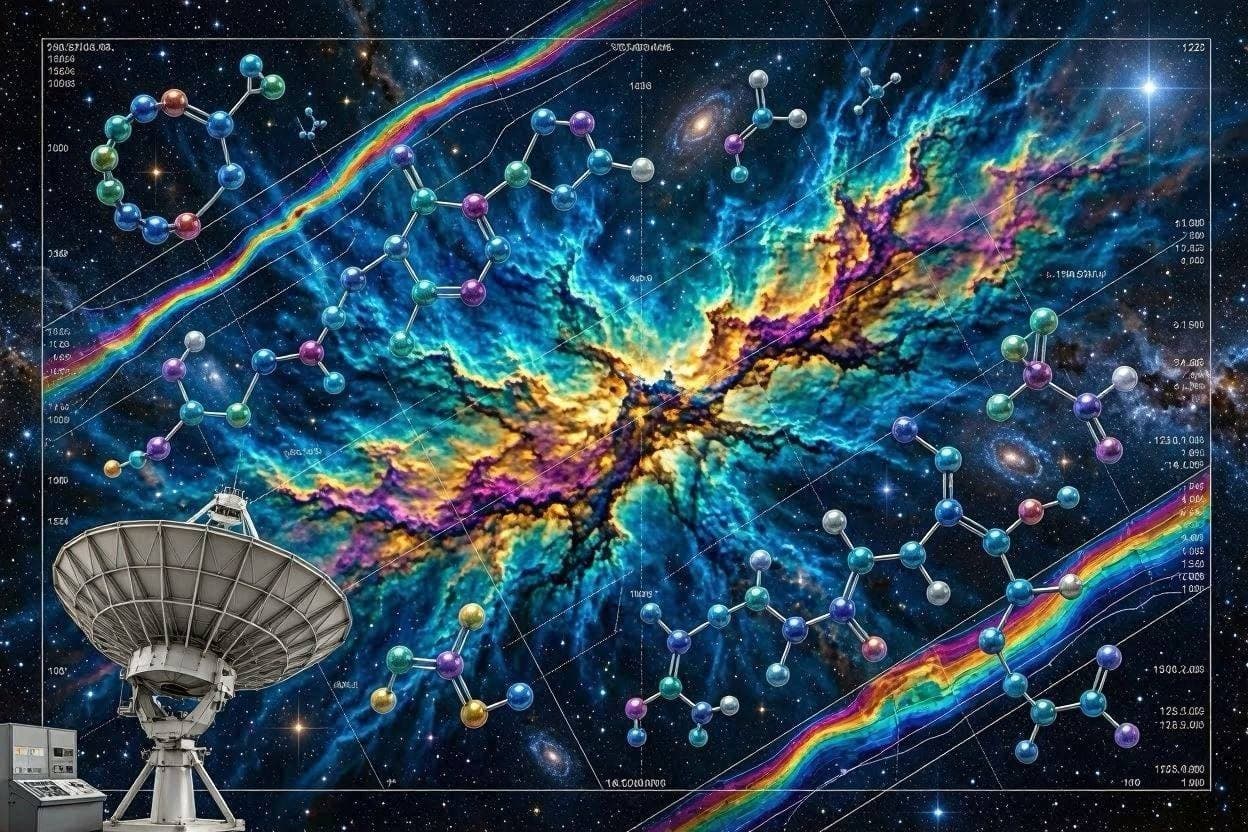
Among the latest scientific highlights summarized by Live Science is the detection of complex sugar molecules in interstellar space. Using advanced radio astronomy techniques, researchers identified chemical compounds that contribute to scientists' understanding of how increasingly complex organic molecules can form within vast clouds of gas and dust between stars. While these molecules are not evidence of life, they provide important clues about the chemistry that existed long before planets such as Earth were formed.
Astronomers have long studied molecular clouds because they serve as the birthplaces of new stars and planetary systems. Discoveries of increasingly sophisticated organic compounds strengthen the idea that many of the chemical ingredients necessary for life may be more widespread throughout the universe than previously understood. Scientists emphasize, however, that finding organic molecules does not demonstrate the existence of living organisms elsewhere in space.
At the same time, archaeological research in Egypt continues to deepen humanity's understanding of one of history's most influential civilizations. Recent excavations have revealed new artifacts, architectural remains, and inscriptions that offer additional insight into daily life, religious practices, and administrative systems in ancient Egypt. Each carefully documented discovery contributes another piece to a civilization that flourished for thousands of years.
Archaeologists stress that modern excavation extends far beyond simply recovering artifacts. Advanced technologies such as satellite imagery, three-dimensional mapping, ground-penetrating radar, and laboratory analysis allow researchers to interpret ancient sites with greater precision while minimizing disturbance to fragile historical remains. These methods continue to transform the study of ancient civilizations.
Although astronomy and archaeology examine dramatically different frontiers, both disciplines rely on interpreting subtle evidence preserved across immense stretches of time. Astronomers analyze faint molecular signals that have traveled through space for millions of years, while archaeologists reconstruct human history from objects that have remained hidden beneath the ground for centuries or millennia. Both fields demonstrate how careful observation can reveal stories invisible to the casual observer.
Researchers also emphasize the importance of international collaboration. Large astronomical observatories involve scientists from many countries working together to process complex observational data, while archaeological expeditions often unite historians, conservators, geologists, and local experts to protect cultural heritage while advancing scientific knowledge. Such partnerships strengthen both the reliability and the reach of modern research.
The latest findings highlighted by Live Science illustrate how scientific exploration continues to connect humanity with both the distant universe and its own ancient past. As new observations and excavations proceed, researchers expect additional discoveries that will refine existing knowledge while opening new questions about the origins of matter, civilizations, and the remarkable history shared by our planet and the cosmos.
AI Image Disclaimer: The accompanying illustrations are AI-generated artistic representations created to visualize the scientific subjects discussed in this article and should not be interpreted as authentic documentary images.
Sources: Live Science; Nature; Science
Published by Banx Network. This article is part of the Banx decentralized media programme, powered by the BXE token on the XRP Ledger.