The Sun is often perceived as a constant, steady presence in our sky, a beacon of immediate light and warmth. However, the journey of that light from its source to our eyes is a tale of two vastly different timelines. In the dense, fiery heart of the Sun, nuclear fusion generates both neutrinos and high-energy photons simultaneously. Yet, while neutrinos race to the surface in mere seconds, the energy carried by photons embarks on an epic odyssey that can last roughly 170,000 years.
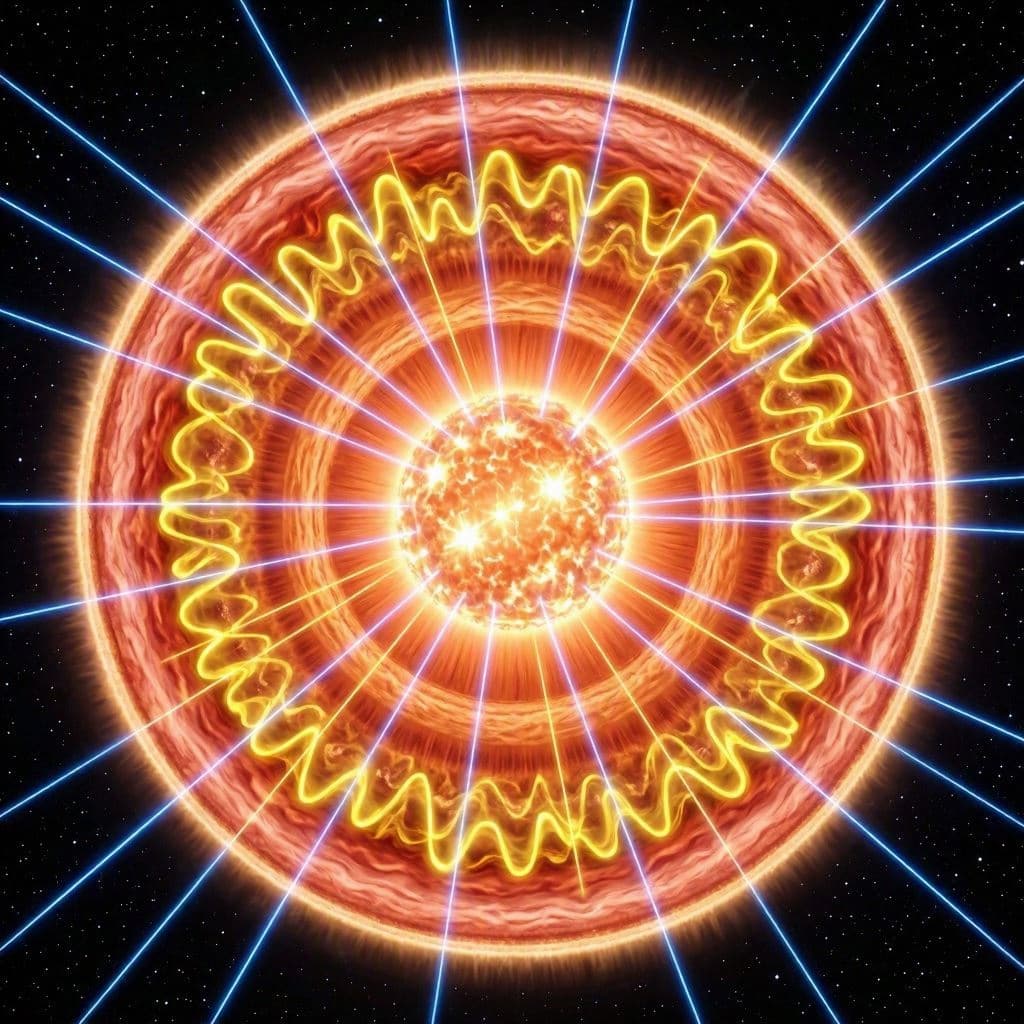
This disparity arises from the fundamental nature of these particles. Neutrinos are ghostly entities, barely interacting with matter. They pass through the dense plasma of the Sun’s interior almost unimpeded, traveling at nearly the speed of light. For a neutrino, the Sun is transparent, a brief checkpoint on its way to the cosmos. In contrast, photons are constantly absorbed and re-emitted by the surrounding ions and electrons, a process that slows their progress to a crawl.
The journey of a photon is akin to a pinball machine of cosmic proportions. Each time a photon is absorbed, it loses energy and is re-emitted in a random direction. This random walk means that while the particle itself moves quickly between interactions, its net progress outward is incredibly slow. Over millennia, the high-energy gamma rays produced in the core gradually degrade into lower-energy visible light and heat, finally escaping the surface as the sunlight we see today.
This 170,000-year delay serves as a reminder that the sunlight warming our skin today was generated during a time when early humans were just beginning to master fire. It connects us to the deep past of our star, bridging epochs through the slow diffusion of energy. The Sun we see is a historical record, a snapshot of conditions that existed long before recorded history began.
Neutrinos, on the other hand, offer a real-time glimpse into the Sun’s current activity. Because they escape so quickly, detecting solar neutrinos allows scientists to monitor the fusion processes happening in the core right now. This dual perspective—immediate neutrinos and ancient photons—provides a comprehensive understanding of stellar dynamics, combining present-day data with historical energy output.
The study of these particles has revolutionized astrophysics. Neutrino detectors on Earth have confirmed models of solar fusion, while spectroscopic analysis of sunlight reveals the composition and temperature of the solar surface. Together, they paint a complete picture of the star that sustains life on Earth, highlighting the complex physics governing its interior.
Understanding this timeline also underscores the stability of the Sun. The slow release of energy ensures that the star does not burn out rapidly, providing a consistent source of power for billions of years. It is a delicate balance of forces that allows for the existence of a stable climate and the evolution of life.
The contrasting journeys of neutrinos and photons from the Sun’s core illustrate the complex physics of stellar interiors. While neutrinos provide instant information, the delayed arrival of photons connects us to the Sun’s ancient past, reminding us of the enduring and gradual nature of cosmic processes.
AI Image Disclaimer: Images used to depict this astronomical phenomenon are AI-generated for illustrative purposes.
Sources: NASA Goddard Space Flight Center Scientific American Physics Today
Published by Banx Network. This article is part of the Banx decentralized media programme, powered by the BXE token on the XRP Ledger.