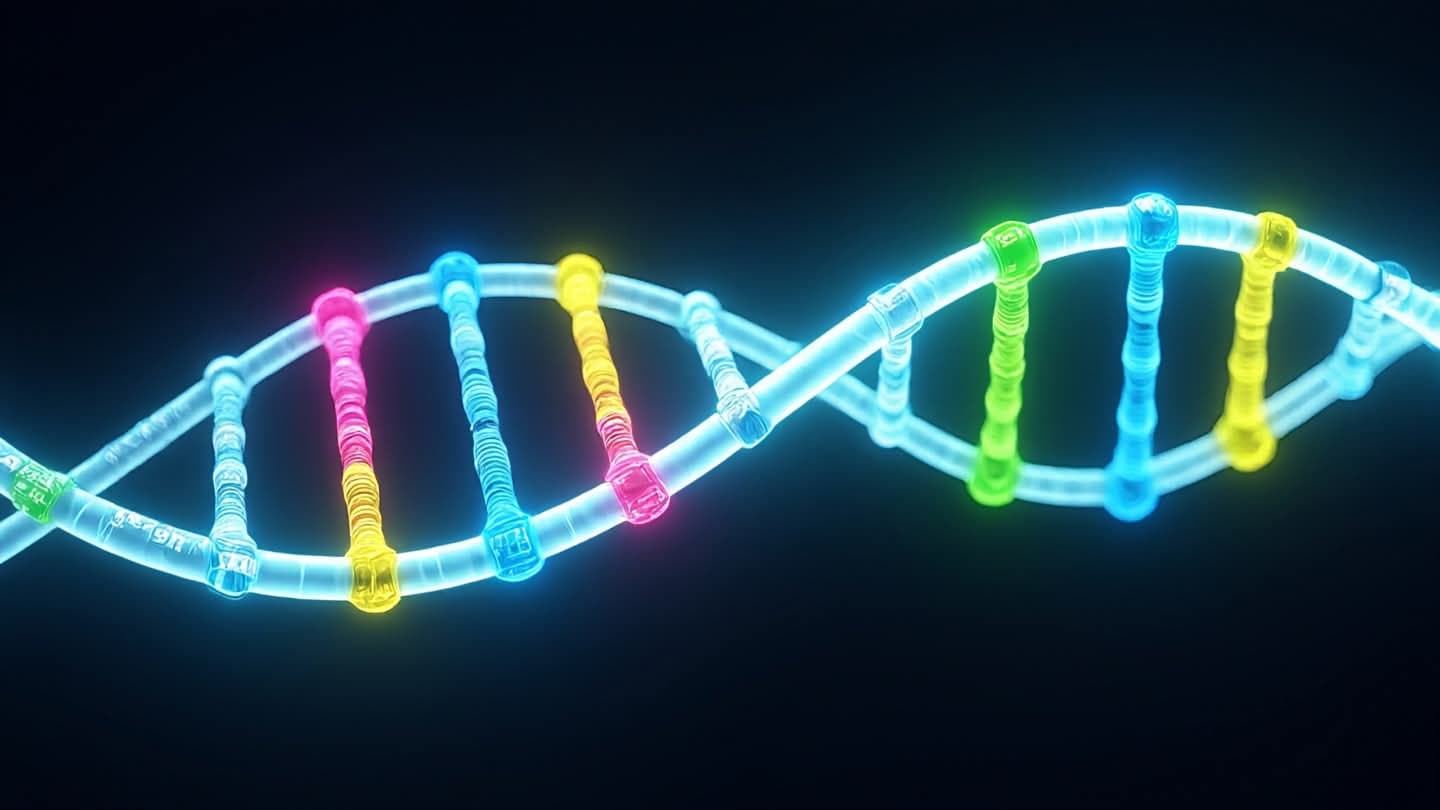
Within the double helix of our genetic code lies a language so complex that for decades, much of it remained silent to us. We knew the letters—A, C, G, and T—but the grammar that dictated when and how they should be read was often obscured by shadows. Now, researchers have illuminated a crucial part of this syntax: a hidden "on switch" that controls gene activity. This discovery is not merely a technical achievement but a profound step toward understanding the very mechanisms that make us human, offering new insights into health, disease, and the intricate dance of biological regulation.
The breakthrough centers on what scientists call "spatial grammar," a layer of information embedded within the structure of DNA itself. Unlike the linear sequence of bases that codes for proteins, this spatial arrangement dictates how genes are accessed and activated. Using advanced artificial intelligence and comprehensive genomic analysis, researchers have decoded the signals that tell cellular machinery where to bind and when to start transcription. It is akin to finding the punctuation marks in a long, run-on sentence, suddenly making the meaning clear.
For years, the non-coding regions of the genome were dismissed as "junk DNA," but this view has shifted dramatically. These areas are now understood to be rich with regulatory elements, including enhancers and promoters that act as switches. The newly decoded "on switch" represents a specific pattern of chromatin accessibility and protein binding that serves as a universal signal for gene activation. Its identification allows scientists to predict with greater accuracy which genes will be expressed in different tissues and under various conditions.
The implications for medicine are significant. Many diseases, from cancer to autoimmune disorders, are not caused by mutations in the protein-coding genes themselves but by errors in their regulation. By understanding the switch that turns these genes on or off, researchers can develop more targeted therapies. Instead of broadly suppressing immune responses or killing rapidly dividing cells, treatments could potentially correct the specific regulatory fault, restoring normal function with fewer side effects.
This discovery also sheds light on human evolution. The regulatory switches that control gene expression are often where subtle differences between species arise. By comparing the spatial grammar of humans with that of other primates, scientists can identify the unique regulatory changes that contributed to our development. It provides a window into how small tweaks in genetic control can lead to vast differences in biology and behavior.
The role of artificial intelligence in this achievement cannot be overstated. The sheer volume of genomic data is too vast for traditional analysis methods. Machine learning algorithms were trained to recognize patterns in the three-dimensional structure of DNA, identifying the subtle signatures of the "on switch" that had eluded human observers. This synergy between biology and technology marks a new era in scientific discovery, where computational power unlocks biological secrets.
As the research continues, the focus will shift to applying this knowledge in clinical settings. Trials are already being designed to test drugs that target these regulatory mechanisms. The hope is that by mastering the switch, we can master the diseases that have long resisted treatment. It is a journey from understanding to action, driven by the desire to alleviate suffering and improve quality of life.
The decoding of the hidden "on switch" in human DNA is a testament to the power of persistence and innovation. It transforms our understanding of the genome from a static library into a dynamic, responsive system. As we learn to read this language more fluently, we open new doors to healing and a deeper appreciation of the complexity of life.
AI Image Disclaimer: Please note that any accompanying visuals for this article are AI-generated representations intended for illustrative purposes only.
Sources: Science Daily Nature Genetics UC Berkeley News Phys.org Genome Biology
Published by Banx Network. This article is part of the Banx decentralized media programme, powered by the BXE token on the XRP Ledger.