
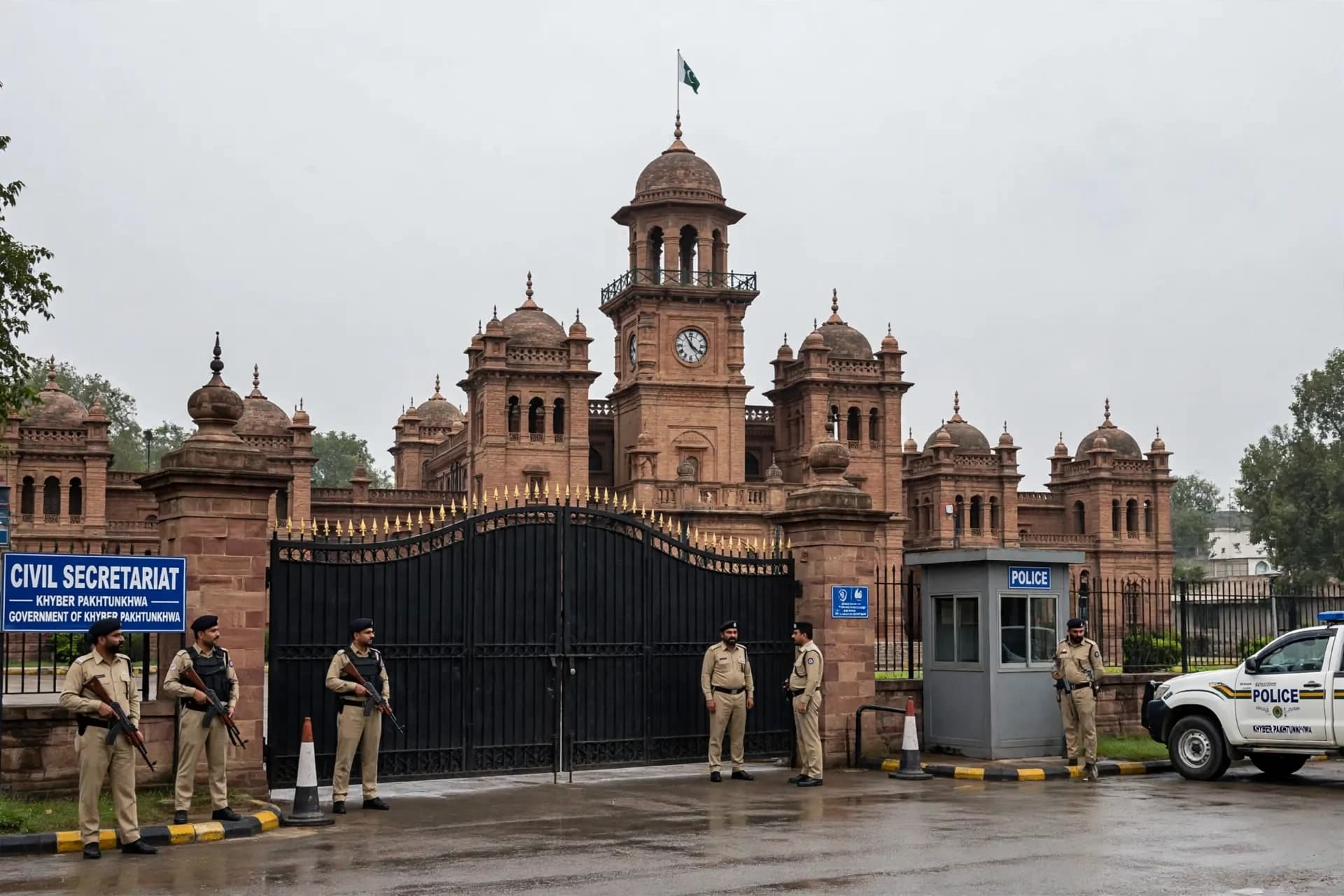
There is a particular tension that arises when political contestation meets the machinery of the state—when a march toward the capital becomes not merely a show of dissent but a test of constitutional boundaries. In Pakistan this week, that tension reached a point where the federal government chose to act, suspending the provincial administration of Khyber Pakhtunkhwa and declaring a state of emergency in the northwestern province.
President Asif Ali Zardari signed the emergency proclamation on Sunday, acting on the advice of Prime Minister Shehbaz Sharif following a federal cabinet decision . The move came as supporters of jailed former Prime Minister Imran Khan’s Pakistan Tehreek-e-Insaf party had been marching for days toward Islamabad, demanding his release and threatening to escalate their protests .
The proclamation cites Articles 232 and 234 of the Constitution, which allow the federal government to assume some or all provincial functions during an emergency . The stated justification is a surge in terrorist attacks and the provincial government’s alleged failure to effectively address lawlessness. The proclamation asserts that attacks on infrastructure, government installations, and law enforcement agencies have increased, and that the situation has gone beyond the provincial government’s control .
Under the measures, the provincial chief minister, ministers, advisers, and the advocate general immediately ceased to hold office. The governor, representing the federal government, assumed the powers of the provincial executive. The provincial assembly’s powers were transferred to Parliament or a body authorized by it . Army troops were deployed under Article 245 to assist civil administration and protect government installations .
The political context is layered. Khan has been imprisoned since 2023 on corruption and other charges that he and his party say are politically motivated . Despite his imprisonment, he retains substantial support, and his party governs Khyber Pakhtunkhwa—the only province it controls . The PTI’s march, launched from the province, followed failed negotiations with the federal government. Talks had been held to postpone the march, but the parties could not reach an agreement, with the government focusing on counterterrorism cooperation while the PTI pressed for Khan’s release, medical care, and family visitation rights .
Zulfikar Bukhari, a close Khan aide and PTI spokesman, called the suspension a “ridiculous decision,” asserting that Khyber Pakhtunkhwa had the country’s only legitimately elected government. “This will only lead to further bloodshed, instability and collateral damage,” he said, adding that the decision showed negotiations were never the government’s intention .
The federal government has pointed to a surge in militant violence in recent years, much of it attributed to the Pakistani Taliban, also known as Tehrik-e-Taliban Pakistan. Islamabad has repeatedly accused Afghanistan’s Taliban government of providing sanctuary to TTP militants, an allegation Kabul denies . The government had urged the provincial chief minister to postpone the march, citing these security concerns .
What unfolds next remains uncertain. The provincial government has been suspended, its leadership removed, and its powers transferred. The march, and the demands that animate it, continue. And the question that lingers—quiet, insistent—is what this moment means for a country where political opposition and state authority have long existed in uneasy proximity.
AI Image Disclaimer: All visual content associated with this report is AI-generated and serves only as illustrative material, not as a photographic record of actual events.
Sources: The Kathmandu Post, The Wire, Tap Info, Pakistan Today, Lusa
Published by Banx Network. This article is part of the Banx decentralized media programme, powered by the BXE token on the XRP Ledger.


.jpg&w=3840&q=75 "Zelensky Warns China Is Helping Russia Develop a Starlink Rival")