
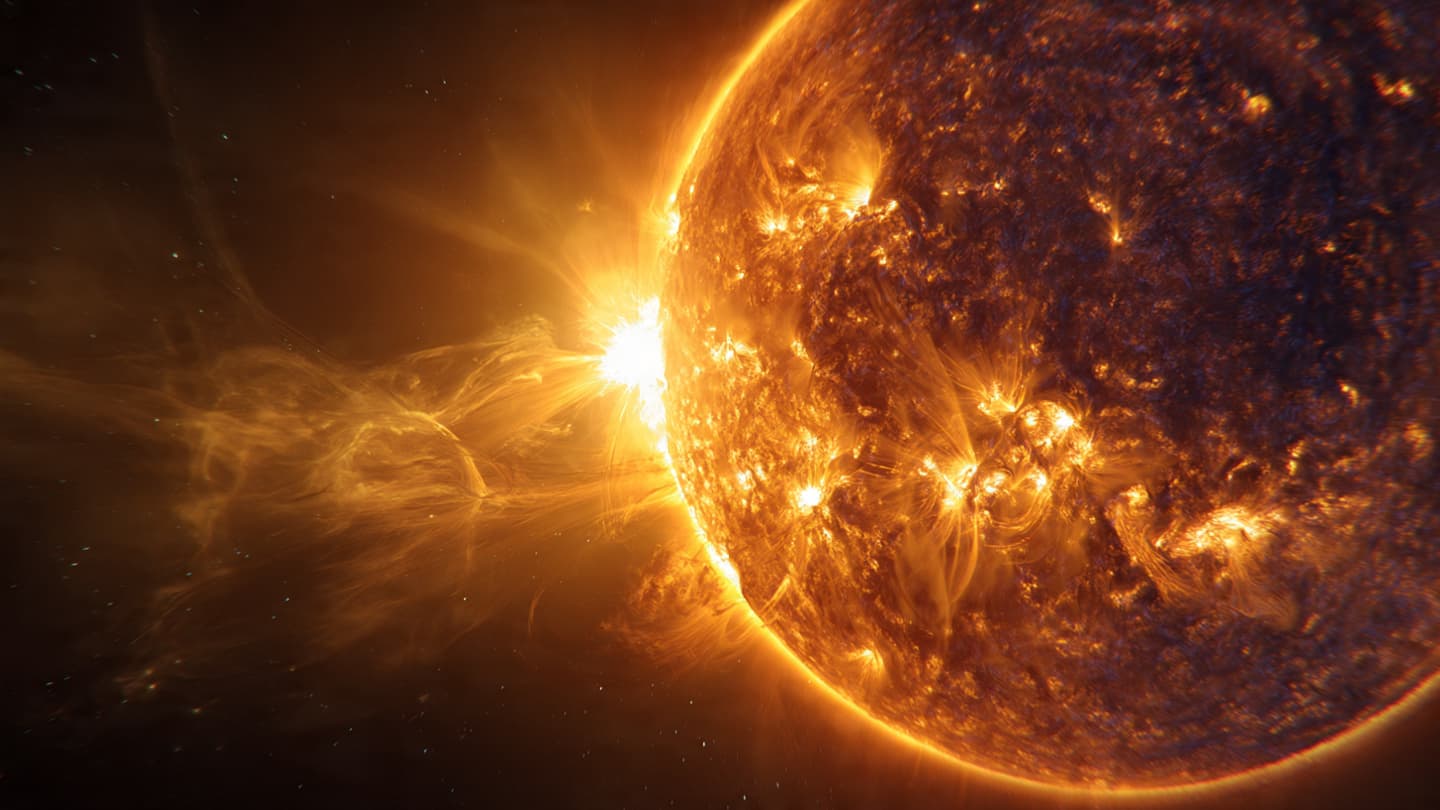
The Sun often appears calm from Earth's surface, rising and setting with familiar consistency. Yet beyond that steady glow lies a dynamic environment shaped by magnetic forces powerful enough to influence conditions across the solar system. This week, scientists turned their attention toward a series of significant solar eruptions moving through space.
According to observations from space weather monitoring agencies, the Sun recently released three major solar flares accompanied by bursts of charged particles. These events have increased interest among researchers tracking their potential effects on Earth's magnetic environment.
Solar flares occur when intense magnetic energy is suddenly released from active regions on the Sun. Some eruptions are accompanied by coronal mass ejections, which send large clouds of plasma and magnetic fields outward into space.
When such activity is directed toward Earth, interactions with the planet's magnetosphere can occur. Depending on their intensity, these interactions may affect satellites, radio communications, navigation systems, and power infrastructure.
Space weather specialists continuously monitor the movement of solar particles using satellites positioned between Earth and the Sun. These observations help scientists estimate arrival times and assess potential impacts.
One of the most visible consequences of strong solar activity is the appearance of auroras. Charged particles interacting with Earth's atmosphere can create colorful displays of light across northern and southern regions.
Researchers emphasize that most solar events do not cause widespread disruptions. However, understanding and forecasting space weather remains increasingly important as societies rely more heavily on technology-based systems.
Advances in solar monitoring have significantly improved forecasting capabilities. Early warnings allow satellite operators and infrastructure managers to take precautionary measures when elevated geomagnetic activity is expected.
As the solar cycle continues to progress, scientists expect additional periods of heightened activity. Each event contributes valuable information to the growing effort to understand the behavior of our nearest star.
AI Image Disclaimer: Visual illustrations accompanying this article are AI-generated representations designed to support scientific storytelling and are not actual observational images.
Sources (Verification Check): CBS News, NOAA Space Weather Prediction Center, NASA, Reuters, Space.com
Published by Banx Network. This article is part of the Banx decentralized media programme, powered by the BXE token on the XRP Ledger.



