
There is a particular kind of comfort in the distant future—the assumption that whatever unfolds in the eons ahead will unfold slowly, gently, according to a schedule we can set aside and forget. The death of our Sun has long occupied such a place in the imagination: a distant event, a quiet fading, a story whose final pages are so far away they hardly seem to matter. But new calculations suggest that the ending may arrive sooner than we believed, and that the outer planets will not go quietly.
New research indicates that once the Sun transforms into a white dwarf some 7 to 8 billion years from now, the outer solar system has roughly 1 billion years left—far less than previous estimates ranging from 100 billion to a quintillion years, according to a study published in The Astrophysical Journal Letters . The research was led by Konstantin Batygin, an astrophysicist at the California Institute of Technology .
The key to this revised timeline lies in how the Sun will die. Previous estimates assumed the Sun would lose its mass smoothly and gradually. In reality, the study argues, the Sun will shed its envelope in violent, random ejections—what the researchers call "stochastic kicks"—rather than a calm, consistent release . This irregular shaking will rapidly destabilize the orbits of the giant planets, including Jupiter, Saturn, Uranus, and Neptune .
The researchers ran 672 different scenarios, tracking when and how much the Sun could lose its mass on its way to becoming a white dwarf. Even in cases where the Sun shed its mass smoothly, approximately 96 percent of the simulated planetary systems spiraled into chaos within 3 billion years of the Sun becoming a white dwarf . The study found that orbit crossings can begin even earlier, on the red giant branch, with roughly 40 percent of realizations undergoing disruption or violent scattering before the white dwarf forms, and about 90 percent self-destructing within 3 billion years .
The inner planets—Mercury, Venus, and Earth—will already be gone by then, consumed by the Sun as it expands into a red giant. Mars is expected to be the lone survivor among the inner planets, sitting far enough away to escape engulfment . The outer planets had been expected to persist, their orbits widening as the Sun lost mass, with their eventual breakup attributed only to passing stars over 30 to 100 billion years . The new findings collapse that timeline dramatically.
"What we've shown is that this timeline gets front-run by the Sun's own death," Batygin said. "Because planetary dynamics is chaotic—exhibiting sensitive dependence on initial conditions—no single simulation tells you what will happen, only what could happen" . The study concludes that "as the Sun dies, it will take the outer solar system down with it" .
For those of us alive today, the findings carry no practical weight. The events described will unfold long after humanity's chapter has closed, if it closes at all. Yet there is something humbling in the knowledge that even the great architectures of the sky are not permanent, and that the quiet stability we take for granted is, in cosmic terms, a temporary arrangement.
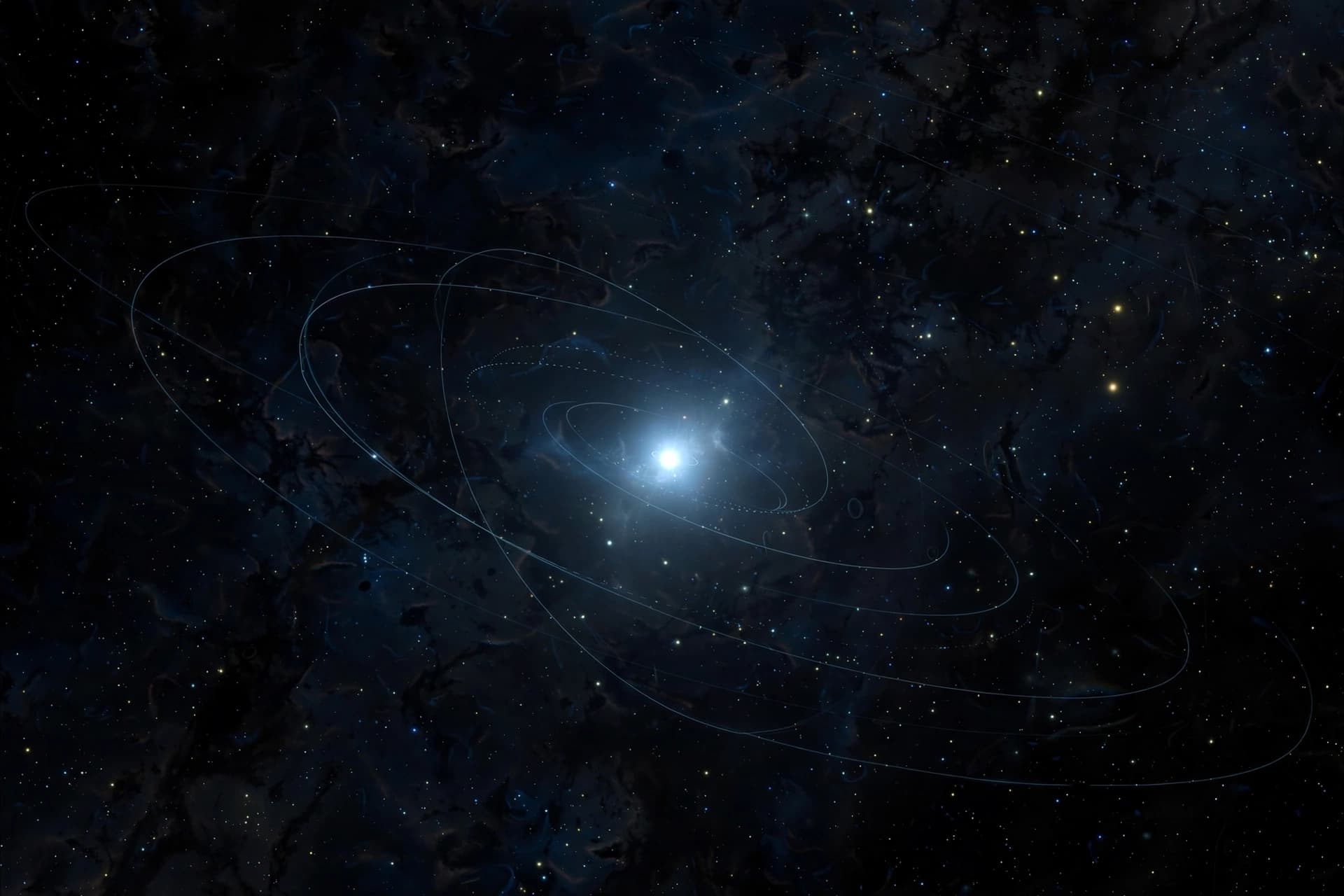
The images accompanying this article are AI-generated and are intended only to illustrate the subject matter.
Sources: Gizmodo, The Astrophysical Journal Letters, California Institute of Technology, Euronews
Published by Banx Network. This article is part of the Banx decentralized media programme, powered by the BXE token on the XRP Ledger.



