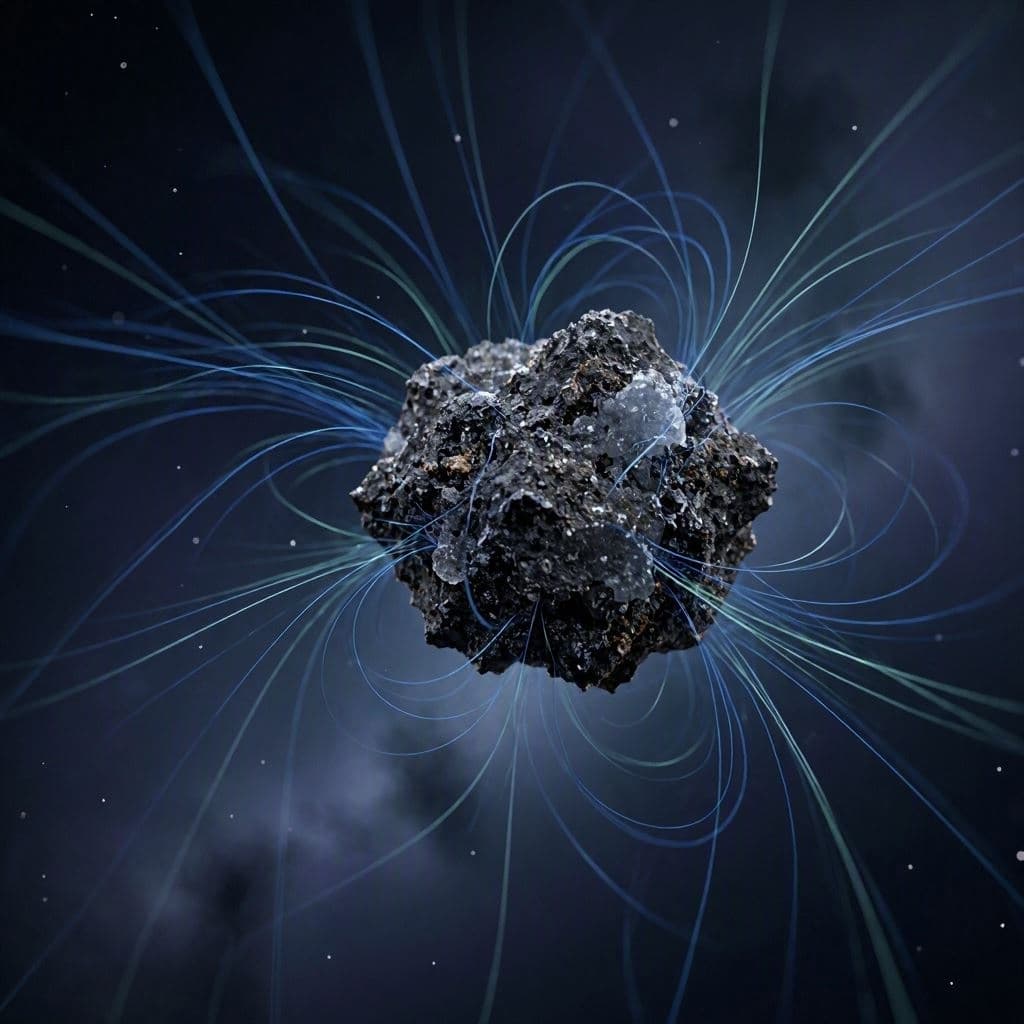
In the quiet depths of meteorites, tiny grains of dust have waited billions of years to tell their story. These microscopic particles, older than the Earth itself, are remnants of the solar nebula—the cloud of gas and dust from which our sun and planets formed. Recently, scientists have discovered that these ancient grains hold magnetic records, offering a rare glimpse into the energetic events that marked the sun’s birth.
Researchers have analyzed presolar grains found in meteorites, focusing on their magnetic properties. These grains, composed of minerals like silicon carbide, formed in the outflows of distant stars before being incorporated into our solar system. By measuring the remnant magnetization within these grains, scientists can infer the strength and nature of the magnetic fields present during the early stages of solar formation.
The findings suggest that the young sun was surrounded by strong magnetic fields, which played a crucial role in shaping the solar nebula. These fields likely influenced the accretion of material, guiding dust and gas into the protoplanetary disk. The magnetic signatures in the grains act as fossilized evidence of these dynamic processes, preserving information that has long since vanished from the rest of the solar system.
This discovery adds depth to our understanding of stellar evolution. It shows that magnetic forces were not just background players but active agents in the creation of our cosmic neighborhood. The intensity of these fields helps explain how material was transported and mixed in the early solar system, leading to the diverse composition of planets and asteroids we see today.
The analysis requires sophisticated techniques, including electron microscopy and sensitive magnetometry. Scientists must isolate individual grains and measure their tiny magnetic moments without disturbing them. It is a painstaking process, akin to reading a book written in microscopic script. Yet, the rewards are profound, offering insights into the very origins of our star.
These magnetic clues also help constrain models of solar formation. By comparing the data with theoretical predictions, researchers can refine their understanding of how stars like the sun come into being. It bridges the gap between observation and theory, providing empirical evidence for processes that occurred over four billion years ago.
The presence of such well-preserved magnetic records is a testament to the resilience of these ancient grains. Despite the violent history of the solar system, including collisions and heating, they have retained their original signatures. They serve as time capsules, carrying messages from the dawn of our solar system to the present day.
The study of ancient dust grains reminds us that the past is not entirely lost. Even in the smallest particles, history is preserved, waiting to be decoded. As we learn more about the sun’s birth, we gain a deeper appreciation for the cosmic forces that shaped our world, connecting us to the distant stars from which we came.
AI Image Disclaimer: Please note that any accompanying visuals for this article are AI-generated illustrations designed to represent microscopic dust grains and magnetic fields, not actual microscope images.
Sources: Science Advances, Nature Astronomy, Smithsonian Magazine, Phys.org
Published by Banx Network. This article is part of the Banx decentralized media programme, powered by the BXE token on the XRP Ledger.