There is a particular poignancy in watching something fall. Satellites in low Earth orbit are always descending, slowly or swiftly, pulled by the thin breath of the atmosphere they skim through. Most of them fade quietly, their missions ending without ceremony. But Swift, a telescope that spent twenty-one years chasing the most violent explosions in the universe, deserved a different kind of farewell. NASA gave it one—a bold attempt to lift it higher, and when that failed, a quiet acknowledgment that the end had come.
The Neil Gehrels Swift Observatory concluded its science operations on October 20, 2026, when it reached an altitude of roughly 275 kilometers. At that height, atmospheric drag had become too strong for the spacecraft to hold a steady gaze at its astronomical targets . The telescope is expected to re-enter Earth’s atmosphere in the coming weeks, burning up over the tropics .
Swift’s decline was accelerated by the sun itself. Increased solar activity expanded Earth’s upper atmosphere, increasing drag on the satellite and hastening its descent. By January 2025, models showed Swift re-entering by the summer of 2026 . NASA saw an opportunity—not only to save the observatory but to advance a capability the agency would need for the future. In September 2025, it awarded Katalyst Space a $30 million contract to build and launch a robotic spacecraft capable of grabbing Swift and boosting it to a higher orbit .
The LINK spacecraft launched on July 3, 2026, a little over nine months after the contract was awarded. It was an unprecedented timeline for an unprecedented mission. No private spacecraft had ever captured and boosted a satellite not designed to be serviced in this way . But about three weeks after liftoff, LINK suffered attitude control problems. Its thrusters and reaction wheels malfunctioned, and it began spinning. The capture attempt was called off .
Swift resumed science observations after the rescue attempt ended, gathering data on hundreds of targets in the weeks that followed. But the return to observations increased drag, and the spacecraft began sinking rapidly again. On October 20, it entered safe mode at 275 kilometers. The operations team at Penn State sent a command that effectively ended the mission .
What Swift leaves behind is substantial. Over more than two decades, it observed more than 2,000 gamma-ray bursts, studied over 1,400 supernovae, and contributed to roughly 7,000 scientific papers . Its rapid-response capability—turning its telescopes toward a burst within about a minute—helped revolutionize time-domain astronomy. The archive of its observations, about 12 terabytes of data, will fuel research for decades .
There is a lesson in the failure of the rescue attempt, though it is not a discouraging one. NASA described the mission as high-risk and high-reward from the start, an attempt to demonstrate commercial satellite servicing on a timeline driven by the sun’s unpredictable activity. The agency has said it will learn from LINK’s rendezvous attempt and apply those lessons to future missions .
Swift’s name was always something of a promise—a promise of speed, of responsiveness, of catching the fleeting light of cosmic catastrophes before it faded. That promise was kept for twenty-one years, far beyond the two-year mission the telescope was designed for. The spacecraft now falls toward Earth, its instruments silent, its data archived and waiting. The explosions it studied have long since faded, but the record of them remains, a quiet testament to a telescope that spent its life looking at the most violent things in the universe and never once flinched.
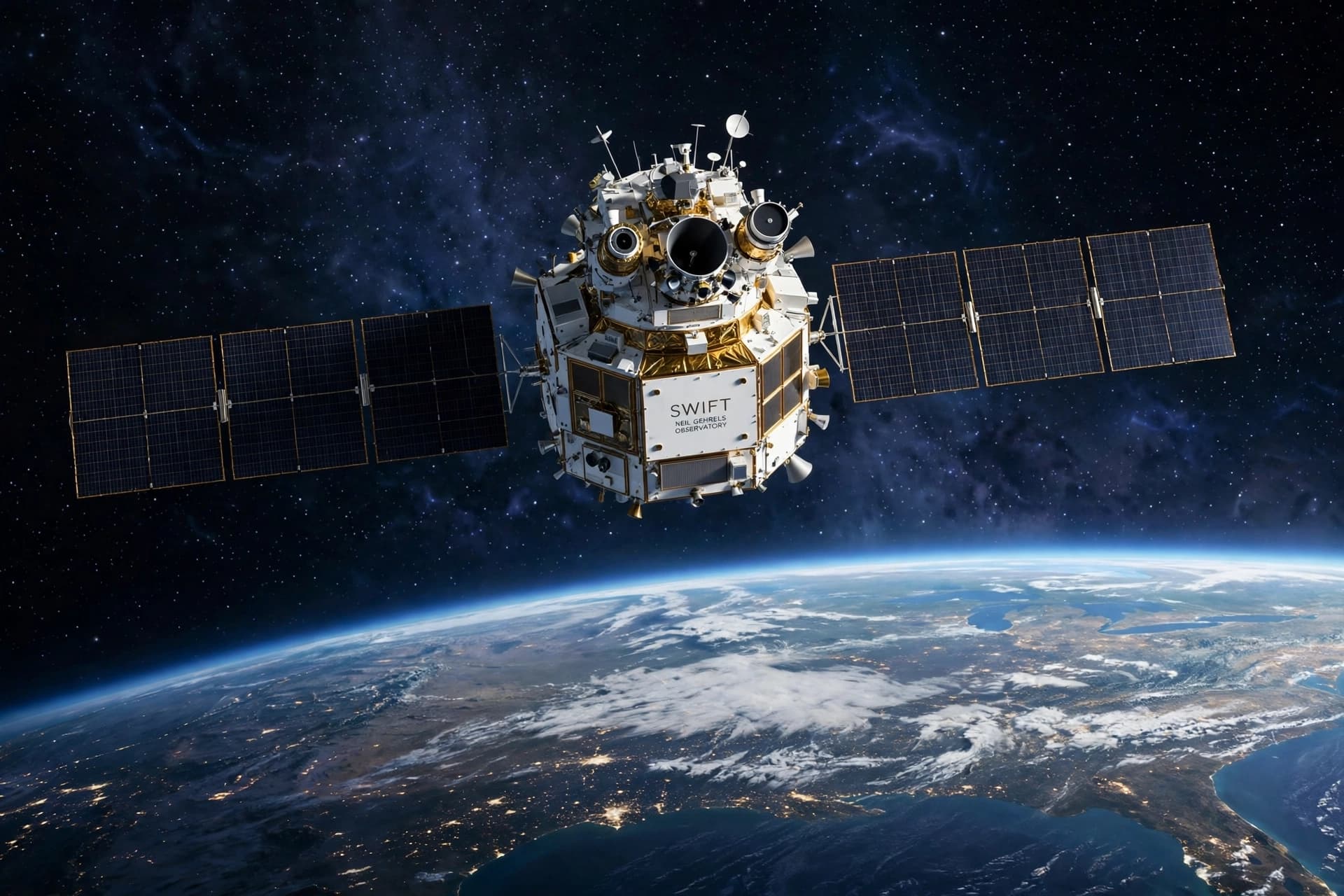
Image note: The image accompanying this article is AI-generated and intended for illustrative purposes only.
Sources: NASA, Space.com, NASA Science, India Today
Published by Banx Network. This article is part of the Banx decentralized media programme, powered by the BXE token on the XRP Ledger.