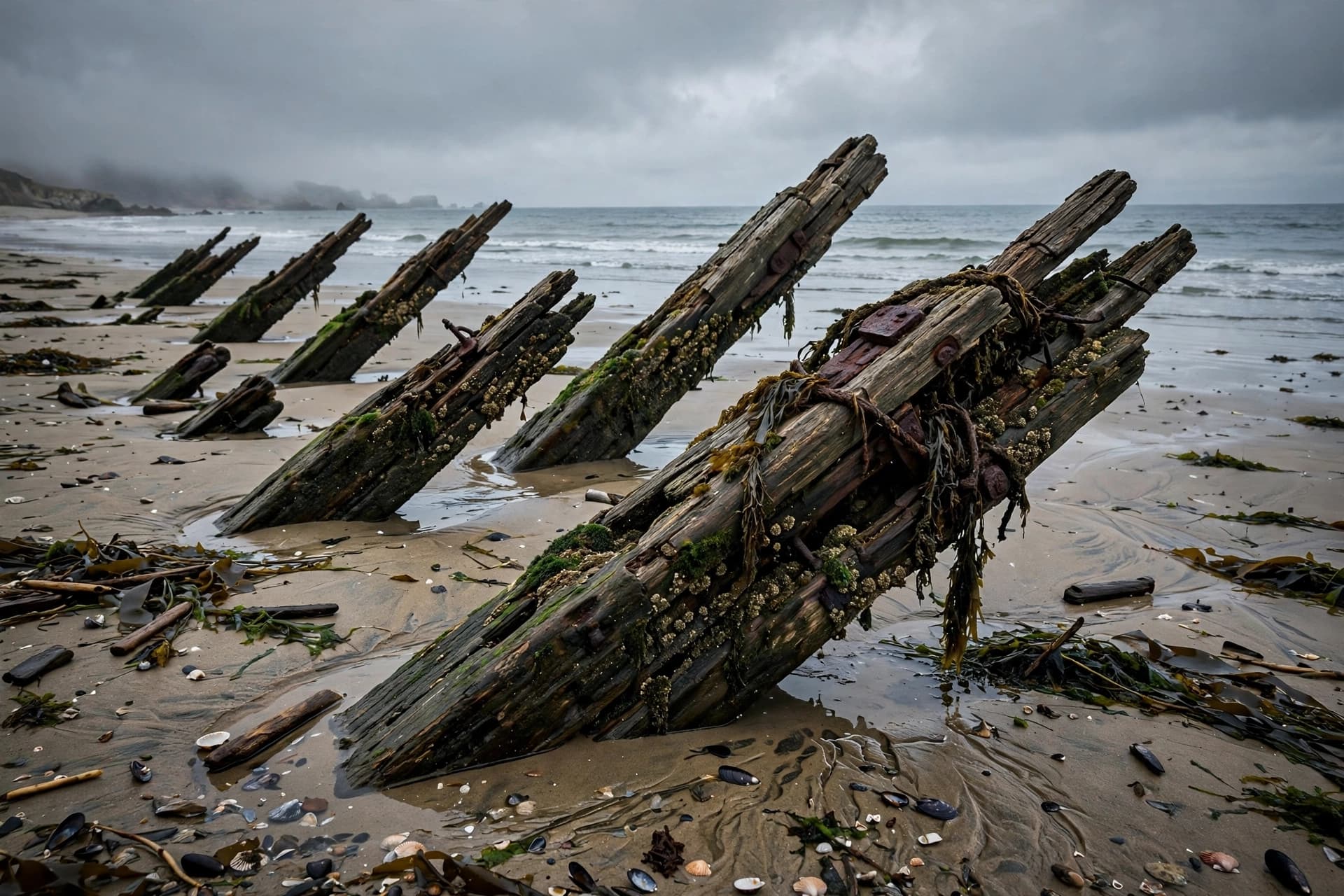
There is a particular kind of memory that lives in sand, patient and buried, waiting for the right storm to bring it back into the light. Along the southern shore of Nantucket, a powerful nor’easter did exactly that over the weekend, stripping away layers of beach to reveal weathered wooden beams fastened with rusted iron—the remains of a vessel that had not been seen in decades, and before that, not for more than a century.
The wreckage was spotted Saturday by Nantucket resident David DeHart near the area locals call the Sewer Beds, and reported to the Nantucket Current . Jason Graziadei, the Current’s editor-in-chief, went to the site with his 8-year-old son and found a large section of hull exposed by erosion . The timbers are believed to belong to the Warren Sawyer, a wooden schooner that ran aground near Miacomet Beach on December 22, 1884, while carrying 1,115 bales of cotton and 28 tons of scrap iron from New Orleans to Boston .
The storm that revealed the wreck was itself a significant weather event. The slow-moving nor’easter battered the Northeast coastline with heavy rain, strong winds, and dangerous surf, flooding low-lying communities and knocking out power to more than 100,000 customers at times . Winds of 45 to 55 mph were common across Cape Cod and the islands, with gusts above 60 mph in some coastal locations. Offshore seas reached 15 to 25 feet, and Nantucket saw about two feet of storm surge during an overnight high tide .
That combination of high water, strong winds, and large waves is especially effective at reshaping Nantucket’s sandy coastline. The island is made largely of glacial sand and loose material, and its south shore has historically experienced some of the highest erosion rates. During a storm like this, waves repeatedly pull sand away from the beach, carrying it along the shoreline or farther offshore. The longer the storm lasts, the more opportunity there is for that process to expose what lies beneath .
The history of the Warren Sawyer is well documented. When the ship ran aground in 1884, the Surfside Life-Saving Station responded and rescued Captain Edwin L. Saunders and his seven crew members . The schooner remained intact on the beach for about two weeks, allowing islanders to salvage 700 bales of cotton using skids and teams of oxen. Then, on January 6, 1885, another storm tore the ship apart, scattering pieces of its hull, remaining cargo, and cordage across more than half a mile of beach .
This is not the first time the Warren Sawyer has surfaced. State archaeologists inspected a roughly 42-foot section of hull exposed on Miacomet Beach in late 2022 and concluded it was likely part of the ship. A smaller section of the lower stern appeared in February 2023, but shifting sands buried it again before it could be documented . David Robinson, director and chief archaeologist for the Massachusetts Board of Underwater Archaeological Resources, told the Nantucket Current that the newly exposed wreckage appears to be part of the same vessel .
Maritime experts from the Egan Maritime Institute planned to visit the site to survey the remains and send a report to state underwater archaeologists . Officials cautioned that the wreckage has not been identified with certainty. The institute urged visitors not to disturb the exposed timbers, and Massachusetts law prohibits removing, damaging, or displacing underwater archaeological resources .
Nantucket has long been known as one of the “graveyards of the Atlantic,” with more than 750 wrecks estimated in the surrounding waters . For Graziadei, the discovery carried a particular resonance: the wreckage lay directly beneath a stretch of beach where cars had been driving all summer. “It’s pretty incredible to think that all summer long, we were driving on that beach and probably driving right over this huge fragment that was underneath the sand without knowing,” he said .
AI Image Disclaimer: All images associated with this report were created by artificial intelligence and are illustrative in nature.
Sources: USA Today, U.S. News & World Report, The Boston Globe, Georgia Public Broadcasting, Nantucket Current, Egan Maritime Institute
Published by Banx Network. This article is part of the Banx decentralized media programme, powered by the BXE token on the XRP Ledger.