Long before giant dinosaurs wandered across ancient landscapes, Earth was already shaped by forces extending far beyond its own horizon. The night sky, often admired for its quiet beauty, has never been entirely distant from our planet's story. Occasionally, events unfolding among the stars leave subtle fingerprints that endure for millions of years, waiting for science to recognize their meaning.
Recent research has strengthened evidence that a nearby supernova—an explosion marking the death of a massive star—occurred close enough to Earth to deposit traces of radioactive material across the planet. Scientists identified the isotope iron-60 in deep-sea sediments, ocean crust, and even lunar samples. Because iron-60 is produced primarily during stellar explosions and decays over time, its presence serves as a geological record of an ancient cosmic event.
The stellar explosion is estimated to have occurred roughly 2.5 million years ago, well after the extinction of the non-avian dinosaurs about 66 million years ago. Although the original headline refers to "before dinosaurs," the scientific evidence instead concerns a much more recent chapter in Earth's geological history. Researchers emphasize that the discovery is important because it demonstrates a direct connection between astronomical events and Earth's environment, not because it rewrites dinosaur history.
When a nearby star explodes, it releases enormous quantities of energetic particles known as cosmic rays. These particles can interact with Earth's atmosphere, increasing atmospheric ionization and potentially influencing ozone chemistry. Scientists continue to investigate whether the supernova's radiation produced measurable environmental effects, but current evidence does not support claims of a global catastrophe or mass extinction directly caused by the event.
The most compelling evidence comes from iron-60 itself. Since this isotope is extremely rare on Earth under normal conditions, its discovery in multiple independent geological archives strongly suggests an extraterrestrial origin. By comparing concentrations found in sediments of different ages, researchers reconstructed the approximate timing of the supernova and concluded that Earth likely passed through material expelled during the stellar explosion over an extended period.
The findings also demonstrate how modern science connects disciplines that once seemed unrelated. Astronomy explains how stars produce heavy elements, geology preserves those elements within Earth's rocks, and physics allows researchers to measure minute quantities of radioactive isotopes. Together, these fields reveal that our planet's history is intertwined with processes unfolding across the Milky Way.
Rather than presenting a dramatic revision of Earth's past, the research offers a deeper appreciation of the subtle ways the universe influences our planet. It reminds us that Earth has never existed in complete isolation. Even events occurring dozens or hundreds of light-years away can leave delicate signatures preserved within sediments waiting to be discovered millions of years later.
Scientists continue studying ancient supernova remnants and radioactive isotopes to better understand how nearby stellar explosions have affected Earth's environment through geological time. While many questions remain, the evidence illustrates that the history of our planet is connected not only to oceans, continents, and volcanoes, but also to the evolving life cycles of distant stars.
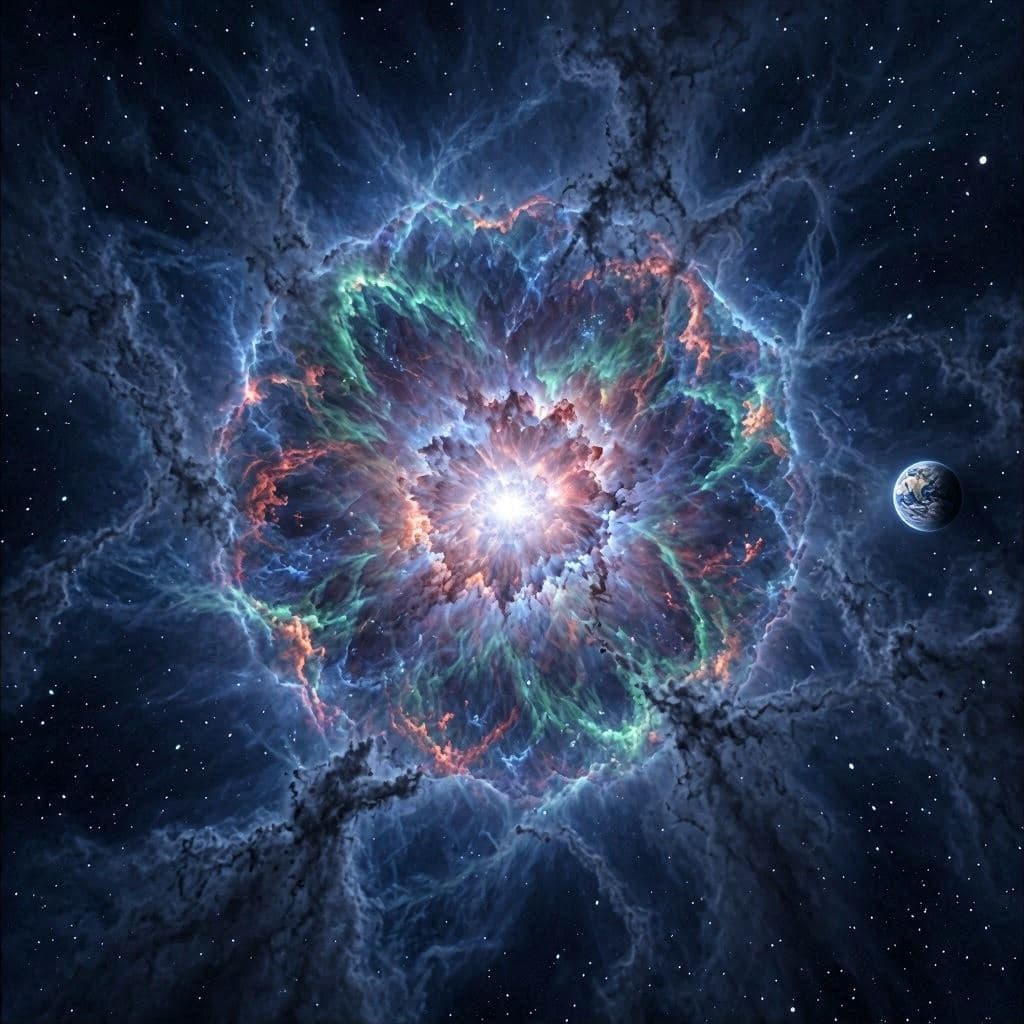
AI Image Disclaimer: The accompanying illustrations are AI-generated artistic interpretations based on published scientific research and are intended solely to visualize the concepts described in this article.
Sources (Verified):
Nature Geoscience Science Advances NASA Smithsonian Magazine Live Science
Published by Banx Network. This article is part of the Banx decentralized media programme, powered by the BXE token on the XRP Ledger.