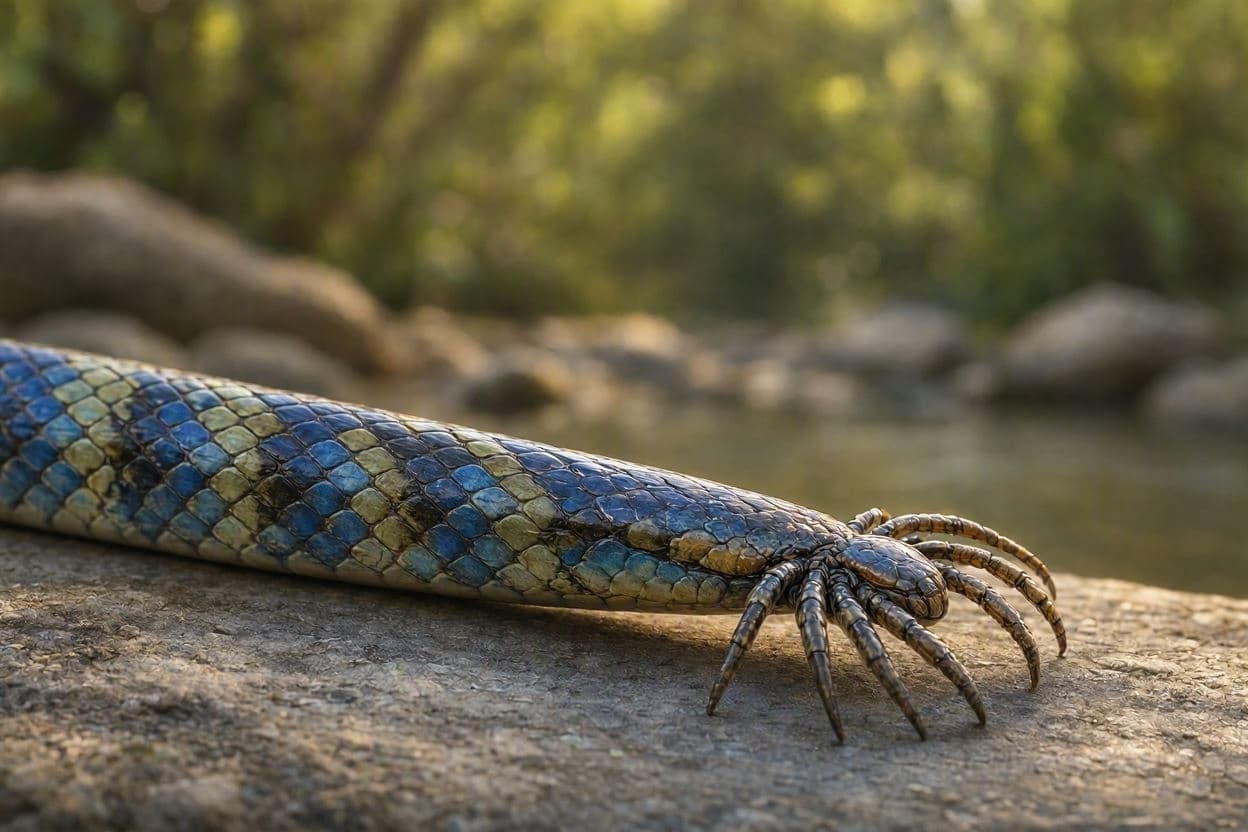
Nature is full of illusions, tricks of evolution that blur the line between predator and prey. Among the most striking examples is the spider-tailed horned viper, a snake native to Iran whose tail tip mimics the appearance of a spider. For years, scientists wondered whether this bizarre appendage was a deformity, a parasite, or a sophisticated lure. Now, advanced imaging technology has finally revealed the truth hidden within its strange form.
Recent studies using high-resolution CT scans have shown that the "spider" is not a separate organism or a tumor, but a specialized modification of the snake’s own skin and scales. The internal structure of the tail vertebrae is typical of vipers, indicating that the arachnid shape is purely external. This discovery confirms that the feature is an evolutionary adaptation, designed to attract bird prey by mimicking their natural food source.
The viper uses this lure with remarkable precision, wiggling its tail to simulate the movement of a spider. Birds, drawn by the sight of potential prey, approach closely, only to fall victim to the snake’s lightning-fast strike. This method of hunting, known as caudal luring, is rare among snakes and highlights the ingenuity of natural selection in developing unique survival strategies.
For researchers, the findings provide insight into the genetic and developmental processes that allow such complex morphological changes to occur. Understanding how the snake modifies its scales to create this illusion can inform broader studies of evolutionary biology and developmental genetics. It is a testament to the flexibility of life in adapting to specific ecological niches.
The spider-tailed horned viper remains a rare and elusive species, making direct observation difficult. Most knowledge comes from preserved specimens and occasional field sightings. The use of non-invasive imaging techniques allows scientists to study these animals without harming them, preserving valuable specimens for future research. This approach balances scientific curiosity with conservation ethics.
Public fascination with such unusual creatures often drives interest in biodiversity and conservation. The story of the viper’s spider tail captures the imagination, reminding us of the wonders that still exist in the natural world. It encourages a deeper appreciation for the complexity of ecosystems and the importance of protecting rare species.
As research continues, scientists hope to learn more about the behavior and ecology of this unique viper. Field studies and genetic analysis will further elucidate the mechanisms behind its distinctive lure. Each discovery adds to our understanding of the intricate web of life, where even the smallest details can have significant survival value.
In the end, the spider-tailed horned viper is a reminder of nature’s creativity. Its ability to deceive prey with a simple wiggle of its tail is a marvel of evolution. By studying such phenomena, we gain not only scientific knowledge but also a renewed sense of wonder at the diversity of life on Earth.
AI Image Disclaimer: The illustrations for this article are AI-generated to represent the concept of the spider-tailed viper and its unique morphology, using artistic and descriptive imagery rather than real photographs of the animal.
Sources: CNN, ScienceAlert, Phys.org, Smithsonian Magazine
Published by Banx Network. This article is part of the Banx decentralized media programme, powered by the BXE token on the XRP Ledger.