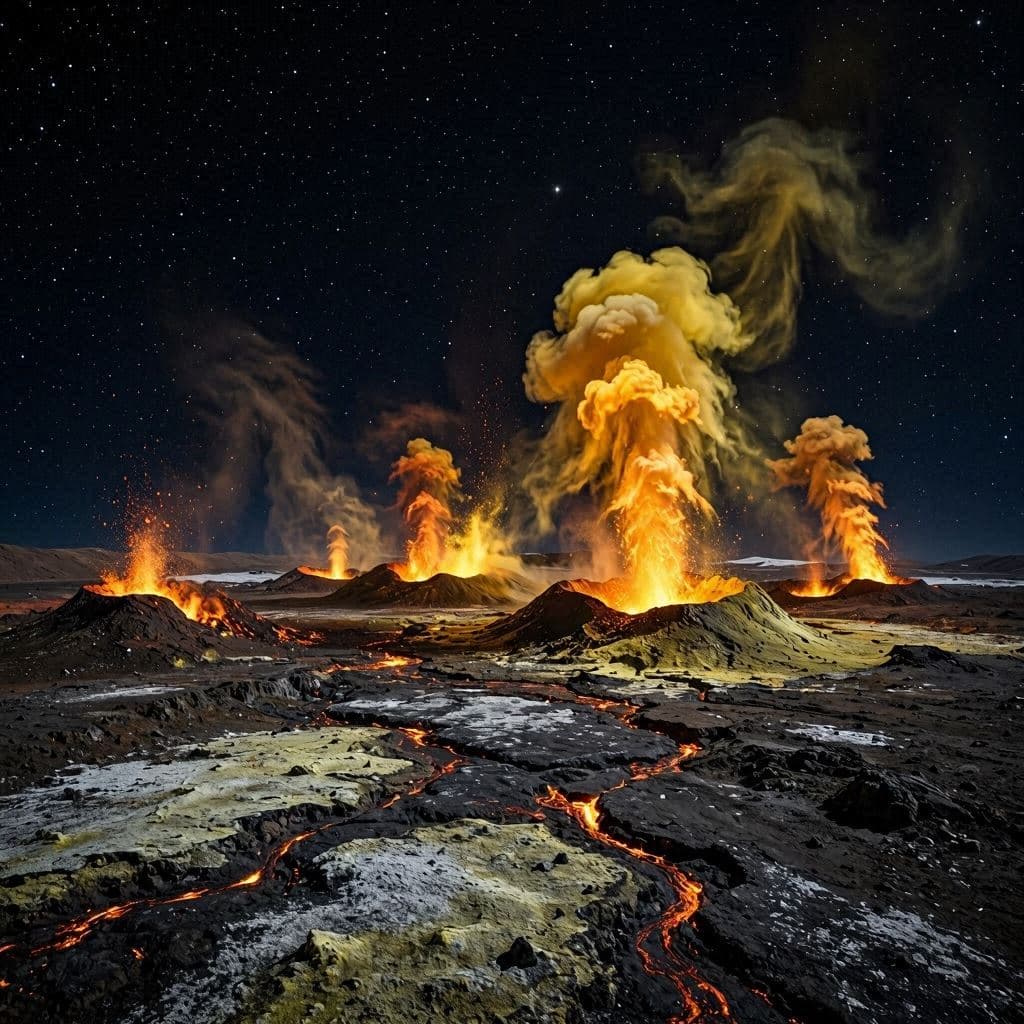
In the cold, dark reaches of the outer solar system, there burns a world of fire and fury. Io, the innermost of Jupiter’s large moons, is a place of paradoxical beauty, where the icy silence of space is shattered by the violent eruption of hundreds of volcanoes. It is a landscape that defies expectation, a molten canvas painted in shades of sulfur yellow and lava red, churning under the gravitational grip of the giant planet it orbits.
When the Voyager spacecraft first sent back images of Io in 1979, the data seemed too extreme to be real. Scientists initially suspected camera glitches, unable to believe that a moon so small could harbor such intense geological activity. Yet, as the haze cleared, the truth emerged: Io was alive, vibrating with an energy that rivals any world in our celestial neighborhood.
Body: Io’s volcanic frenzy is driven by a phenomenon known as tidal heating. As it orbits Jupiter, the moon is squeezed and stretched by the planet’s immense gravity, as well as the gravitational pull of its neighboring moons, Europa and Ganymede. This constant flexing generates friction within Io’s interior, melting rock into magma and fueling eruptions that can shoot plumes of sulfur and sulfur dioxide more than 500 kilometers into space.
These plumes are not merely local curiosities; they are visible from Earth-based telescopes and have been studied in detail by subsequent missions like Galileo and Juno. The material ejected from these volcanoes falls back to the surface, creating a colorful mosaic of deposits that change over time. Io is a world in constant flux, its surface being resurfaced so rapidly that impact craters are quickly erased, leaving no record of ancient history.
The intensity of Io’s activity makes it a unique laboratory for studying planetary geology. Unlike Earth, where plate tectonics drive volcanic activity, Io’s volcanism is powered entirely by external gravitational forces. This distinction offers scientists insights into how tidal forces can shape the evolution of moons and planets, particularly those orbiting gas giants in other solar systems.
Despite the hostile environment, with radiation levels from Jupiter that are lethal to humans, Io remains a target of fascination. Future missions, such as NASA’s Europa Clipper, will fly by Io to study its heat flow and volcanic composition. These observations will help researchers understand the internal structure of the moon and the mechanisms that sustain its fiery heart.
The sulfur plumes also contribute to Jupiter’s magnetosphere, creating a torus of charged particles that encircles the planet. This interaction between Io and Jupiter is a dynamic example of how celestial bodies influence one another, linking the fate of a small moon to the behavior of the largest planet in our solar system. It is a cosmic dance of energy and matter.
For astronomers, Io serves as a reminder that the universe is far more dynamic than it appears from a distance. What might seem like a static point of light is often a world of dramatic change and violent beauty. The story of Io challenges us to look closer, to question our assumptions, and to appreciate the diverse ways in which planets and moons can evolve.
Closing: As we continue to explore the outer solar system, Io stands as a testament to the power of gravitational forces and the resilience of geological activity. Its fiery eruptions, once mistaken for errors, are now celebrated as some of the most spectacular phenomena in space. In its chaos, we find a deeper understanding of the forces that shape our cosmic home.
AI Image Disclaimer: The visual content associated with this article is generated by artificial intelligence to illustrate the thematic elements of planetary science and does not represent specific photographic evidence from Voyager or other space missions.
Sources: NASA Jet Propulsion Laboratory National Geographic Science Magazine The Planetary Society
Published by Banx Network. This article is part of the Banx decentralized media programme, powered by the BXE token on the XRP Ledger.