There is a quiet kind of maintenance that keeps the most ambitious things alive. The International Space Station has been circling the Earth for more than two decades, a laboratory and a home, its systems humming with the patient work of repair and renewal. This autumn, astronauts will complete one of the final chapters in that work: the installation of the last two roll-out solar arrays, the panels that help keep the station's lights on and its experiments running.
Two spacewalks are scheduled to finish the job. On Thursday, October 29, NASA astronaut Anil Menon and Canadian Space Agency astronaut Joshua Kutryk will exit the Quest airlock to install and deploy the seventh International Space Station Roll-Out Solar Array, or IROSA, on the station's 2A electrical power channel . On Thursday, November 5, the same pair will install the eighth and final array on the 3B channel, completing the power augmentation program .
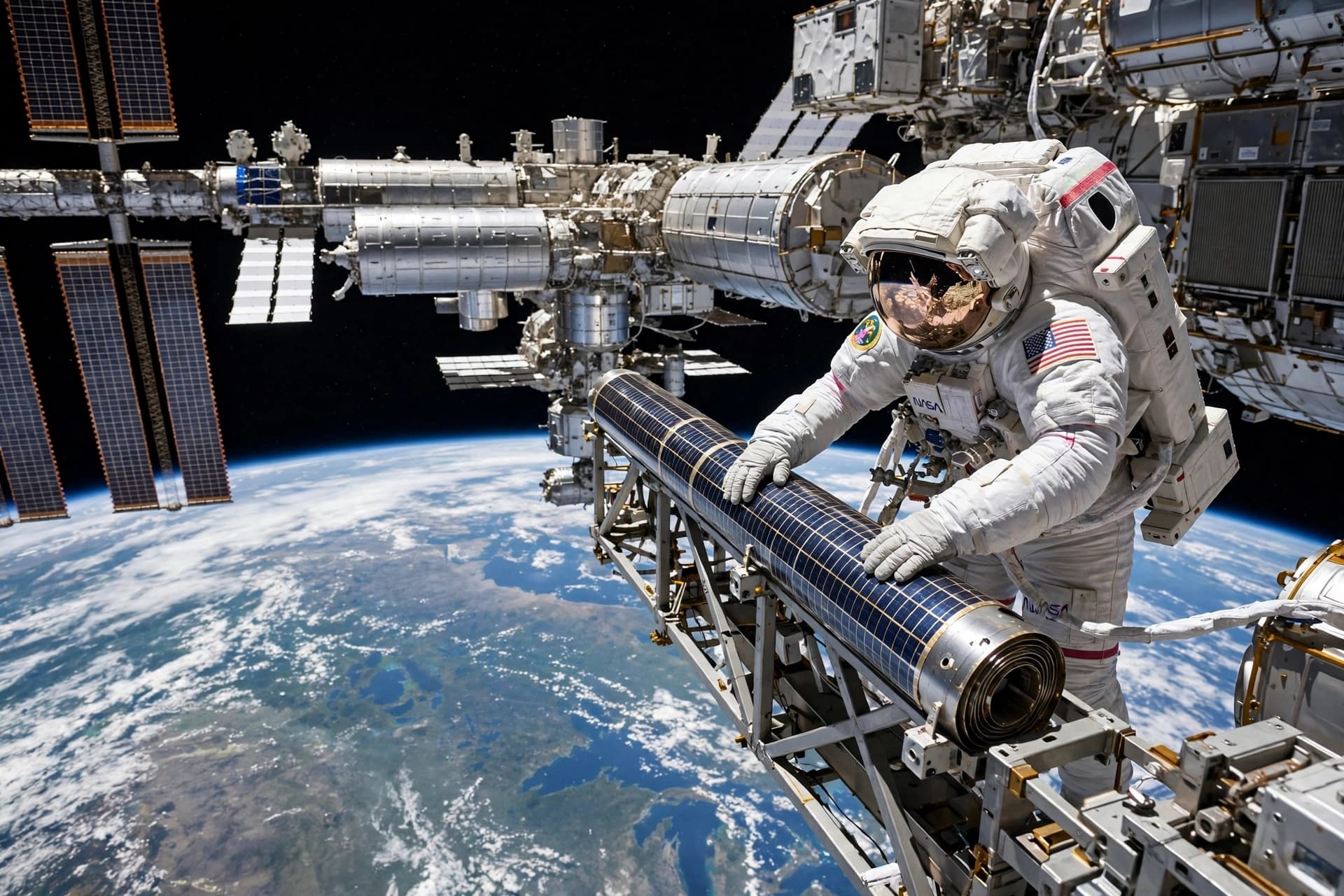
The IROSAs are a different breed of solar panel. Unlike the station's original rigid arrays, these are designed to launch as compact cylinders and unfurl like a yoga mat once in orbit, using composite booms that deploy from stored strain energy without motors . Each new array is about half the size of the legacy panels but produces roughly 28 kilowatts of additional power . Six were installed between 2021 and 2023, and the final two arrived at the station aboard a SpaceX Dragon resupply mission .
When all eight are in place, the station's power generation capacity will rise from 160 kilowatts to approximately 215 kilowatts, an increase of up to 30 percent . That additional electricity is not a luxury. It supports life support systems, scientific research, and the operations that will eventually allow the station to be deorbited safely and in a controlled manner at the end of its life .
The spacewalks will be the 285th and 286th conducted in support of station assembly, maintenance, and upgrades . Menon and Kutryk will work outside the station, connecting the arrays to the existing power infrastructure. The design allows the station to increase generation without replacing its entire solar system, a modular approach that has extended the life of the orbiting laboratory without the need for a complete overhaul .
There is something almost elegiac in this final round of upgrades. The space station is aging, its future uncertain, its eventual end already being planned. Yet the work continues—the careful choreography of astronauts tethered to a structure moving at 17,500 miles per hour, the quiet satisfaction of a solar array unfurling in the vacuum, the knowledge that the power it generates will support research that outlasts the station itself. Maintenance, in this context, is a form of hope.
The IROSAs also carry a legacy beyond the station. The deployable solar technology they demonstrate could power habitats on the Moon, rovers, or future commercial spacecraft, where launch volume is constrained and every kilogram matters . What is installed in orbit this autumn is not just a fix for an aging station but a test of technology that will travel farther than the station ever will.
When the final array is deployed and the spacewalkers return to the airlock, the station's power system will be complete. The lights will stay on. The experiments will continue. And for a while longer, the International Space Station will keep doing what it has done for decades: teaching us how to live beyond the Earth.
Image note: The visual accompanying this article is an AI-generated illustration and does not represent actual NASA imagery.
Sources: NASA, eeNews Europe, Electronics For You, Economia dello Spazio Magazine
Published by Banx Network. This article is part of the Banx decentralized media programme, powered by the BXE token on the XRP Ledger.