There are stars that simply shine, and then there are stars that seem to breathe.
In the quiet tapestry of the night sky, one of the universe’s most immense stars has begun to whisper changes that ripple far beyond its distant glow. Astronomers, watching patiently across years, have noticed something both subtle and profound—an evolving rhythm in a giant long thought to be familiar, yet never fully understood.
The star in question, , has long been a celestial landmark, glowing reddish at the shoulder of the constellation Orion. Massive, unstable, and nearing the end of its life, it has always carried a quiet sense of anticipation—as though one day, it might dramatically transform the sky itself.
What scientists are now observing, however, is not a sudden finale, but a series of remarkable internal shifts.
In recent years, Betelgeuse dimmed unexpectedly in an event often referred to as the “Great Dimming,” prompting speculation that it might be on the brink of a supernova. That dramatic fade, it turns out, was likely caused by a vast cloud of ejected material—stellar dust drifting outward, briefly veiling its light from Earth. Yet the story did not end there.
New observations suggest that Betelgeuse’s behavior continues to evolve. Its surface appears to be undergoing structural changes, with enormous convection cells—vast regions where hot plasma rises and cools—shifting in ways that alter its brightness and shape. Unlike our Sun, whose surface granules are relatively small, Betelgeuse’s convective patterns can span a significant fraction of the star itself, giving it an almost fluid, restless appearance.
There are also indications that its pulsation cycle—the rhythm by which it expands and contracts—may be changing. These cycles, once predictable, now show irregularities, as if the star is adjusting its internal tempo. Some researchers suggest that Betelgeuse may have shed part of its outer layers, subtly altering its structure and future evolution.
In this way, Betelgeuse becomes less like a fixed point of light and more like a living system—dynamic, expressive, and in transition.
Yet even as these changes unfold, astronomers remain careful in their interpretations. While Betelgeuse is indeed approaching the end of its life on cosmic timescales, “approaching” may still mean tens of thousands of years. The dramatic supernova that many imagine is not necessarily imminent.
What is certain, however, is that we are witnessing a rare chapter in stellar evolution in real time.
To observe such transformations is to glimpse the slow heartbeat of the universe. These are processes that usually stretch across millennia, yet here they are—visible within a human lifetime, recorded by telescopes and translated into patterns of light.
In the end, Betelgeuse does not announce its future with certainty. It offers something quieter: a reminder that even the largest structures in existence are not fixed, but unfolding. Its light, traveling across hundreds of light-years, carries not just brightness—but change.
And for those who look up at Orion on a clear night, that faint red glow now holds a deeper story—one still being written, one pulse at a time.
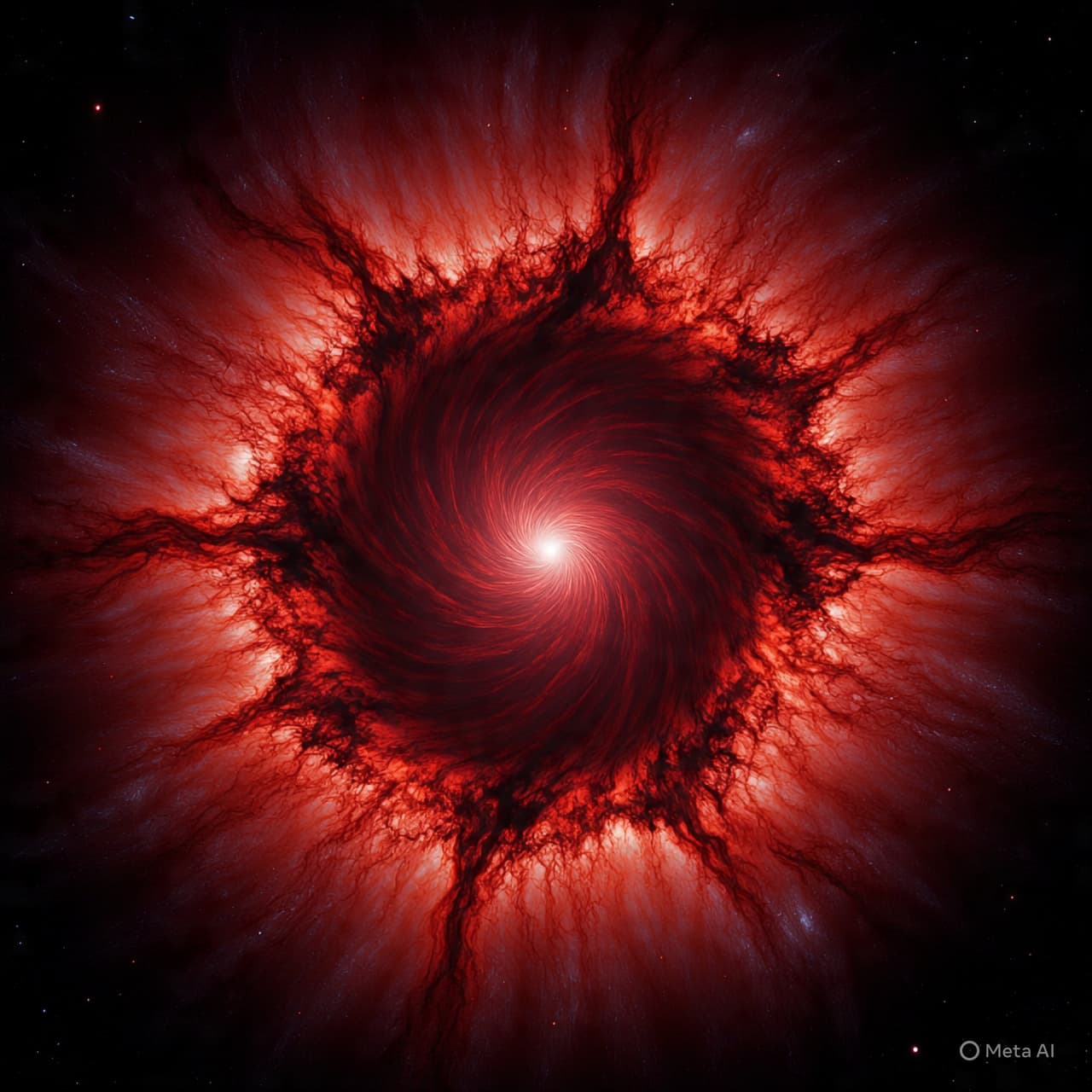
AI Image Disclaimer
Graphics are AI-generated and intended for representation, not reality
Sources NASA ESA (European Space Agency) Space.com BBC News Scientific American
Published by Banx Network. This article is part of the Banx decentralized media programme, powered by the BXE token on the XRP Ledger.