
Key Highlights
- A Japanese robotics startup has launched a fleet of autonomous underwater vehicles (AUVs).
- These AUVs are designed to explore the ocean depths and gather crucial ecological data.
- The initiative aims to enhance marine conservation efforts and protect high seas from pollution.
[The Rise of Autonomous Underwater Exploration]
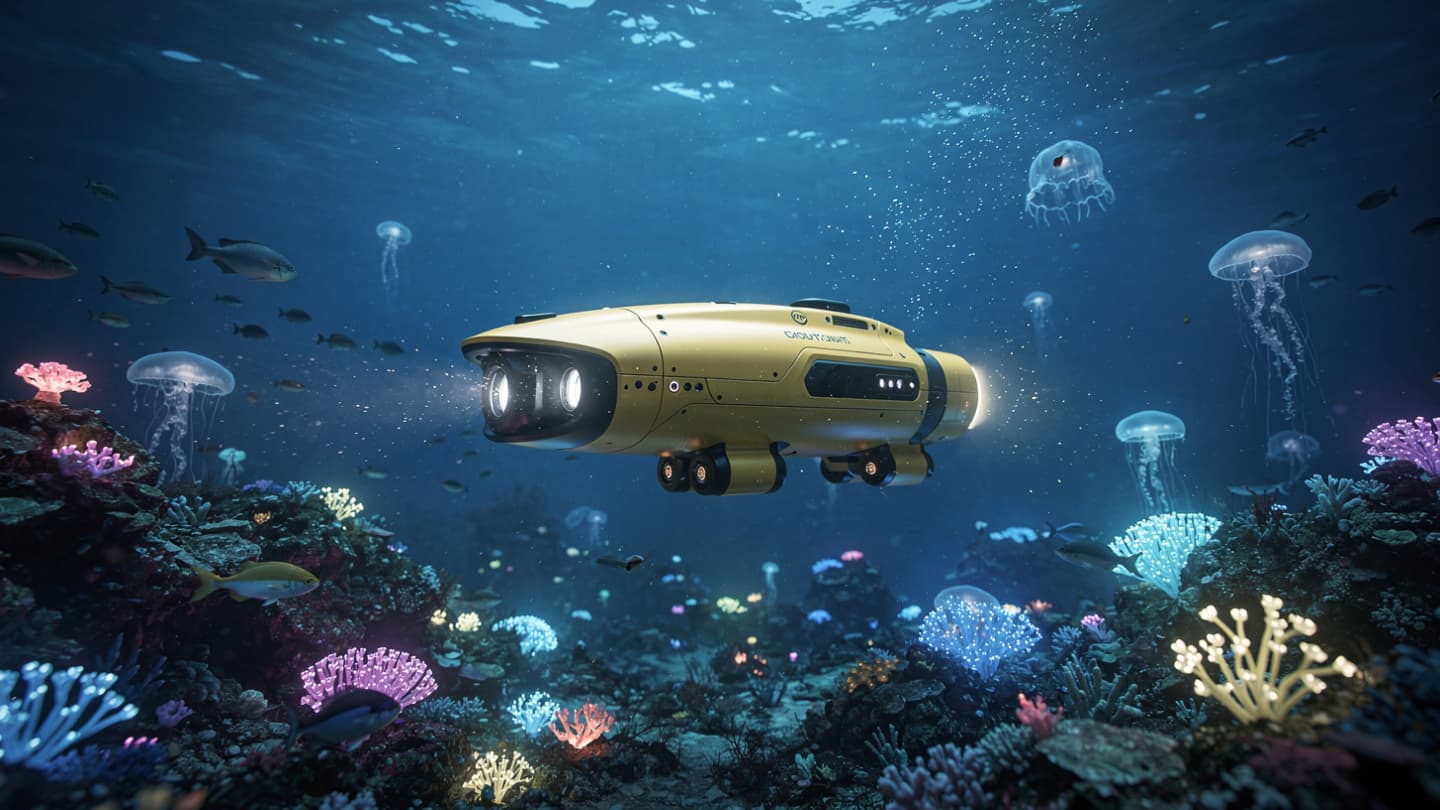
The ocean surface is a restless mirror, reflecting the sky in a constant churn of white and blue. Beneath this chaotic threshold lies a world defined by heavy silence and darkness that has remained undisturbed for millennia. Into this quietude descends a new kind of explorer—a sleek, autonomous craft designed to navigate the crushing pressures of the deep. It moves with grace, mimicking the life it seeks to study, its sensors casting thin ribbons of light across the jagged geography of the sea floor. Here, in the twilight zone of the planet, the machinery of man becomes a guest in the vast house of the sea.
There is a strange beauty in the way these underwater voyagers operate, detached from the tether of a mother ship and guided only by the logic of their internal maps. They herald a new age of oceanography, where the hazards of the deep no longer limit human curiosity. As the robots glide over ancient thermal vents and through forests of bioluminescent coral, they record a reality that has existed beyond our sight since the dawn of time. This interaction between the cold precision of robotics and the wild majesty of the underwater wilderness is reshaping our understanding of marine ecosystems.
In coastal laboratories, researchers monitor data streaming back in real-time, creating a digital reconstruction of a world they may never physically visit. Each frame of video and every reading of salinity serves as a vital clue in the ongoing effort to understand the health of our planet’s greatest regulator. This technology allows us to witness the ocean not merely as a resource to be exploited but as a living system that requires careful observation. It marks a transition from conquest to contemplation, facilitated by tools that once drove industrial expansion.
The sensors on these craft are finely tuned to detect the slightest variations in water chemistry, seeking out subtle shifts that signal changes in ecological balance. They can identify microscopic life and the movement of currents that dictate weather patterns across continents. This level of detail provides a baseline for conservation that was previously unattainable. By mapping the unknown, we are creating a safety net for the future, ensuring that the mysteries of the deep are preserved even as we unlock them.
There is a profound sense of solitude in the mission of an autonomous underwater vehicle. It wanders through canyons of basalt and over plains of silt, a solitary spark of intelligence in a landscape of eternal night. This isolation is a testament to the durability of engineering, a triumph of material science that allows delicate electronics to survive the weight of miles of water. The machine becomes a proxy for our senses, extending our empathy into a realm where we cannot breathe.
As the craft returns to the surface, shedding the immense pressure of the depths, it carries with it the digital memory of a transformed world. Images of strange, translucent creatures and alien landscapes challenge our perceptions of life on this planet. They remind us that Earth is much larger and more mysterious than the thin crust of land we inhabit. This technology acts as a bridge, bringing the wonders of the abyss into the light of day for all to see.
The data gathered during these dives informs international efforts to protect the high seas from pollution and warming threats. It provides the scientific foundation for marine protected areas, giving a voice to the silent inhabitants of the deep. The work is slow and methodical, a patient gathering of evidence that seeks to prove the intrinsic value of the unexplored. Each successful mission is a victory for knowledge over ignorance, a step toward a more harmonious relationship with the water.
Ultimately, the exploration of the deep sea through robotics reflects our enduring desire to connect with the unknown. We send our machines into the dark not to dominate but to understand, to find our place within the grand architecture of the natural world. As the silicon pulse of the deep continues to beat, it carries a message of hope—that through innovation and respect, we can safeguard the blue heart of our home for generations to come.
A Japanese robotics startup, in collaboration with regional marine biologists, has successfully deployed a fleet of autonomous underwater vehicles (AUVs) to explore the ocean's depths and gather vital ecological data, marking a significant advancement in marine research and conservation efforts.
Published by Banx Network. This article is part of the Banx decentralized media programme, powered by the BXE token on the XRP Ledger.



